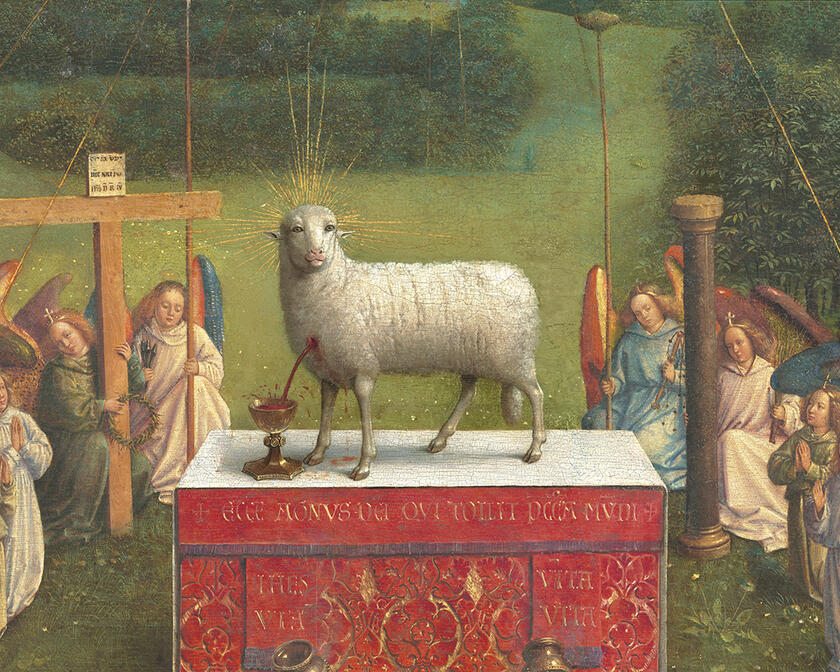
When Pope Pius IX went into exile at Gaeta in 1849 he had as his companion Blessed Giovanni Merlini, third superior general of the Missionaries of the Precious Blood. Merlini suggested that the Holy Father make a vow to extend the feast of the Precious Blood to the entire Church, if he would again obtain possesion of the papal states. Pius took the matter under consideration, but a few days later sent a message to Merlini saying, "The pope does not deem it expedient to bind himself by a vow; instead His Holiness is pleased to extend the feast immediately to all Christendom". It was June 30, 1849 -- the day the French conquered Rome and the republicans capitulated. That day was the Saturday before the first Sunday of July, leading the pope to decree that henceforth that Sunday should be dedicated to the Most Precious Blood. Pope Pius X would later place the date on July 1. In the reform of the General Roman calendar, the feast was suppressed though a votive Mass of the Precious Blood was newly added to the Roman Missal which may be celebrated freely on July 1. Pope St. Paul VI, moroever, altered the name of the feast "Corpus Christi" to that of the "Body and Blood of Christ." The feast nonetheless continues to be celebrated as a solemnity in calendars of some religious orders such as the Missionaries and Adorers of the Blood of Christ as well as some dioceses. The entire month of July is, moreover, traditionally dedicated to the Mystery of our redemption.
A reading from the Book of Leviticus (17:10-14)
If anyone of the house of Israel or of the aliens who reside among them eats any blood, I will set my face against that person who eats blood, and will cut that person off from the people. For the life of the flesh is in the blood; and I have given it to you for making atonement for your lives on the altar; for, as life, it is the blood that makes atonement. Therefore I have said to the people of Israel: No person among you shall eat blood, nor shall any alien who resides among you eat blood. And anyone of the people of Israel, or of the aliens who reside among them, who hunts down an animal or bird that may be eaten shall pour out its blood and cover it with earth. For the life of every creature—its blood is its life; therefore I have said to the people of Israel: You shall not eat the blood of any creature, for the life of every creature is its blood; whoever eats it shall be cut off.
From “The Church’s Year of Grace” by Pius Parsch (+1954)
The feast of the Most Precious Blood continues the mystery of redemption proper to Good Friday and to feasts such as Holy Cross, Corpus Christi and Sacred Heart. The observance was placed on the first Sunday of July by Pius IX in 1849, as the whole month was formerly dedicated to the Precious Blood. The Breviary reform of Pius X assigned the feast to the present date.
Let us classify the matter which the liturgy presents on the subject of the Precious Blood under the following headings: a) types from the Old Testament; b) scenes from the life of Jesus; c) symbols.
a) The Church takes us back to the beginning. Cain and Abel are making an offering. Abel’s sacrifice is pleasing to God, Cain’s is not. This gives rise to the sin of hatred, and fratricide is its resolution. The thirsting earth soaks up Abel’s blood as it shouts to heaven for vengeance. This shouting prefigured the scene on Calvary, where Christ’s Blood cried to heaven for the redemption of mankind.
Millenia pass, and now we see Israel oppressed by Egypt. God commands the people to kill a lamb and to sprinkle the doorposts with its blood; houses thus besprinkled are spared by the messenger of death. But where the doors are not reddened with the blood of the lamb, all male firstborn from king to slave die. This blood on the doorposts was a type of the Blood of Christ. Can the blood of a lamb save a man? No, but as a figure of the Redeemer’s Blood it certainly does. For when the Destroyer sees the thresholds of a human heart marked with Christ’s sacred Blood, he must pass by. And another soul is saved
In a vision the prophet Isaias saw a man treading out grapes (in the Orient, trampling upon grapes in the wine-press was the usual means of extracting the juice). The prophet asked the man: “Why are your garments so red? “The wine-press I have trodden alone,” he answers, “because from the nations there is no one with me.” The trodder of the wine-press is Christ, His garments crimsoned by the Blood of redemption.
b) The Church reminds us of the first drops of blood that flowed for our redemption on the day when Jesus was circumcised. It is night on Mount Olivet, and the moon is shining. We see the holy face crimsoned with blood during the agony in the garden. Unhappy, despairing Judas casts the blood-money down in the temple. “I have betrayed innocent blood!” In the scourging chamber we see the Lord in deepest humiliation; under raw strokes the divine Blood spurts out over the floor. Christ is led before Pilate. Pilate shows the blood-covered Body to the crowds: Ecce homo! We go through Jerusalem’s streets following the bloody footsteps to Golgotha. Down the beams of the Cross blood trickles. A soldier opens the sacred side. Water and Blood.