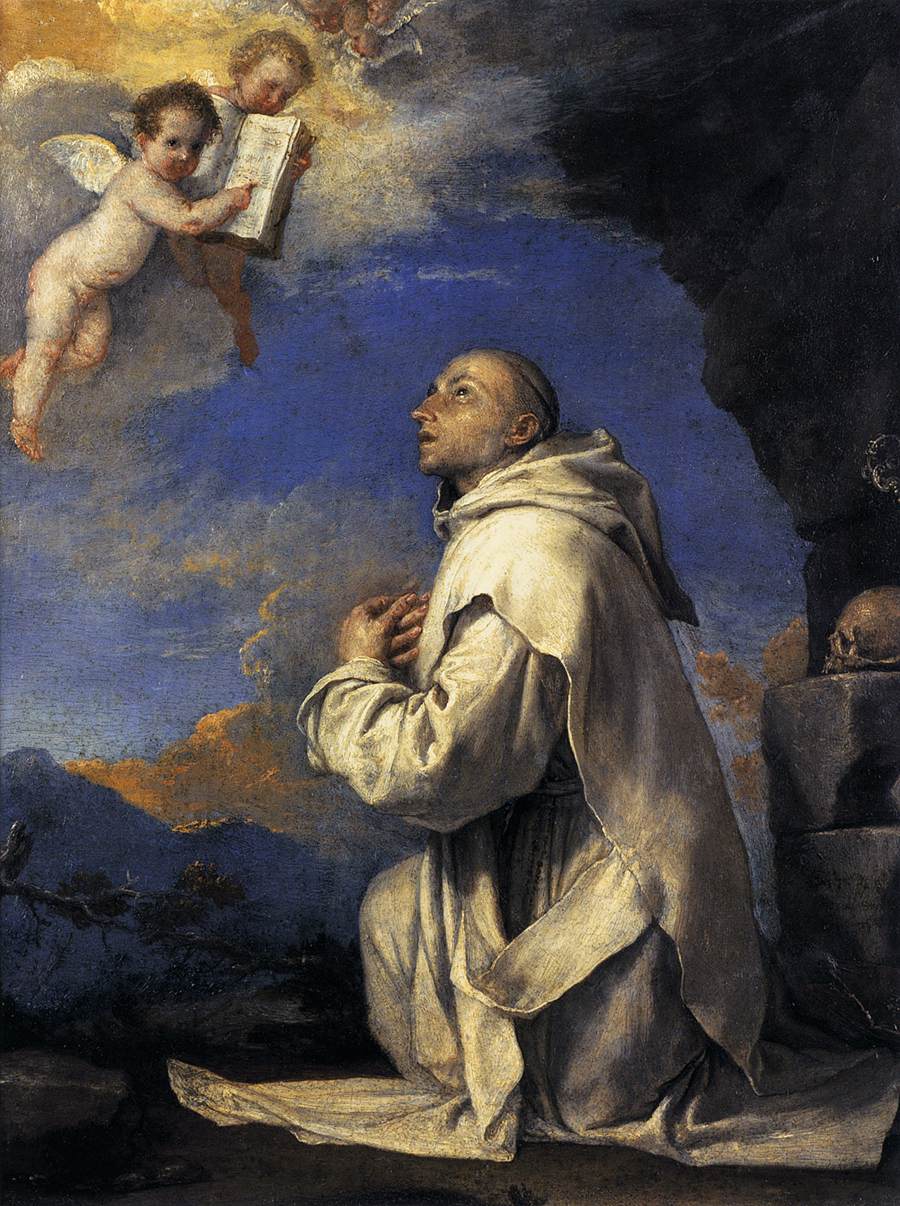
St. Bruno, founder of the Carthusians, was born into an unidentified noble family of Cologne, Germany. Called by his talents to an intellectual life, he studied first at Reims, then at Tours, and became a brilliant scholar in philosophy and sacred and profane literature. Returning to Cologne for theological studies, he was ordained a priest in 1055. Then he was named director of his Alma Mater at Reims. During the 20 years of his directorship, this noted school maintained its high reputation. Many of the alumni became distinguished scholars and churchmen including Odo of Chatillon, the future Pope Urban II.
Bruno was too omnicompetent, however, to be left in the schoolroom. Named chancellor of the diocese of Reims, he soon became embroiled with the archbishop, Manasses I. Manasses, who is said to have become archbishop through simony (buying his appointment) was in opposition to the church reform policy of Pope St. Gregory VII. When Bruno and some other diocesan officials stood for reform against Manasses, they were forced to leave the archdiocese. Bruno went back to Cologne. Eventually Archbishop Manasses was ousted and Bruno returned to Reims. He was even offered the Reims archbishopric himself, but he firmly declined. He had no ecclesiastical ambitions, and as a matter of fact, the whole episode had shown him the folly of church politics. Resigning his own offices and disposing of his possessions, he now retired with a few friends to the Cistercian monastery of Molesmes, France. Here they put themselves under the spiritual direction of St. Robert, founder of the Cistercian monks.
The Cistercians had been founded to provide a more ascetical approach to the monastic rule of St. Benedict. Bruno and his friends sought an even stricter life. They asked St. Robert’s permission to live apart from the Cistercian monks as hermits, but even that device did not satisfy them. At length Bruno persuaded his former pupil, St. Hugh, Bishop of Grenoble, to provide them with a still more remote site for a hermitage. In 1085 they moved to a hidden valley called Cartusia or LaChartreuse. Here they built a simple chapel and surrounded it by some small cells. This was the origin of the Carthusian Order of hermit-monks; this was its motherhouse, La Grande Chartreuse (The Great Chartreuse). Actually, Bruno had not intended to found a new order. His aim was rather to take the Rule of St. Benedict and give it a simpler and more ascetical interpretation. But the Carthusian slant could only produce an obviously different sort of institute.
Several years after the foundation of this community of hermits, a Benedictine abbot who paid a visit to the pioneer Carthusians wrote the following wide-eyed report: “Their dress is poorer than that of other monks, so short and thin and rough that the very sight frightens me. They wear hair shirts next their skin and fast almost perpetually; eat only bran bread; never touch meat, either sick or well; never buy fish, but eat it if given to them as alms … Their constant occupation is praying, reading and manual work, which consists chiefly in transcribing books. They celebrate Mass only on Sundays and festivals.”
How could this rigid life even survive? Bruno’s secret for survival was to inculcate a spirit of love and joy that made the austerity pleasant and achieved in its practitioners a wonderful sense of balance.
Most religious rules in the history of the Church have had to be altered or adapted. Since the Carthusian rule was compiled, it has never been changed, for it has never needed to be changed. Hence the proverb about this rule: “nummian reformata ouianumauam deformata” (never reformed because never deformed").
Naturally, in a period when the whole Church badly needed general reform, St. Bruno, with his joyful austerity, became one of the reformist leaders. In 1090 his former pupil, Pope Urban II ordered him to come to Rome and serve as his adviser. The Saint obeyed, provided that he be allowed to maintain, as best he could, his eremitic life. Pope Urban permitted him to have a little hermitage tucked away in the vast ruins of the Roman Baths of Diocletian. Inevitably, however, the hermit was drawn into the turmoil of public life. He no doubt assisted the Pope loyally in defending him against antipope Gilbert of Ravenna, and in running several reformist synods. But the Abbot’s monastic detachment enabled him to remain ever the monk. Thus he refused to accept the bishopric of Reggio, and he was able to establish two monasteries in Italy following his way of life. In Italy as in France, he acquired the reputation of a wonder worker.
Bruno the Carthusian died in 1101 without ever returning to his original monastery, but he had already set firmly the Carthusian mode of life. A popular cult of him quickly developed in southern Italy. Pope Leo X canonized Bruno viva voce in 1514. His feast was extended to the whole church in 1623.
Carthusian monasteries have been ever since a strong, if select, presence in the Church. During the Reformation, 50 Carthusian monks died for the faith. The first and only “Charterhouse” in the U.S.A. was founded in 1950 at Arlington, Vermont. St. Bruno’s arm is long! — Father Robert F. McNamara
Scripture:Philippians 3:8-14
I consider everything as a loss because of the supreme good of knowing Christ Jesus my Lord. For his sake I have accepted the loss of all things and I consider them so much rubbish,
that I may gain Christ and be found in him, not having any righteousness of my own based on the law but that which comes through faith in Christ, the righteousness from God, depending on faith to know him and the power of his resurrection and the sharing of his sufferings by being conformed to his death, if somehow I may attain the resurrection from the dead. It is not that I have already taken hold of it or have already attained perfect maturity, but I continue my pursuit in hope that I may possess it, since I have indeed been taken possession of by Christ Jesus. Brothers and sisters, I for my part do not consider myself to have taken possession. Just one thing: forgetting what lies behind but straining forward to what lies ahead, I continue my pursuit toward the goal, the prize of God's upward calling, in Christ Jesus.
Writings
(Year A). TO MY ESTEEMED FRIEND RAOUL, Dean of the Cathedral Chapter at Rheims
I, Bruno, send my greetings, as all my heartfelt affection toward you bids me. The loyalty you have shown during our long and mellowed friendship is all the more beautiful and remarkable in that it is only too rarely found. For, even though a great distance and many years lie between us, your kindly sentiments have always been with me. This is certainly clear enough from your wonderful letters, in which you have professed your friendship over and over again, and from the many other indications you have given of it, including the favors you have so generously shown, both to me, and to brother Bernard on my account. For all this, I give you my thanks, dear friend, not in a way thatcould ever be commensurate with what you deserve of me, but springing, at least, from the deepest source of sincere love….
I assure you, first of all, that my health is good, thinking that the news will not be unwelcome to you. I wish that I could say the same for my soul! The external situation is as satisfactory as could be desired; but I stand as a beggar before the mercy of God, praying that he will heal all the infirmities of my soul, and fulfill all my desires with his bounty.
I am living in the wilderness of Calabria, far removed from all habitation. There are some brethren here with me, some of whom are very well educated, and they are keeping assiduous watch for their Lord, so as to open to him at once when he knocks. I could never even begin to tell you how charming and pleasant it is. The temperatures are mild, and the air healthful; a broad plain, delightful to behold, stretches between the mountains along their entire length, bursting with fragrant meadows and flowery fields. One could hardly describe the impression made by the gently rolling hills on all sides, with their cool and shady glens tucked away, and such an abundance of refreshing springs, brooks, and streams. Besides all this, there are verdant gardens, and all sorts of fruit-bearing trees.
Yet why dwell on such things as these? The man of true insight has other delights, far more useful and attractive, because divine. It is true, though, that our rather feeble nature is renewed and finds new life in such perspectives, wearied by its spiritual pursuits and austere mode of life. It is like a bow, which soon wears out and runs the risk of becoming useless, if it is kept continually taut.
In any case, what benefits and divine exultation the silence and solitude of the desert hold in store for those who love it, only those who have experienced it can know. For here strong men can enter into themselves and remain there as much as they like, diligently cultivating the seeds of virtue, and eating the fruits of Paradise with joy.
Here, they can acquire the eye that wounds the Bridegroom with love by the clearness of its gaze, and whose purity allows them to see God Himself. Here they can observe a busy leisure, and rest in quiet activity. Here also, God crowns His athletes for their stern struggle with the hoped-for reward: a peace unknown to the world, and joy in the Holy Spirit.
Such a way of life is exemplified by Rachel, who was preferred by Jacob for her beauty, even though she bore fewer children than Leah, with her less penetrating eyes. Contemplation, to be sure, has fewer offspring than does action, and yet Joseph and Benjamin were the favorites of their father. This life is the best part chosen by Mary, never to be taken away from her. It is also that extraordinarily beautiful Shunammite, the only one in Israel able to take care of David and keep him warm in his old age. I could only wish, brother, that you, too, had such an exclusive love for her, so that, lost in her embrace, you burned with divine love! If only a love like this would take possession of you! Immediately, all the glory of the world would seem like so much dirt to you, whatever the smooth words and false attractions she offered to deceive you. Wealth, and its attendant anxieties, you would cast off without a thought as a burden to the freedom of the spirit. You would want no more of pleasure either, harmful as it is to both body and soul. You know very well who it is that says to us, “He who loves the world, and the things in the world, such as the lust of the flesh, the lust of the eyes, and ambition, does not have the love of the Father abiding in him”; also “Friendship with the world is enmity with God.”
What could be so evil and destructive, then, so unfortunate, or so much the mark of a crazed and headstrong spirit, as to put yourself at odds with the One Whose power you cannot resist, and Whose righteous vengeance you could never hope to escape? Surely we are not stronger than He! Surely you do not think He will leave unpunished in the end all the affronts and contempt He receives, merely because His patient solicitude now incites us to repentance! For what could be more perverted, more reckless and contrary to nature and right order, than to love the creature more than the creator, what passes away more than what lasts forever, or to seek rather the goods of earth than those of heaven?(Letter to his friend Raoul; extract)
Musical Selection
Withdraw yourself for times
Of listening to silence
Withdraw yourself for times
Of sweet solitude
And come to avoid the sounds
Of men constantly speaking
And the word of heavenly wisdom
Will come to you
No man safely speaks
But he who first listens
No man can rejoice
If he hasn't learned to cry
No man can safely give sight
To the blinded
Unless this man first
Knows the Eternal Light
This is the wisdom
Of listening to silence
This is the wisdom
Of the sweet solitude
These are thе paradoxes
Of His loving
When the Word of thе Lord
Comes in silence to you.
Collect
O God, who called Saint Bruno to serve you in solitude,
grant, through his intercession, that amid the changes of this world
we may constantly look to you alone.
Through our Lord Jesus Christ, your Son,
who lives and reigns with you
in the unity of the Holy Spirit, God, for ever and ever. Amen.