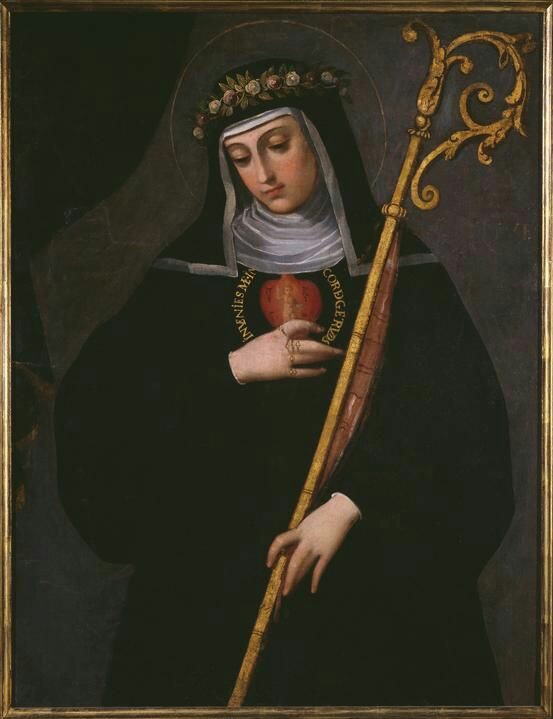
Few men have merited the title, “the Great”; fewer women. I know of only one nun so honored, St. Gertrude of Helfta, a mystic whose spiritual writings have remained influential up to the present.
Nothing is known of this German woman’s family background. When five years old, she was entrusted to the sisters of Helfta Abbey to be educated. A bright child, she became a good Latin scholar. In her teen years she asked to join the community. Therefore, she probably spent her whole life from childhood on within the abbey walls.
As a young nun, Gertrude continued her studies, but the extensive reading that she did was mostly nonreligious. Then, one evening in 1281, Jesus appeared to her, took her hand, and said, “I will save and deliver you. Fear not.” From that day on, Sister Gertrude was “converted” from a life of religious mediocrity to one of ardent pursuit of union with God.
Gertrude committed to writing many of her mystical experiences in the book commonly called the “Revelations of St. Gertrude.” Her piety focused on the humanity of our Lord, and in this she showed the strong influence of the Christ-centered St. Bernard of Clairvaux, the famous Cistercian monk. It seems that, apart from a period of 18 days, she had a continued sense of Jesus’ being within her. She was united with Him, so to speak, in a spiritual marriage.
St. Bernard had been the first to promote devotion to the loving heart of Jesus. Devotion to the Sacred Heart was strong at Helfta Abbey, and Gertrude did much to foster it. On one occasion, Jesus, in an apparition, pointed out to her the wound in his side, out of which flowed a stream of crystal-clear water. (One thinks of the prophet Isaiah’s inspired promise: “With joy you will draw water at the fountain of salvation.”) The heart of Christ seemed to her to be suspended like a lamp in her own heart. She heard it throbbing with saving love for saint and sinner. Some of the saints’ writings about the Sacred Heart remind one, even verbally, of the revelations that would be made to St. Margaret Mary of Alacoque four centuries later.
Another object of St. Gertrude’s special attention was the Holy Eucharist. She tells the reader how to hear Mass and how to prepare for receiving Holy Communion. Worshiping the Holy Eucharist gained in popularity in the 13th century, and Gertrude had much to do with promoting that development. It would culminate in the institution of the feast of Corpus Christi and the beautiful meditations on the Eucharist in the fourth book of the Imitation of Christ.
The enduring influence of this nun on the shaping of popular devotions reminds us once again how many of our forms of popular piety were originated by or fostered by religious orders. Thus, we owe the brown scapular to the Carmelites, the rosary to the Dominicans, the Miraculous Medal devotions to the Vincentians, and so forth. The Eucharistic liturgy must, of course, hold pride of place in Catholic public worship; still, “popular devotions,” as Vatican II insists, “are warmly commended…”
St. Gertrude desired that God might be for us “all in all”. If we seek to make Him so, according to our own graces, then we will glorify Him not only through the Mass but also through some of those nonliturgical devotions that keep us alive to His constant presence. -- Father Robert F. McNamara
who inspired Gertrude the Great
with a special devotion to the love of Christ
expressed in the imagery of his sacred heart:
fill our hearts with rejoicing
that we are acceptable to you despite our shortcomings;
may your goodness and mercy help and protect us,
so that we may not be led into temptation.
We ask this in the name of Jesus Christ your Son our Lord,
who is lives and reigns with you,
in the unity of the Holy Spirit,
God, for ever and ever. Amen. (English Missal)