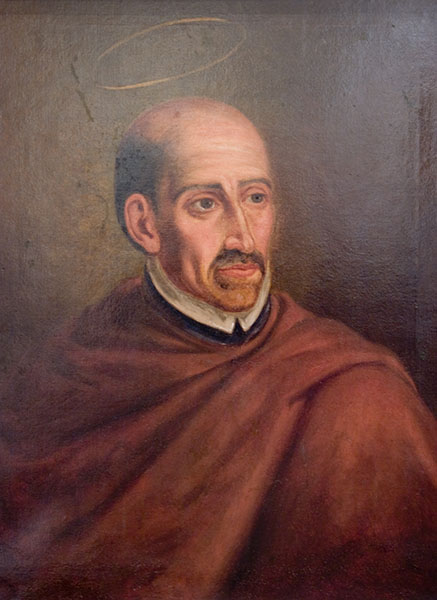
Acta Sanctorum: St. Toribio of Mongrovejo (Mar 23)
March 23, 2026
Fr. John Colacino C.PP.S.
March 23
St. Toribio of Mongrovejo
Life(1538-1606)
So far, I believe, only four bishops of the Western Hemisphere have been canonized as saints. The earliest of these was archbishop of Lima, Peru, from 1579 to 1606. St. Toribio Alfonso de Mogrovejo, a native of Spain, set a splendid apostolic example to all the future bishops of the Americas. Toribio was the child of a noble Spanish family. He made a brilliant course in civil and canon law at the University of Salamanca, and then joined that university’s faculty. Taking note of Toribio’s legal talent, King Philip II of Spain named him chief judge of the ecclesiastical court of Inquisition at Salamanca. Usually that post was occupied by a bishop. Toribio was a cleric, but had received no holy orders. Even so, he proved to be an admirable judge, winning acclaim for both his skill and his moderation.
In 1568, the Spanish Council of the Indies, which had charge under the kings of Spain of supervising Spain’s transatlantic domains, decided that their colonies were badly in need of reform. Philip nominated Toribio to the pope as the new archbishop of Lima in Peru. The professor/judge tried to decline the honor because he was not in holy orders. But his plea was overruled. He was given all the clerical orders in quick succession, and consecrated a bishop in 1580. The new prelate then set out with his sister and her family on the long and dangerous ocean journey to Peru. After making the last 600 miles of the trip overland on foot, the archbishop was installed in Lima on May 11, 1581.
Once the jurist-archbishop had made the first of his arduous pastoral visits of the archdiocese, he convoked the Third Council of Lima in 1583. Through this and subsequent synods, he worked to apply the reform decrees of the Council of Trent. It was not easy to achieve reform. Many of the clergy justified their abusive practices as “local custom.” The archbishop reminded them: “Christ said, ‘I am the truth.’ He did not say, ‘I am the custom.’” In connection with his reforms, Toribio also established the first seminary for priests in the new world (Lima, 1591).
Archbishop Mogrovejo was not the sort of bishop who just sat at home and issued laws. He devoted as much time as possible to covering on visitation the 18,000 miles of his archdiocese. “Time is not our own,” he would say, “and we must give a strict account of it.” To prepare himself as a preacher he diligently studied the many languages spoken by the Indians. He performed his visitations mostly on foot, often under great hardships and at risk of life. Even when traveling, however, he never failed to offer Mass daily and go to confession daily to his chaplain-companion. As a follow-up of these journeys, he constructed roads across the wilderness, and set up churches, schools, convents and hospitals. Archbishop de Mogrovejo was also solicitous of the poor, both the Native Americans and the Spanish. Some of the proud but impoverished Spaniards would have refused to accept charity. Toribio saw to it that they were helped secretly without knowing their benefactor.
Like his contemporary, St. Charles Borromeo, the reforming bishop of Milan, St. Toribio did succeed in large part in improving the quality of faith in Peru. A valuable assistant was the great Franciscan preacher, St. Francis Solano. Saints also sprang up in his garden. Among the 500,000 he personally confirmed was St. Rose of Lima, and probably also the two Dominicans, St. Martin de Porres and St. John Massias. When Toribio died, aged 68, he left his estate to his servants and to the poor. He had established legal precedents that would benefit not only Latin America but even the future United States. Along with St. Rose of Lima, he had exemplified Spanish America at its Catholic noblest and best. --Father Robert F. McNamara
Scripture. 2 Timothy 1: 13-14;2:1-3
Beloved:
Take as your norm the sound words that you heard from me,
in the faith and love that are in Christ Jesus.
Guard this rich trust with the help of the Holy Spirit
who dwells within us.
My child, be strong in the grace that is in Christ Jesus.
And what you heard from me through many witnesses
entrust to faithful people
who will have the ability to teach others as well.
Bear your share of hardship along with me
like a good soldier of Christ Jesus.
Writings
(Year A). These days I have spent among you have been very intense and gratifying. I have been able to learn about and experience some of the different realities that shape these lands, and to share at first hand the faith of God’s holy and faithful people, which does us so much good. Thank you for the opportunity to “touch” the faith of the people that God has entrusted to you. Here, in fact, it is impossible not to touch it. If you do not touch the faith of the people, the faith of the people does not touch you. But to be there, and to see the streets crowded with people, is a grace for which we should fall to our knees and give thanks. The theme of this Visit speaks to us of unity and hope. This is a demanding yet exciting programme, which makes us think us of the heroic accomplishments of Saint Turibius of Mogrovejo, archbishop of this see and patron of the Latin American episcopate, an example of a “builder of ecclesial unity”, as my predecessor, Saint John Paul II described him during his first Apostolic Visit to this land. It is significant that this holy bishop is frequently portrayed as a “new Moses”. As you know, the Vatican has a picture in which Saint Turibius appears crossing a great river whose waters open before him like the Red Sea, so that he could get to the other shore, where a numerous group of natives awaited him. Behind Saint Turibius is a great crowd, representing the faithful people who follow their shepherd in the task of evangelization. This beautiful image in the Vatican Museums can serve to anchor my reflection with you. Saint Turibius, the man who wanted to get to the other shore. We see him from the time in which he accepted the mandate to come to these lands with the mission to be a father and a shepherd. He left the security of familiar surroundings in order to enter a completely new universe, unknown and filled with challenges. He journeyed towards a promised land guided by faith as “the assurance of things hoped for” (Heb 11:1). His faith and his trust in the Lord impelled him, then and for the rest of his life, to get to the other shore, where the Lord himself was waiting for him in the midst of a great crowd. He wanted to get to the other shore in search of the distant and dispersed. To do so, he had to leave behind the comfort of the bishop’s residence and traverse the territory entrusted to him in constant pastoral visits; he tried to visit and stay wherever he was needed, and how greatly was he needed! He went out to encounter everyone, along paths that, in the words of his secretary, were meant more for goats than for people. Turibius had to face greatly differing climates and landscapes, “of the twenty-two years – and some – of his episcopate, eighteen were spent outside of Lima, outside of his city, crossing his territory three times”. That territory extended from Panama to the beginning of the Captaincy of Chile. I don’t know where it began back then – perhaps on the highlands of Iquique, but I’m not sure. All the way to the Captaincy of Chile. Like one of your own dioceses, no more! In eighteen years, he crossed his territory three times. He knew that this was the one way to be a pastor: to be close to his own, dispensing the sacraments, and he constantly exhorted his priests to do the same. He did so not only by words, but by his witness in the front lines of evangelization. Today we would call him a “street” bishop. A bishop with shoes worn out by walking, by constant travel, by setting out to “preach the Gospel to all: to all places, on all occasions, without hesitation, reluctance and fear. The joy of the Gospel is for all people: no one can be excluded”. How much Saint Turibius knew this! Without fear and without hesitation he immersed himself in our continent in order to proclaim the good news. He wanted to get to the other shore not only geographically but also culturally. Consequently, he worked in many ways for an evangelization in the native languages. With the Third Council of Lima he provided for catechisms to be compiled and translated into Quechua and Aymara. He encouraged the clergy to learn the language of their flock in order to administer the sacraments to them in a way they could understand. I think of the liturgical reform that Pius XII began to introduce for the whole Church… Visiting and living with his people, he realized that it was not enough just to be there physically, but to learn to speak the language of others, for only in this way could the Gospel be understood and touch the heart. How necessary is this vision for us, the pastors of the twenty-first century! For we have to learn completely new languages, like that, for example, of this, our digital age. To know the real language of our young people, our families, our children… As Saint Turibius clearly realized, it is not enough just to be present and occupy space; we have to be able to generate processes in people’s lives, so that the faith can take root and be meaningful. And to do that, we have to be able to speak their language. We need to get to the places where new stories and paradigms are being born, to bring the word of Jesus to the very heart of our cities and our peoples. The evangelization of culture requires us to enter into the heart of culture itself, so that it can be illuminated from within by the Gospel. I was moved, the day before yesterday, in Puerto Maldonado, when, amid all those native peoples from different ethnic groups, three men brought me a stole, all painted and wearing their native dress. They were permanent deacons. Take heart, as Turibius did. At that time there were no permanent deacons, there were catechists in the people’s own language and culture, and off he went. I was moved to see those permanent deacons. (Pope Francis)
Musical Selection
A santo Toribio,
excelso Pastor,
cantemos con júbilo
un himno de amor.
Collect
Lord God,
you have given life and growth to your Church
through the zeal for truth and the apostolic labours
of your bishop Toribio;
grant that your holy people may continually grow
in sanctity and in faith.
We ask this through our Lord Jesus Christ, your Son,
who lives and reigns with you in the unity of the Holy Spirit,