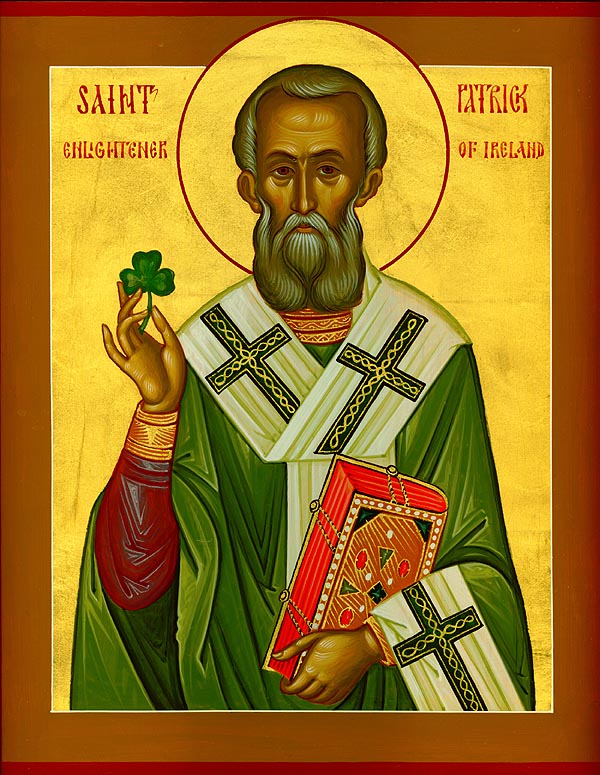
Those of Irish blood are most fond of St. Patrick their apostle; and his popularity is well-deserved. Patricius Magonus Sucatus, like many missionaries of all times, was not a native of the country that he converted. He was born somewhere in western Britain, the son of Calpurnius, a Romanized Briton, who was both a town official and a Catholic deacon. How Patrick first came to Ireland is a dramatic tale that he himself later recorded in his book of “Confessions.” One day, around 403, when he was about 14, he and some of his neighbors were set upon by wild pagan Irish raiders, and taken back to Ireland as slaves. For six years thereafter, Patricius tended the flocks of his master, who seems to have lived in Ulster, Ireland’s northern province. When captured, Patrick, by his own admission, was a careless Catholic. During the hardships of his captivity, however, he learned the expertise of prayer, so that “the spirit was fervent within,” despite his exposure to “snow and frost and rain.”
At the end of the six years, Patrick, now about 20, was advised in a dream to escape his owner and make his way to a certain spot on the coast. There a shipmaster would give him passage back to his native land. The youth obeyed the command, and made contact with the shipper, who took him over to Gaul (now France). Eventually, Patrick got passage from Gaul to Britain and rejoined his family, who begged the long-lost son to stay with them forever. Perhaps Patrick would have stayed home forever, but new dreams now came to him in which Irishmen begged the “holy youth” to “come and walk among them once more.” He felt that he could not resist that cry. So, he first prepared himself to go back as a missionary by returning to Gaul, learning there the ways of the monastic life and seeking ordination to the priesthood. Then he offered himself to his Gaelic bishop as a missionary to Ireland. For some time his request was rejected. Finally, in the year 432, St. Germanus, bishop of Auxerre, consecrated him a bishop and sent him to his adoptive people.
Bishop Patrick faced no easy task. A crucial achievement was the compact he concluded at Tara in County Meath with the Irish High King. This gave him leave to preach in the whole island. He now proceeded systematically through all four of Ireland’s provinces. In addition to the physical trials of his journeys, he encountered strong opposition and threats from the pagan Druids. As he went about, he organized the church and appointed a few regional bishops. Meanwhile, he did not allow this remote island to fall out of communication with the church at Rome. One of the rules he set down was that, if any problem of faith should arise in Ireland, it should be carried to the pope for settlement. There was no doubt about Patrick’s stunning success as a missionary. He himself writes of the “so many thousands” whom he personally baptized and confirmed. He marveled at the generosity of their response; “Sons and daughters of Scottic chieftains are seen to become monks and virgins of Christ.” There were still enemies of the Faith who would have liked to do him violence. But he persevered to the end in his missionary career confident that the Lord in whom he trusted would protect him and his work. In his last days, Bishop Patrick climbed up the stony heights of the mount called Croagh Patrick, and after 40 days of fasting and prayer he was shown by God the ultimate fruit of his labors. From that summit, he gave his final blessing to the whole Irish race. When he died, not long afterward, he was buried at Saul on Strangford Lough. Ever since their saint’s death, devout Irish people have undertaken annually a penitential barefoot climb to the top of Croagh Patrick. Perhaps it is their willingness to do stern penance that has preserved among the Irish the tradition of Christian piety that they learned from the bishop who first preached Christ crucified in the “island of saints and scholars.” --Father Robert F. McNamara
Scripture1 Peter 4:7b-11
Beloved: Be serious and sober-minded so that you will be able to pray. Above all, let your love for one another be intense, because love covers a multitude of sins. Be hospitable to one another without complaining. As each one has received a gift, use it to serve one another as good stewards of God's varied grace. Whoever preaches, let it be with the words of God; whoever serves, let it be with the strength that God supplies, so that in all things God may be glorified through Jesus Christ, to whom belong glory and dominion forever and ever. Amen.
Writings
(Year A). My name is Patrick. I am a sinner, a simple country person, and the least of all believers. I am looked down upon by many. My father was Calpornius. He was a deacon; his father was Potitus, a priest, who lived at Bannavem Taburniae. His home was near there, and that is where I was taken prisoner. I was about sixteen at the time. At that time, I did not know the true God. I was taken into captivity in Ireland, along with thousands of others. We deserved this, because we had gone away from God, and did not keep his commandments. We would not listen to our priests, who advised us about how we could be saved. The Lord brought his strong anger upon us, and scattered us among many nations even to the ends of the earth. It was among foreigners that it was seen how little I was. It was there that the Lord opened up my awareness of my lack of faith. Even though it came about late, I recognised my failings. So I turned with all my heart to the Lord my God[Nota], and he looked down on my lowliness and had mercy on my youthful ignorance. He guarded me before I knew him, and before I came to wisdom and could distinguish between good and evil. He protected me and consoled me as a father does for his son. That is why I cannot be silent – nor would it be good to do so – about such great blessings and such a gift that the Lord so kindly bestowed in the land of my captivity. This is how we can repay such blessings, when our lives change and we come to know God, to praise and bear witness to his great wonders before every nation under heaven. This is because there is no other God, nor will there ever be, nor was there ever, except God the Father. He is the one who was not begotten, the one without a beginning, the one from whom all beginnings come, the one who holds all things in being – this is our teaching. And his son, Jesus Christ, whom we testify has always been, since before the beginning of this age, with the father in a spiritual way. He was begotten in an indescribable way before every beginning. Everything we can see, and everything beyond our sight, was made through him. He became a human being; and, having overcome death, was welcomed to the heavens to the Father. The Father gave him all power over every being, both heavenly and earthly and beneath the earth. Let every tongue confess that Jesus Christ, in whom we believe and whom we await to come back to us in the near future, is Lord and God. He is judge of the living and of the dead; he rewards every person according to their deeds. He has generously poured on us the Holy Spirit, the gift and promise of immortality, who makes believers and those who listen to be children of God and co-heirs with Christ. This is the one we acknowledge and adore – one God in a trinity of the sacred name. He said through the prophet: ‘Call on me in the day of your distress, and I will set you free, and you will glorify me.’ Again he said: ‘It is a matter of honour to reveal and tell forth the works of God.’ Although I am imperfect in many ways, I want my brothers and relations to know what I’m really like, so that they can see what it is that inspires my life. I am not ignoring the evidence of my Lord, who testifies in the psalm: ‘You destroy those who speak lies.’ And again he says: ‘A mouth which lies kills the soul.’ And the same Lord says in the gospel: ‘The idle words which people speak, they will account for on the day of judgment.’ So I should greatly dread, with fear and trembling, this sentence on that day, where nobody can avoid or escape, but all shall give complete account of the least of sins before the tribunal of the Lord Christ. (Confession)
Musical Selection
Christ be beside me, Christ be before me, Christ be behind me, King of my heart. Christ be within me, Christ be below me, Christ be above me, never to part. Christ on my right hand, Christ on my left hand, Christ all around me, shield in the strife. Christ in my sleeping, Christ in my sitting, Christ in my rising, light of my life. Christ be in all hearts thinking about me; Christ be on all tongues telling of me. Christ be the vision in eyes that see me; in ears that hear me Christ ever be.
Collect
Almighty God, who in your providence chose your servant Patrick to be the apostle of the Irish people: keep alive in us thefire of the faith he kindled and strengthen us in our pilgrimage towards the light of everlasting life; through Jesus Christ your Son our Lord, who lives and reigns with you, in the unity of the Holy Spirit, God, now and for ever. Amen.(English Missal)