 Introit
Collect
O God, who on the Solemnity of the Apostles Peter and Paul give us the noble and holy joy of this day, grant, we pray, that your Church may in all things follow the teaching of those through whom she received the beginnings of right religion. Through our Lord Jesus Christ your Son, who lives and reigns with you in the unity of the Holy Spirit, God, for ever and ever. Amen.
First Reading. Acts 12.1-11
In those days, 1 King Herod laid violent hands upon some who belonged to the church. 2 He had James, the brother of John, killed with the sword. 3 After he saw that it pleased some of the people, he proceeded to arrest Peter also. This was during the festival of Unleavened Bread. 4 When he had seized him, he put him in prison and handed him over to four squads of soldiers to guard him, intending to bring him out to the people after the Passover. 5 While Peter was kept in prison, the church prayed fervently to God for him. 6 The very night before Herod was going to bring him out, Peter, bound with two chains, was sleeping between two soldiers, while guards in front of the door were keeping watch over the prison. 7 Suddenly an angel of the Lord appeared and a light shone in the cell. He tapped Peter on the side and woke him, saying, “Get up quickly.” And the chains fell off his wrists. 8 The angel said to him, “Fasten your belt and put on your sandals.” He did so. Then he said to him, “Wrap your cloak around you and follow me.” 9 Peter went out and followed him; he did not realize that what was happening with the angel’s help was real; he thought he was seeing a vision. 10 After they had passed the first and the second guard, they came before the iron gate leading into the city. It opened for them of its own accord, and they went outside and walked along a lane, when suddenly the angel left him. Then Peter came to himself and said, “Now I am sure that the Lord has sent his angel and rescued me from the hands of Herod and from all that the people were expecting.”
Responsorial Psalm 34.1-2, 3-4, 5-6, 7-8
Second Reading 2 Timothy 4.6-8, 17-18
As for me, I am already being poured out as a libation, and the time of my departure has come. 7 I have fought the good fight, I have finished the race, I have kept the faith. 8 From now on there is reserved for me the crown of righteousness, which the Lord, the righteous judge, will give me on that day, and not only to me but also to all who have longed for his appearing. 17 The Lord stood by me and gave me strength, so that through me the message might be fully proclaimed and all the Gentiles might hear it. So I was rescued from the lion’s mouth. 18 The Lord will rescue me from every evil attack and save me for his heavenly kingdom. To him be the glory forever and ever. Amen.
Gospel Acclamation
Gospel Matthew 16.13-19
When Jesus came into the district of Caesarea Philippi, he asked his disciples, “Who do people say that the Son of Man is?” 14 And they said, “Some say John the Baptist, but others Elijah, and still others Jeremiah or one of the prophets.” 15 He said to them, “But who do you say that I am?” 16 Simon Peter answered, “You are the Messiah, the Son of the living God.” 17 And Jesus answered him, “Blessed are you, Simon son of Jonah! For flesh and blood has not revealed this to you, but my Father in heaven. 18 And I tell you, you are Peter, and on this rock I will build my church, and the gates of Hades will not prevail against it. 19 “I will give you the keys of the kingdom of heaven, and whatever you bind on earth will be bound in heaven, and whatever you loose on earth will be loosed in heaven.”
Catena Nova
Look at the holy Apostles. It was by sinful jealousy that Peter was subjected to tribulation, not once or twice but many times; it was in that way, that he bore his witness before leaving us for his well-earned place in glory. And Paul, because of jealousy and contention, has become the very type of endurance rewarded. … In him we have one of the greatest of all examples of endurance. … [And] we too, are in the same arena and have the same conflict before us. Pope St. Clement I
There is one day for the passion of two apostles. But these two also were as one; although they suffered on different days, they were as one. Peter went first, Paul followed. We are celebrating a feast day, consecrated for us by the blood of the apostles. Let us love their faith, their lives, their labours, their sufferings, their confession of faith, their preaching. St Augustine of Hippo
There must be general rejoicing, dearly beloved, over this holy company [of martyrs of the Roman church] whom God has appointed for our example in patience and for our confirmation in faith. But we must glory even more in the excellence of their fathers, Peter and Paul, whom the grace of God has raised to such a height among all the members of the Church that He has set them like twin lights of eyes in that Body whose head is Christ. Pope St. Leo the Great
A glorious, solemn feast has dawned, that of the martyrs and foremost of martyrs, made sacred by their deaths, Peter and Paul…. They show us the path to life and bring us to that one Mediator who has made peace between heaven and earth by his blood and who “committed no sin, nor was guile in his mouth”. But how, then, can I can possibly approach Jesus? He is the purest one and I am so sinful! For this very reason, God gave me two great sinners. If I feel I am the greatest of sinners, yet I think I may be able to approach two who were themselves such great sinners and still found grace with God. St. Bernard of Clairvaux
[Saints Peter and Paul] are the pillars that support the church by their teaching, their prayers, and their example of patience. Our Lord strengthened them. In the beginning these pillars of the Church were very weak. They couldn’t support either themselves or others. It was wonderfully arranged by God’s Providence. If they had always been strong, one might have thought their strength was their own. But now all know that their strength was entirely from God…. St. Peter was very weak indeed. The Lord strengthened him by asking him three times, “Peter, do you love me?” This was followed by another strengthening when the Holy Spirit was sent. Likewise, Paul was weak at first but he was made strong. “I am certain”, he said, that neither death nor life nor angels nor anything else in all creation will be able to separate me from the love of God”. Something very like this is true of all of us. We were weak but we have been given strength in Christ to build up the Church in our community and nation. St. Aelred of Rievaulx
There are the gates of our true country, the two lights of the immense world. There Paul’s voice is heard like thunder; there Peter withholds or hurls the bolt . The former opens the hearts of men, the latter opens Heaven. Peter is the Foundation-stone, Paul the Architect of the temple where stands the Altar by which God is propitiated. Both together form a single Fountain, which pours out its healing and refreshing waters. St. Venantius Fortunatus
Today heaven welcomes [Peter and Paul] with infinite joy and honor, not too much differently than Rome formerly received the leaders and commanders of its armies when they had conquered the enemy and expanded the Roman Empire. They returned victorious and triumphant to their fatherland amid a thousand palms and trophies and crowns of victory…. Their glory, moreover, is ours as well for, since they are the patriarchs of the entire Church, they are like the fathers of all Christ’s faithful. They have begotten all of us for Christ through the Gospel by laying the first foundation stones of the faith of the Church. It is only fitting, therefore, that we celebrate with honor and praise, and with all the filial love at our command rejoice over the glory given to our fathers. St. Lawrence of Brindisi
Homily (Pope Leo XIV; June 29, 2024)
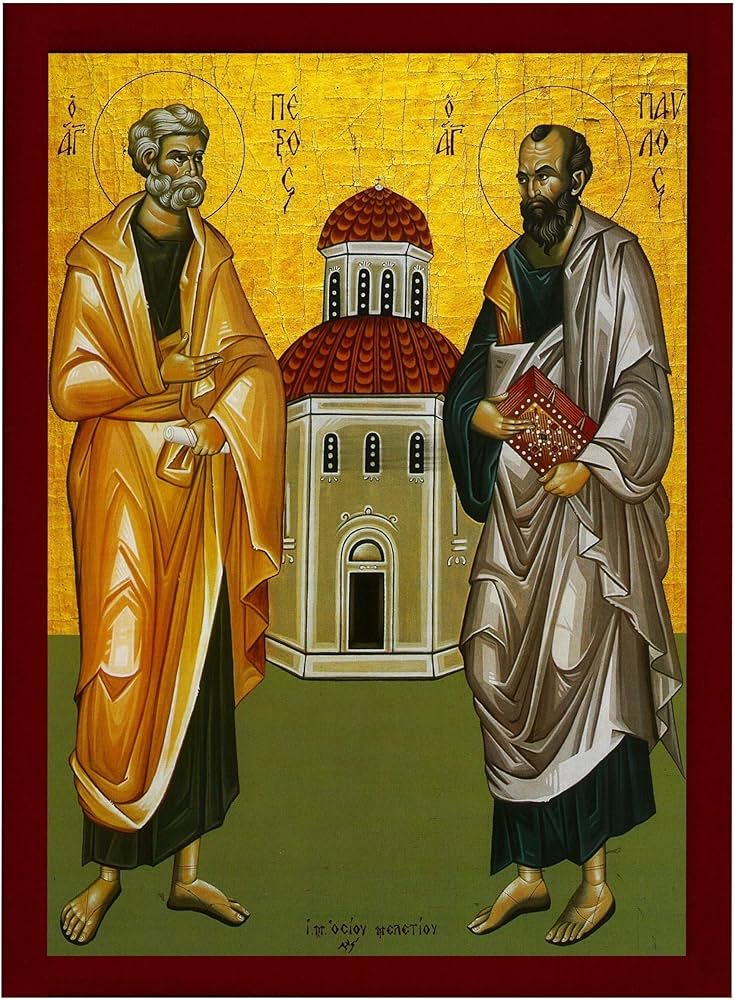
Today, in a single Solemnity, we commemorate Saints Peter and Paul, the patron saints of the city and Diocese of Rome. One was chosen by Jesus as shepherd of his flock, and the other as apostle to the Gentiles. In them, we venerate two pillars of the Church.
Peter, guardian of the People of God, is often portrayed in the New Testament as striving to preserve communion among the brothers. It is he who, after a night of seemingly fruitless labor on the Sea of Galilee, says to the Master, “we caught nothing. But on your word, I will release the net” (Lk 5:5). He then sets sail, taking the others with him. Again, while many are turning away from the Lord after the difficult discourse on the Bread of Life, it is he who says to the Messiah, “To whom can we go? You have the words of eternal life” (Jn 6:68), and remains together with the other eleven. It is he who, at Caesarea, recognizes Jesus as the Son of God and, as we heard in the Gospel (cf. Mt 16:13–19), speaks for all in professing the one faith. Even after the Resurrection, on the shore of the lake, Peter is the first to reach Christ, jumping into the water and swimming ahead of the others to humbly renew his love and receive confirmation of his mission (cf. Jn 21:1-17).
Peter remains faithful to this mission even when, for example, in Jerusalem, the question of admitting uncircumcised Gentiles to Baptism threatens to divide the community. He gathers the brothers together, listens to them and in the end, guided by the Holy Spirit, makes a decision that preserves communion and ushers in a new era for the entire People of God. Indeed, he declares, “We believe that we will be saved through the grace of the Lord Jesus, just as they will” (Acts 15:11).
This magnanimity does not mean that Peter is perfect. During the Passion, he denies the Master, only later to shed sincere tears of repentance (cf. Lk 22:54–62); and Paul himself, in different circumstances, rebukes him for the inconsistency of some of his actions (cf. Gal 2:11–14). Yet Peter knows how to acknowledge his mistakes and repent, without becoming discouraged and without failing in his mission to proclaim the Gospel and gather Christ’s flock, even unto martyrdom — a fate which he suffered here in Rome, not far from where we are gathered.
This faithful and patient concern for unity is well expressed by the symbol of the keys, with which we often identify Peter (cf. Mt 16:19). A key does not break down doors; rather, it opens and closes them by finding the proper levers within and guiding their movements, so that locks may release, bolts withdraw, and doors turn freely on their hinges, thereby joining rooms together and transforming many isolated spaces into one welcoming home. In the same way, communion within the Church is not built by clinging rigidly to one’s own position, but by seeking, in all hearts, points of encounter in the Truth, in whose light alone each person becomes a means of growth for another.
In this light, we can interpret the mission entrusted by the Lord to Peter and his Successors for the benefit of the entire holy People of God. It is a mission to listen, with his help, to the voice of each person; to discern inspirations; to guide the way; to correct errors; to instruct, encourage, exhort and accompany our brothers and sisters so that, docile to the action of the same Spirit (cf. 1 Cor 12:1–11), they may cooperate in the salvation of one another and of all humanity. Moreover, Peter’s example is an invitation to every Christian to become a builder of unity, placing God at the center of one’s life and drawing close to one’s brothers and sisters, attentive to their circumstances and needs (cf. Francis, Catechesis, 9 October 2024). In this way, we learn to live with one another in charity, so that the message might be fully proclaimed (cf. 2 Tim 4:17).
This is also the teaching of Paul, the other great apostle we celebrate today and the tireless herald of the Good News. He, too, has distinctive symbols: the book and the sword, which are closely linked to one another. The author of the Letter to the Hebrews explains this well when he writes that, “the word of God is living and active, sharper than any two-edged sword,” capable of penetrating “until it divides soul from spirit” and of discerning “the thoughts and intentions of the heart” (Heb 4:12).
This is what God accomplished in the heart of the young Saul, winning him over (cf. Phil 3:12), bringing him first to conversion to the Gospel and giving him a new name, and then sending him to proclaim it throughout the world. Finally, like Peter, he was to bear witness to the Gospel even to the point of giving his life in this very city. The apostle to the Gentiles allowed himself to be transformed by the power of God’s word, which rescued him from the way of violence and led him onto the path of love.
Saint Augustine, commenting on Paul’s conversion and mission, said, “As he was traveling [to Damascus] with a heart filled with threats and murder, he was called by name and thrown to the ground by the heavenly voice (cf. Acts 9:1–7), that is, by the Word who was calling him” (Sermon 299/A augm., 6). And he added: “God took the persecutor of the Church and made him a messenger of peace. He forgave him all his sins and placed him in a ministry where he could forgive the sins of others” (ibid.).
Dear friends, it is important for us today to look to these two Saints — Peter and Paul — to understand how we, in turn, can be apostles and builders of unity, and generous servants of the truth in charity. In this spirit, we are about to celebrate the ancient and moving rite of the conferral of the pallia on the Metropolitan Archbishops. These bands of white wool adorned with crosses indeed express the commitment of every Shepherd — and also of every Christian — to take upon their shoulders the brothers and sisters entrusted to them, like so many lambs of the Lord’s flock, and to sacrifice their energy, time, effort and even their lives for them. They do so in order that the Gospel may reach everyone, and the whole world may find in it harmony and concord (cf. Second Vatican Ecumenical Council, Pastoral Constitution Gaudium et spes, 38).
Offertory Hymn
Communion Antiphon
Closing Hymn