Introit
Collect
O God, who teach us that you abide
in hearts that are just and true,
grant that we may be so fashioned by your grace
as to become a dwelling pleasing to you.
Through our Lord Jesus Christ, your Son,
who lives and reigns with you in the unity of the Holy Spirit,
God, for ever and ever. Amen. (RM)
First Reading Sirach 15:15-20
If you choose, you can keep the commandments, and to act faithfully is a matter of your own choice. 16 The Lord has placed before you fire and water; stretch out your hand for whichever you choose. 17 Before each person are life and death, and whichever we choose will be given. 18 For great is the wisdom of the Lord; he is mighty in power and sees everything; 19 his eyes are on those who fear him, and he knows every human action. 20 He has not commanded anyone to be wicked, and he has not given anyone permission to sin.
Responsorial Psalm 119:1-2,4-5,17-18,33-34
R/. Blessed are they who follow the law of the Lord!
Second Reading 1 Cor 2:6-10
My brothers and sisters, 6 among the mature we do speak wisdom, though it is not a wisdom of this age or of the rulers of this age, who are doomed to perish. 7 But we speak God’s wisdom, secret and hidden, which God decreed before the ages for our glory. 8 None of the rulers of this age understood this; for if they had, they would not have crucified the Lord of glory. 9 As it is written, “What no eye has seen, nor ear heard, nor the human heart conceived what God has prepared for those who love him.” 10 These things God has revealed to us through the Spirit; for the Spirit searches everything, even the depths of God.
Gospel Acclamation
Gospel Mt 5:2-22a, 27-28, 33-34a, 37
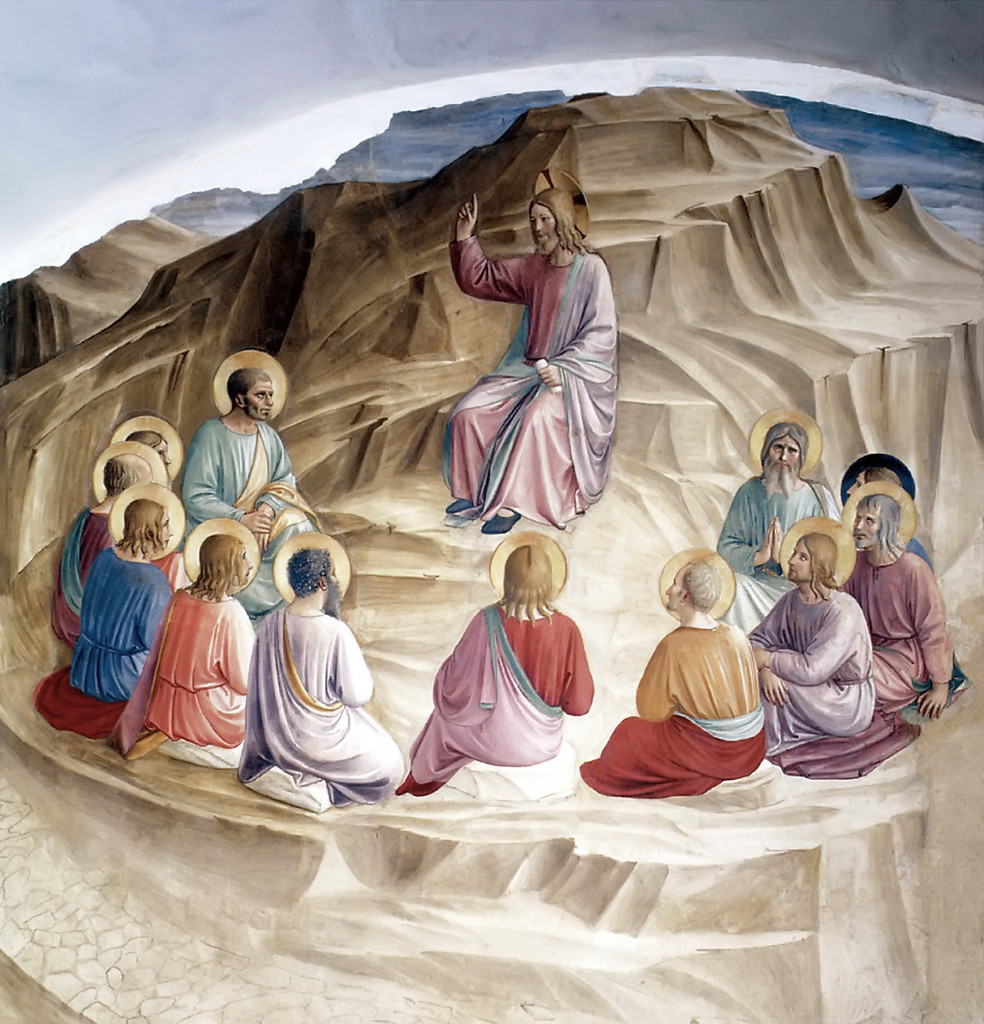
On the mountain, Jesus gathered his disciples around him and he taught them, saying: 17 “Do not think that I have come to abolish the law or the prophets; I have come not to abolish but to fulfil. 20 For I tell you, unless your righteousness exceeds that of the scribes and Pharisees, you will never enter the kingdom of heaven. 21 “You have heard that it was said to those of ancient times, ‘You shall not murder’; and ‘whoever murders shall be liable to judgment.’ But I say to you that if you are angry with a brother or sister, you will be liable to judgment; and if you insult a brother or sister, you will be liable to the council; and if you say, ‘You fool,’ you will be liable to the hell of fire. 23 “So when you are offering your gift at the altar, if you remember that your brother or sister has something against you, 24 leave your gift there before the altar and go; first be reconciled to your brother or sister, and then come and offer your gift. 27 “You have heard that it was said, ‘You shall not commit adultery.’ 28 But I say to you that everyone who looks at a woman with lust has already committed adultery with her in his heart. 33 “Again, you have heard that it was said to those of ancient times, ‘You shall not swear falsely, but carry out the vows you have made to the Lord.’ 34 But I say to you: Do not swear at all, either by heaven, for it is the throne of God, 37 Let your word be ‘Yes,’ if ‘Yes’ or ‘No,’ if ‘No’; anything more than this comes from the evil one.”
Catena Nova
So as far as a human being can, you must do what Christ the Son of God did, and become a promoter of peace both for yourself and for your neighbour. Christ calls the peacemaker a child of God. The only good deed he mentions as essential at the time of sacrifice is reconciliation with one’s brother or sister. This shows that of all the virtues the most important is love. (St. John Chrysostom)
We must see that there is no possible compromise between killing and being killed . . . For all violence to be destroyed, it would be sufficient for all mankind to decide to abide by this rule. If all mankind offered the other cheek, no cheek would be struck . . . If all men loved their enemies, there would be no more enemies. But if they drop away at the decisive moment, what is going to happen to the one person who does not drop away? For him the word of life will be changed into the word of death. It is absolute fidelity to the principle defined in his own preaching that condemns Jesus. There is no other cause for his death than the love of one's neighbor lived to the very end, with an infinitely intelligent grasp of the constraints it imposes. (René Girard)
Through violence you may murder a murderer but you can’t murder murder. Through violence you may murder a liar but you can’t establish truth. Through violence you may murder a hater, but you can’t murder hate. Darkness cannot put out darkness. Only light can do that. (Martin Luther King Jr.)
Anger is rooted in our lack of understanding of ourselves and of the causes, deep-seated as well as immediate, that brought about this unpleasant state of affairs. Anger is also rooted in desire, pride, agitation, and suspicion. The primary roots of our anger are in ourselves. Our environment and other people are only secondary. It is not difficult for us to accept the enormous damage brought about by a natural disaster, such as an earthquake or a flood. But when damage is caused by another person, we don't have much patience. We know that earthquakes and floods have causes, and we should see that the person who has precipitated our anger also has reasons, deep-seated and immediate, for what he has done. (Thich Nhat Hanh)
Thoughts that are thought about become desires. Desires that are thought about become passions. Good thoughts become virtues. Bad thoughts become bad desires; bad passions or habits of action become sins. The passions are acted upon us when we consent, then the passions move from passive to active engagement....First thoughts beget second thoughts, which become intentions. Intentions constitute motivations and indicate where the heart resides. Motivation moves the will to decide and act on the thought. Decisions give voice to the choices we intend to act upon. Attention to our thoughts reveals our intentions. Right deeds must be accompanied by the right reason, or the deed becomes wrong for us in that particular situation. Discernment is our ability to do the right deed with the right intention or motivation. (Mary Margaret Funk)
Jesus gives a series of teachings which reveal the way in which humans are utterly constituted in violence — anger is the equivalent of killing, lust the equivalent of adultery, a quarrel with a brother the complete invalidation of an act of worship of God. Because of this, the law, which Jesus does not come to abolish, does not go far enough. Jesus is determined to teach people at the level the law cannot reach: how to be free from being bound into the other by violence: so, no retribution to the other who violates you, because if you do, you remain on the same level as that person — so instead, turn the other cheek, walk the extra mile. It is only by not being stuck at the level of reacting to the violent other that we are free. Move out of reciprocally violent relationships, and into free ones. The strictures against false piety and hypocrisy are because the ones who practice those things are tied into what other people think, they are not able to act freely. They are run by the opinion, or what they hope to be the opinion of the other. Hence the tremendous importance of forgiveness, or loosing the bonds which tie one in to the violent other. For only thus can one be free, and perfect as the heavenly Father is perfect. (James Alison)
Today, the meaning of words is ever more fluid, and the concepts they represent are increasingly ambiguous. Language is no longer the preferred means by which human beings come to know and encounter one another. Moreover, in the contortions of semantic ambiguity, language is becoming more and more a weapon with which to deceive, or to strike and offend opponents. We need words once again to express distinct and clear realities unequivocally. Only in this way can authentic dialogue resume without misunderstandings. This should happen in our homes and public spaces, in politics, in the media and on social media. It should likewise occur in the context of international relations and multilateralism, so that the latter can regain the strength needed for undertaking its role of encounter and mediation. This is indeed necessary for preventing conflicts, and for ensuring that no one is tempted to prevail over others with the mindset of force, whether verbal, physical or military. (Pope Leo XIV)
Homily
Intercessions (Joe Milner; The Sunday Website)
For the Church: that we may seek ever-greater holiness and never be satisfied with merely fulfilling the letter of the law.
For moral theologians and ethicists: that the Spirit will lead them to a greater understanding of the wisdom of God and better ways to express it so that believers may live the Gospel more faithfully.
For all who are struggling with moral decisions: that the Spirit of God will inspire them with wisdom and help them find the support they need in their faith community.
For all who struggle with anger: that God will give them the strength to direct it in productive ways and not allow it to become violent nor self-destructive.
For all who have suffered violence: that God will heal their painful memories and that the Spirit will free them to live life fully.
For all who are recovering from disasters, that God will give them strength, renew their spirits, and help them find the resources that they need.
For civility in public discourse: that the Spirit will help us honor the dignity of each person and speak respectfully of those with whom we disagree.
All-seeing God, you alone judge rightly our inmost thoughts. Teach us to observe your law from the heart even as we keep it outwardly. Purify our desires, calm every anger, and reconcile us to one another. Then will our worship at your altar render you perfect praise. We make our prayer through our Lord Jesus Christ, your Son, who lives and reigns with you in the unity of the Holy Spirit, God for ever and ever. Amen. (ICEL; 1998)
Offertory Antiphon
Offertory Motet (Orlando di Lasso)
Oculos non vidit, nec auris audivit, nec in cor hominis ascendit, quae preparavit Deus his qui diligit eum.
Eye has not seen, nor has ear heard, nor has it occurred to the human heart what God has prepared for those who love him.
Communion Antiphon
Closing Hymn (Marty Haugen)
Eye has not seen,
ear has not heard
what God has ready
for those who love him;
Spirit of love, come,
give us the mind of Jesus,
teach us the wisdom of God.
When pain and sorrow weigh us down,
be near to us, O Lord,
forgive the weakness of our faith,
and bear us up within your peaceful word. (Refrain)
Our lives are but a single breath,
we flower and we fade,
yet all our days are in your hands,
so we return in love what love has made. (Refrain)
To those who see with eyes of faith,
the Lord is ever near,
reflected in the faces
of all the poor and lowly of the world. (Refrain)
We sing a mystery from the past
in halls where saints have trod,
yet ever new the music rings
to Jesus, Living Song of God. (Refrain)