Introit
Collect
Grant us, Lord our God,
that we may honor you with all our mind,
and love everyone in truth of heart.
Through our Lord Jesus Christ, your Son,
who lives and reigns with you in the unity of the Holy Spirit,
God, for ever and ever. Amen.
First Reading Zep 2:3, 3:12-13
Seek the Lord, all you humble of the land, who do his commands; seek righteousness, seek humility; perhaps you may be hidden on the day of the Lord’s wrath. 12 For I will leave in the midst of you a people humble and lowly. They shall seek refuge in the name of the Lord— 13 the remnant of Israel; they shall do no wrong and utter no lies, nor shall a deceitful tongue be found in their mouths. Then they will pasture and lie down, and no one shall make them afraid.
Responsorial Psalm 146:6-7,8-9,9-10
R/. Blessed are the poor in spirit; the kingdom of heaven is theirs!
Second Reading 1 Cor 1:26-31
Consider your own call, brothers and sisters: not many of you were wise by human standards, not many were powerful, not many were of noble birth. 27 But God chose what is foolish in the world to shame the wise; God chose what is weak in the world to shame the strong; 28 God chose what is low and despised in the world, things that are not, to reduce to nothing things that are, 29 so that no one might boast in the presence of God. 30 God is the source of your life in Christ Jesus, who became for us wisdom from God, and righteousness and sanctification and redemption, 31 in order that, as it is written, “Let the one who boasts, boast in the Lord.”
Gospel Acclamation Mt 5:12a
Gospel Mt 5:1-12a
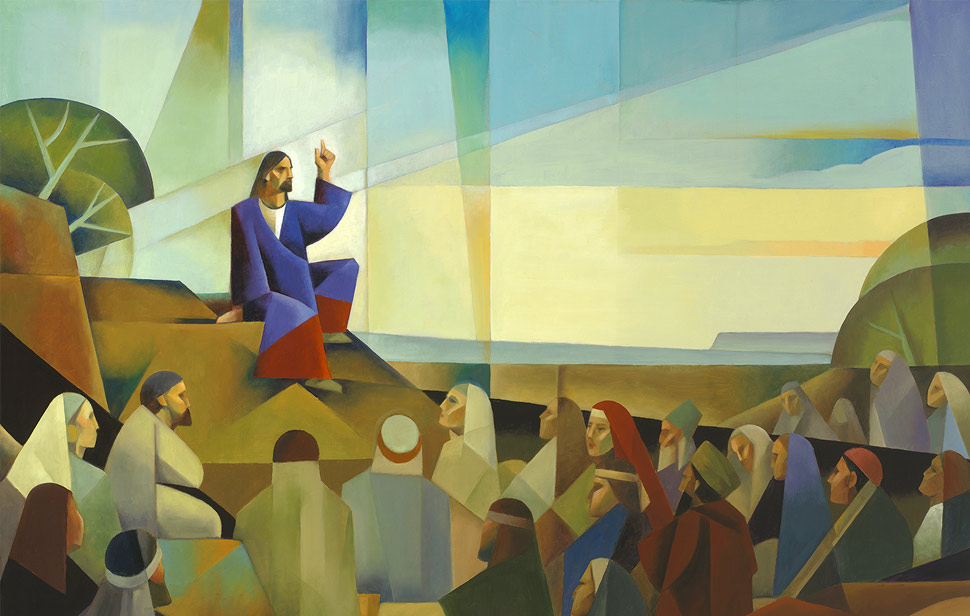
When Jesus saw the crowds, he went up the mountain; and after he sat down, his disciples came to him. 2 Then he began to speak, and he taught them, saying: 3 “Blessed are the poor in spirit, for theirs is the kingdom of heaven. 4 Blessed are those who mourn, for they will be comforted. 5 Blessed are the meek, for they will inherit the earth. 6 Blessed are those who hunger and thirst for righteousness, for they will be filled. 7 “Blessed are the merciful, for they will receive mercy. 8 Blessed are the pure in heart, for they will see God. 9 Blessed are the peacemakers, for they will be called children of God. 10 Blessed are those who are persecuted for righteousness’ sake, for theirs is the kingdom of heaven. 11 “Blessed are you when people revile you and persecute you and utter all kinds of evil against you falsely on my account. 12 Rejoice and be glad, for your reward is great in heaven, for in the same way they persecuted the prophets who were before you.”
Catena Nova
To this assembly have come not only the disciples, as if they were leaving behind the multitudes, as they did in the case of the Beatitudes. Rather, there are great crowds here, many of whom are deaf or suffer from many afflictions. Look at the crowds who come to this mountain where the Son of God sits. Some of them have become deaf to the things that have been promised. Others have become blind in soul, not looking toward the true light. Others are lame and not able to walk according to reason. Others are maimed and unable to work profitably. Each of these who are suffering in soul from such things go up along with the multitudes into the mountain where Jesus sits. Some who do not draw near to the feet of Jesus are not healed. But those who are brought by the multitude and cast at His feet are being healed. Even those who come only to the edges, just the extremities of the body of Christ, who feel themselves unworthy to obtain such things, are being healed.... And so the multitudes are astonished at beholding the transformations that are taking place. (Origen of Alexandria)
Do not suppose that by heaven here is meant the upper regions of the sky of this visible world, for your reward is not to be placed in things that are seen, but by “in heaven” understand the spiritual firmament, where everlasting righteousness dwells. Those then whose joy is in things spiritual will even here have some foretaste of that reward; but it will be made perfect in every part when this mortal shall have put on immortality. (St. Augustine of Hippo)
While our Lord and Saviour was going the rounds of the various cities and regions preaching and healing every disease and infirmity among the people, he saw the crowds coming to him and went up on the mountain, as today’s reading tells us. There is a fittingness in this: the Most High God goes up to a high place in order to preach a lofty message to those who desire to reach the heights of virtue. It is appropriate that the new law should be promulgated on a mountain, because it was on a mountain that the law had been given to Moses. The old law comprised ten commandments that were intended to guide its adherents on the path of instruction and discipline in this present life; the new law consists of eight beatitudes, because it lead its followers to eternal life and the heavenly fatherland. (St. Chromatius of Aquileia)
In the Beatitudes something of the celestial grandeur breaks through. They are no mere formulas for superior ethics, but tidings of sacred and supreme reality’s entry into the world. (Romano Guardini)
Blessed be the politician with a lofty sense and deep understanding of his role. Blessed be the politician who personally exemplifies credibility. Blessed be the politician who works for the common good and not his or her own interest. Blessed be the politician who remains consistent. Blessed be the politician who works for unity. Blessed be the politician who works to accomplish radical change. Blessed be the politician who is capable of listening. Blessed be the politician who is without fear. (Cardinal François-Xavier Nguyan Vãn Thuán)
The key feature of blessedness is that it involves living a deliberately chosen and cultivated sort of life which is not involved in the power and violence of the world, and which because of this fact, makes the ones living it immensely vulnerable to being turned into victims. That is the center of the ethic as taught by Jesus in the Sermon on the Mount. (James Alison)
In his Beatitudes, in his extraordinary concern for the outcasts and marginalized, in his wholly unconventional treatment of women, in his love of children, in his rejection of the belief that high-ranking men are the favorites of God, in his subversive proclamation of a new order in which domination will give way to compassion and communion, Jesus brought to fruition the prophetic longing for the “kingdom of God” --- an expression we might paraphrase as “God’s domination-free order. (Walter Wink)
Homily
Once upon a time, the three pre-Lenten Sundays were known as Septuagesima, Sexagesima and Quinquagesima Sunday respectively. They were meant to alert us to the impending Lenten season and to help us prepare. (Ash Wednesday is February 18). This year, as if a sign from liturgical providence, the gospels for these Sundays are taken from the Sermon on the Mount, beginning today with the Beatitudes. Nothing could be more apropos given the events of recent weeks internally dividing the United States and negatively impacting the nation on the global stage. I am planning, therefore, a series of homilies suggesting ways the Sermon illumines the present situation and challenges Catholic to a response — beginning today with voices raised by church leadership. While I intended to make reference to recent statements of Episopal and Catholic bishops, I came across the following video in which all these references are present. So in lieu of a written homily this week, I present the video. I am also appending the full statements from the several church leaders referenced in the video from which I would otherwise have quoted at length].
Charting A Moral Vision of American Foreign Policy
In 2026, the United States has entered into the most profound and searing debate about the moral foundation for America’s actions in the world since the end of the Cold War. The events in Venezuela, Ukraine and Greenland have raised basic questions about the use of military force and the meaning of peace. The sovereign rights of nations to self-determination appear all too fragile in a world of ever greater conflagrations. The balancing of national interest with the common good is being framed within starkly polarized terms. Our country’s moral role in confronting evil around the world, sustaining the right to life and human dignity, and supporting religious liberty are all under examination. And the building of just and sustainable peace, so crucial to humanity’s well-being now and in the future, is being reduced to partisan categories that encourage polarization and destructive policies.
For all of these reasons, the contribution of Pope Leo in outlining a truly moral foundation for international relations to the Vatican diplomatic corps this month has provided us an enduring ethical compass for establishing the pathway for American foreign policy in the coming years. He stated:
In our time, the weakness of multilateralism is a particular cause for concern at the international level. A diplomacy that promotes dialogue and seeks consensus among all parties is being replaced by a diplomacy based on force, by either individuals or groups of allies. War is back in vogue and a zeal for war is spreading. The principle established after the Second World War, which prohibited nations from using force to violate the borders of others, has been completely undermined. Peace is no longer sought as a gift and desirable good in itself, or in pursuit of “the establishment of the ordered universe willed by God with a more perfect form of justice among men and women.” Instead, peace is sought through weapons as a condition for asserting one’s own dominion.
Pope Leo also reiterates Catholic teaching that “the protection of the right to life constitutes the indispensable foundation for every other human right” and that abortion and euthanasia are destructive of that right. He points to the need for international aid to safeguard the most central elements of human dignity, which are under assault because of the movement by wealthy nations to reduce or eliminate their contributions to humanitarian foreign assistance programs. Finally, the Holy Father points to the increasing violations of conscience and religious freedom in the name of an ideological or religious purity that crushes freedom itself.
As pastors and citizens, we embrace this vision for the establishment of a genuinely moral foreign policy for our nation. We seek to build a truly just and lasting peace, that peace which Jesus proclaimed in the Gospel. We renounce war as an instrument for narrow national interests and proclaim that military action must be seen only as a last resort in extreme situations, not a normal instrument of national policy. We seek a foreign policy that respects and advances the right to human life, religious liberty, and the enhancement of human dignity throughout the world, especially through economic assistance.
Our nation’s debate on the moral foundation for American policy is beset by polarization, partisanship, and narrow economic and social interests. Pope Leo has given us the prism through which to raise it to a much higher level. We will preach, teach, and advocate in the coming months to make that higher level possible.
Signed,
Cardinal Blase J. Cupich, Archbishop of Chicago
Cardinal Robert W. McElroy, Archbishop of Washington
Cardinal Joseph W. Tobin, C.Ss.R., Archbishop of Newark
Statement of New Hampshire Episcopal Bishop Rob Hirschfeld
Archbishop Timothy P. Broglio, J.C.D. Statement on Caribbean Interceptions (December 3, 2025)
Everyone shares the concern about drug trafficking and the use of illegal narcotics in our country. Addressing this issue requires coordinated efforts from all sectors of society, including prevention and education, especially for young people, drug-free schools, accessible treatment and harm reduction, better international cooperation, and evidence- based drug-policy reform. If there is no market, the profits of cartels and those who support them will collapse, and with them, the incentive to smuggle drugs into this country. No one denies that dismantling the powerful criminal networks responsible for the flow of illegal substances into our Nation is a necessary and laudable task. To be sure, the illegal drug trade is not merely a criminal enterprise; it is a complex global problem with tragic human, socio-economic, and environmental consequences. We have all witnessed its far- reaching and damaging impact, creating cycles of human suffering and public health crises, violence, poverty, and instability; including the dramatically increased global overdose mortality resulting from the illicit production and use of synthetic opioids, such as fentanyl. Questions have been raised about the use of military force in the Caribbean Sea and Pacific Ocean and, as a Nation, we must ensure that the use of military force is ethical and legal. I have a specific interest in this question, because from the beginning George Washington wanted chaplains with his troops to tell him the truth. In the fight against drugs, the end never justifies the means, which must be moral, in accord with the principles of the just war theory, and always respectful of the dignity of each human person. No one can ever be ordered to commit an immoral act, and even those suspected of committing a crime are entitled to due process under the law. As the moral principle forbidding the intentional killing of noncombatants is inviolable, it would be an illegal and immoral order to kill deliberately survivors on a vessel who pose no immediate lethal threat to our armed forces. We do not know if every sailor on a vessel presumed to be carrying illegal drugs knows the nature of the cargo. We do know that there is a legal way to intercept a suspicious vessel, board it, and have members of the Coast Guard on hand who have the authority to make arrests. Then, the courts function in determining the guilty and the appropriate punishment. Due process must apply to everyone, regardless of his or her role in illegal activity. The rule of law must guide all actions; abandoning due process undermines human rights, erodes public trust, and risks harming innocent people. True justice is achieved through transparent legal procedures, accountability, and respect for life—not through violence outside the law. Our Nation has a long tradition of responding to injustice, liberating the oppressed, and leading the free world. We cannot tarnish that reputation with questionable actions that fail to respect the dignity of the human person and the rule of law. Efforts to end the drug trade and their illicit use must never exclude employing the rule of law. To be the best, we must give example and do what is right. When we allow the moral law to guide our actions, we not only protect the innocent, we protect our men and women in uniform. These principles have nothing to do with partisan politics, right, left, or center. I call on our Nation’s leaders, legislators, and those specifically charged to direct our Armed Forces to respect the consciences of those who raise their right hands to defend and protect the Constitution by not asking them to engage in immoral actions. Show the world our respect for human dignity and the rule of law.
Intercessions (Joe Milner; The Sunday Website)
For all disciples: that we may recognize the Blessedness given us by the Spirit and manifest it in our lives through loving sacrifice, deeds of justice, and words of compassion.
For the grace to be poor in Spirit: that we may recognize our poverty whenever God is not at the center of our life and decisions.
For all who mourn: that they may know God’s presence this day and that we may stand with them and support them through their grief.
For all who hunger and thirst for righteousness, for those who have been abused, unjustly imprisoned, suffered discrimination, and those who work to empower the marginalized: that the Spirit of God will guide their deeds and strengthen their spirits.
For peacemakers, for those who promote dialogue and understanding within families or between nations, racial groups, or gangs: that God will bless and make fruitful their efforts.
For all who show mercy, for those who care for the sick and elderly, and for those who assist those who are in need: that the face and love of God may continue to shine through them.
For all who suffer for the sake of Christ, for those who live in communities that are hostile to Christians, for those imprisoned or persecuted because of the Gospel: that they may have courage and hope as they live the paschal mystery today.
O God, teach us the hidden wisdom of the gospel, so that we may hunger and thirst for holiness, work tirelessly for peace, and be counted among those who seek first the blessedness of your kingdom. We ask this through Christ our Lord. Amen. (ICEL; 1998)
Offertory Antiphon
Offertory Hymn (John Michael Talbot)
Blessed are the poor in spirit Theirs is the kingdom of heaven
They shall be comforted
They shall be comforted
They shall inherit the earth
Blest are those who hunger for God
Nevermore shall they hunger or thirst
Nevermore shall they hunger or thirst
Blessings upon the disciples of Jesus
Blessings upon those who climb the mountain
With Jesus the Lord, with Jesus our Lord
Blessed are those who show mercy
Blessed are the pure of heart
They shall see the face of God
They shall see the face of God
Blest are those who strive for peace
Blest are those who suffer for holiness
Theirs is the kingdom of God
Theirs is the kingdom of God
Communion Antiphon
Closing Hymn
In your kingdom remember us, O Lord.
How blessed are the poor in spirit,
for theirs is the kingdom of heaven.
How blessed are those who mourn,
for they shall be comforted.
How blessed are the meek,
for they shall inherit the earth.
How blessed are those who hunger
and thirst after righteousness,
for they shall be filled.
How blessed are the merciful,
for they shall obtain mercy.
How blessed are the pure in heart,
for they shall see God.
How blessed are the peacemakers,
for they shall be called the children of God.
How blessed are those who are persecuted
for righteousness' sake,
for theirs is the kingdom of heaven.
How blessed are you when men shall revile you
and persecute you, and shall say all manner of evil against you
falsely for My sake.
Rejoice and be exceeding glad,
for great is your reward in heaven.
In your kingdom remember us, O Lord.