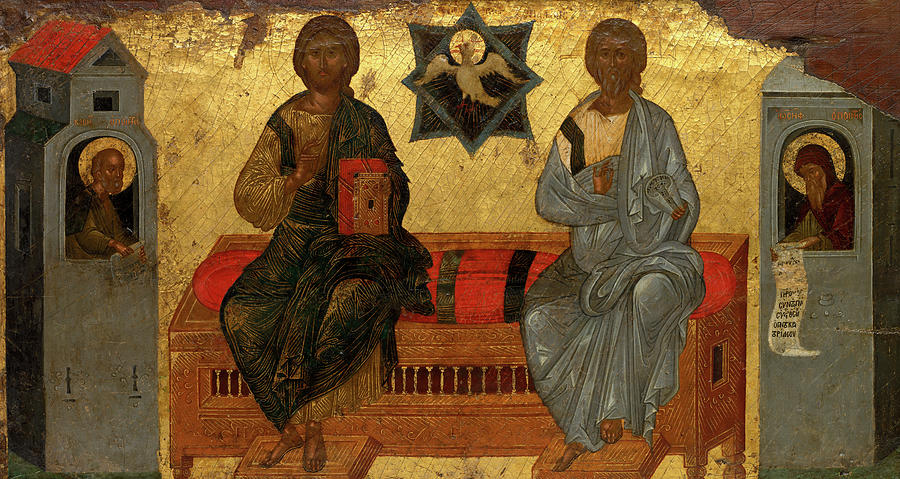
Introit
Collect
God our Father, who by sending into the world
the Word of truth and the Spirit of sanctification
made known to the human race your wondrous mystery,
grant us, we pray, that in professing the true faith,
we may acknowledge the Trinity of eternal glory
and adore your Unity, powerful in majesty.
Through our Lord Jesus Christ, your Son,
who lives and reigns with you in the unity of the Holy Spirit,
one God, for ever and ever. Amen. (RM)
First reading Exodus 34:4b–6, 8–9
Moses rose early in the morning and went up on Mount Sinai, as the Lord had commanded him, and took in his hand the two tablets of stone. 5 The Lord descended in the cloud and stood with him there, and proclaimed the name, “The Lord.” 6 The Lord passed before Moses, and proclaimed, “The Lord, the Lord, a God merciful and gracious, slow to anger, and abounding in steadfast love and faithfulness.” 8 And Moses quickly bowed his head toward the earth, and worshipped. 9 He said, “If now I have found favour in your sight, O Lord, I pray, let the Lord go with us. Although this is a stiff-necked people, pardon our iniquity and our sin, and take us for your inheritance.”
Responsorial Psalm Daniel 3:52, 53, 54, 55, 56
Second reading 2 Corinthians 13:11–13
Brothers and sisters, put things in order, listen to my appeal, agree with one another, live in peace; and the God of love and peace will be with you. 12 Greet one another with a holy kiss. All the saints greet you. 13 The grace of the Lord Jesus Christ, the love of God, and the communion of the Holy Spirit be with all of you.
Gospel Acclamation
Gospel John 3:16–18
Jesus said to Nicodemus: 16 “God so loved the world that he gave his only Son, so that everyone who believes in him may not perish but may have eternal life. 17 “Indeed, God did not send the Son into the world to condemn the world, but in order that the world might be saved through him. 18 Those who believe in him are not condemned; but those who do not believe are condemned already, because they have not believed in the name of the only Son of God.”
Catena Nova
I give you to share, and to defend all your life, the one Godhead and power, found in the Three in unity, and comprising the Three separately, not unequal in substance or nature, neither increased nor diminished by superiorities or inferiorities; in every respect equal, in every respect the same; just as the beauty and the greatness of the heavens is one. This is the infinite conjunction of three infinite Ones, each is God when considered in Himself; as the Father, so the Son; as the Son, so the Holy Spirit. No sooner do I conceive of the One than I am illumined by the splendour of the Three; no sooner do I distinguish them than I am carried back to the One. When I think of any One of the Three I think of him as the Whole, and my eyes are filled, and the greater part of what I am thinking of escapes me. I cannot grasp the greatness of that One so as to attribute a greater greatness to the Rest. When I contemplate the Three together, I see but one torch, and cannot divide or measure out the Undivided Light (St. Gregory Nazianzen).
Eternal God, eternal Trinity, you have made the blood of Christ so precious through his sharing in your divine nature. You are a mystery as deep as the sea; the more I search, the more I find, and the more I find the more I search for you. But I can never be satisfied; what I receive will ever leave me desiring more. When you fill my soul I have an even greater hunger, and I grow more famished for your light. I desire above all to see you, the true light, as you really are. You are my Creator, eternal Trinity, and I am your creature. You have made of me a new creation in the blood of your Son, and I know that you are moved with love at the beauty of your creation, for you have enlightened me. Eternal Trinity, Godhead, mystery deep as the sea, you could give me no greater gift than the gift of yourself. For you are a fire ever burning and never consumed, which itself consumes all the selfish love that fills my being. Yes, you are a fire that takes away the coldness, illuminates the mind with its light and causes me to know your truth. By this light, reflected as it were in a mirror, I recognise that you are the highest good, one we can neither comprehend nor fathom. (St. Catherine of Siena).
O my God, Trinity whom I adore, let me entirely forget myself that I may abide in you, still and peaceful as if my soul were already in eternity; let nothing disturb my peace nor separate me from you, O my unchanging God, but that each moment may take me further into the depths of your mystery ! Pacify my soul! Make it your heaven, your beloved home and place of your repose; let me never leave you there alone, but may I be ever attentive, ever alert in my faith, ever adoring and all given up to your creative action.
O my beloved Christ, crucified for love, would that I might be for you a spouse of your heart! I would anoint you with glory, I would love you - even unto death! Yet I sense my frailty and ask you to adorn me with yourself; identify my soul with all the movements of your soul, submerge me, overwhelm me, substitute yourself in me that my life may become but a reflection of your life. Come into me as Adorer, Redeemer and Savior.
O Eternal Word, Word of my God, would that I might spend my life listening to you, would that I might be fully receptive to learn all from you; in all darkness, all loneliness, all weakness, may I ever keep my eyes fixed on you and abide under your great light; O my Beloved Star, fascinate me so that I may never be able to leave your radiance.
O Consuming Fire, Spirit of Love, descend into my soul and make all in me as an incarnation of the Word, that I may be to him a super-added humanity wherein he renews his mystery; and you O Father, bestow yourself and bend down to your little creature, seeing in her only your beloved Son in whom you are well pleased.
O my “Three,” my All, my Beatitude, infinite Solitude, Immensity in whom I lose myself, I give myself to you as a prey to be consumed; enclose yourself in me that I may be absorbed in you so as to contemplate in your light the abyss of your Splendor! (St. Elizabeth of the Trinity)
Homily
The Church’s Social Doctrine brings us to the very heart of our faith: the mystery of the living God, revealed in Jesus Christ, who, as a communion of Persons — Father, Son and Holy Spirit — is love itself in relationship, expressed in the mutual gift of self and in sharing with the world. As the Council recalled, human persons are called to communion with God and “can fully discover their true selves only in sincere self-giving.” Indeed their deepest vocation is to enter into the Trinitarian dynamic of love received and shared. (no. 48)
If the mystery of God as Love is the source of Social Doctrine, we see its most concrete expression in the face of Jesus Christ, the Incarnate Word. By becoming man, the Son of God enters our history and takes on human flesh, bringing with him the love that unites him to the Father and the Holy Spirit. In him, “the mystery of humanity truly becomes clear” because his humanity is completely free, open to others, capable of building healthy and beautiful relationships and committed to the total gift of self. Those who believe in him are engaged in the great work of renewal that began with the mystery of his passion, death and resurrection, and they cooperate in building up the Kingdom of God, learning to embrace all men and women as brothers and sisters, children of one Father. In this way, both the proclamation of the Gospel and Christian life, guided by the action of the Holy Spirit, tend to bring about social consequences in the world. (no. 49)
At the heart of the Christian understanding of the human person lies the great biblical affirmation that men and women are created in the image and likeness (cf. Gen 1:26-27) of the Triune God. Created for relationship, every human person is planned and willed by God to enter into communion with him, with others and with creation. Human dignity does not depend on a person’s abilities, wealth or position in life, nor on the right or wrong choices made; instead, it is a gift that precedes and transcends each person, endowed by God as an expression of his unfailing love. For this reason, the human person always remains the “way for the Church” and the heart of every authentic path of integral human development. (no. 50)
And isn't this all a commentary on what the Gospel of John, in perhaps its most famous and oft-repeated verse, told us earlier: God so loved the world that he gave his only Son, so that everyone who believes in him might not perish but might have eternal life? (G). Who live and reign, in the unity of the Holy Spirit, God, forever and ever. Amen.
Nicene Creed
Intercessions (Joe Milner; The Sunday Web Site)
For the Church: that the unconditional love of the Trinity may strengthen and inspire each of us, deepen our love for one another, and help us to witness God’s love and mercy to others.
For a spirit of wonder and awe: that we may behold the marvelous deeds of God in nature, in relationships, and within ourselves and be motivated to cooperate with God in greater commitment and sincerity.
For a new experience of grace and mercy in our lives: that God’s love will free us from our past failures, give us courage to make amends, and help us renew and rebuild our significant relationships.
For all who are ill: that God will renew and restore all who have physical ailments and give strength to their caregivers.
For a healing of the wounds of racism: that God will heal all who have been impacted by discrimination, open hearts to the dignity of each person, and help all to work together against poverty, disease, and malnutrition.
For victims of human trafficking: that God will free them from captivity, awaken hearts to the suffering that exists, and bring forth a new attitude in society that respects the dignity of each person.
For refugees: that God will protect all who have fled their homes from harm, guide them on their journey, and lead them to hospitable communities.
For an end to violence in our cities: that God will give courage to all who are working for peace in neighborhoods, help the voices of those who have experienced injustice to be heard, and turn the hearts of those prone to violence toward new ways of working for change.
Merciful and gracious Father, you showed the fullness of your love when you gave your only Son for our salvation and sent down upon us the power of your Spirit. Complete within us the work of your love, that we who have communion in Christ may come to share fully the undying life he lives with you,
in the unity of the Holy Spirit, God for ever and ever. Amen. (ICEL; 1998)
Offertory Chant
Offertory Hymn (St. Hildegard of Bingen)
Laus Trinitati, que sonus et vita ac creatrix omnium in vita ipsorum est, et que laus angelice turbe et mirus splendor arcanorum, que hominibus ignota sunt, est, et que in omnibus vita est.
Praise be to the Trinity, who is sound, and life, and the creatrix of all things in their very life; and who is the praised one of the angelic host, and the wonderful radiance of secrets that are unknown to men, and the life in all things.
Communion Chant
Closing Hymn (John Stainer)
God so loved the world.
God so loved the world,
that He gave His only begotten Son,
that whoso believeth, believeth in Him
should not perish, should not perish
but have everlasting life.
For God sent not His Son into the world to condemn the world.
God sent not His Son into the world to condemn the world;
but that the world through Him might be saved.
God so loved the world.
God so loved the world,
that He gave His only begotten Son,
that whoso believeth, believeth in Him
should not perish, should not perish
but have everlasting life,
everlasting life, everlasting, everlasting life.
God so loved the world.
God so loved the world.
God so loved the world.