Almighty ever-living God, who govern all things, both in heaven and on earth, mercifully hear the pleading of your people and bestow your peace on our times. Through our Lord Jesus Christ, your Son, who lives and reigns with you in the unity of the Holy Spirit, one God, for ever and ever. Amen.
First Reading: Isaiah 49:3, 5-6
The Lord said to me, “You are my servant, Israel, in whom I will be glorified.” And now the Lord says, who formed me in the womb to be his servant, to bring Jacob back to him, and that Israel might be gathered to him, for I am honoured in the sight of the Lord, and my God has become my strength. He says, “It is too small a thing that you should be my servant to raise up the tribes of Jacob and to restore the survivors of Israel; I will give you as a light to the nations, that my salvation may reach to the end of the earth.”
Responsorial Psalm 40:2,4,7-8,8-9,10
R/ Here am I, Lord; I come to do your will.
Second Reading: 1 Corinthians 1:1-3
From Paul, called to be an Apostle of Christ Jesus by the will of God, and from our brother Sosthenes. To the Church of God that is in Corinth, to those who are sanctified in Christ Jesus, called to be saints, together with all those who in every place call on the name of our Lord Jesus Christ, both their Lord and ours: Grace to you and peace from God our Father and the Lord Jesus Christ.
Gospel Acclamation Jn 1:14a,12a
Gospel: John 1:29-34
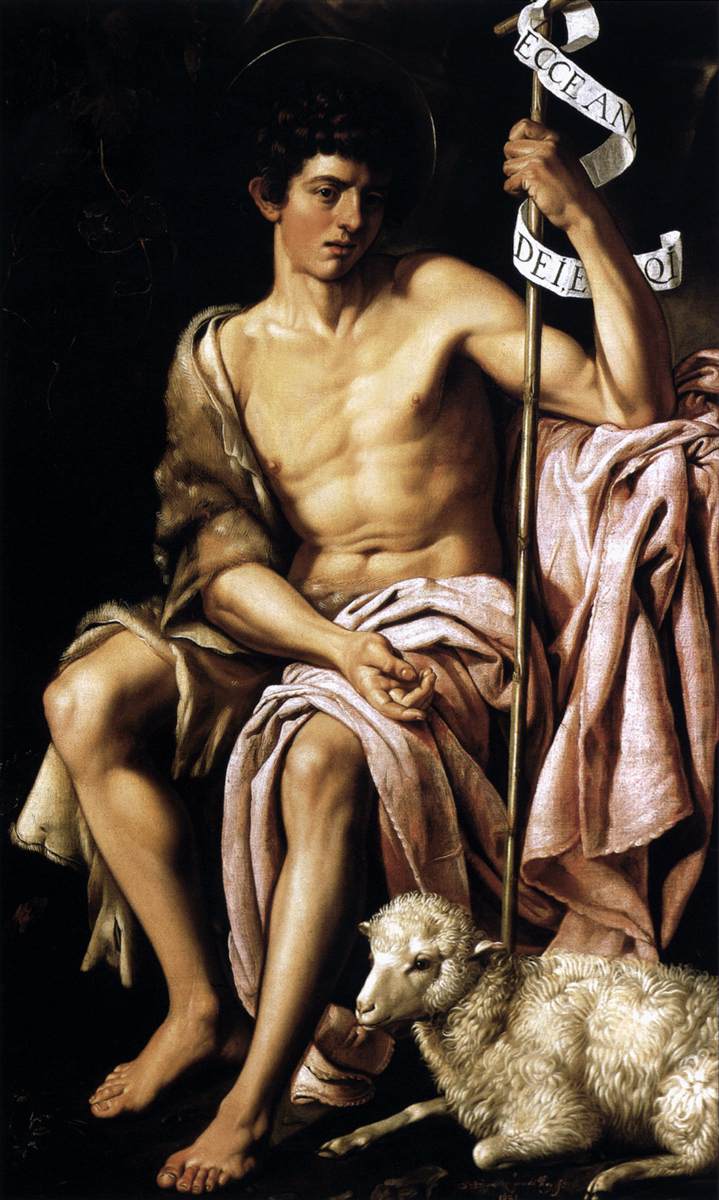
John the Baptist saw Jesus coming toward him and declared, “Here is the Lamb of God who takes away the sin of the world! This is he of whom I said, ‘After me comes a man who ranks ahead of me because he was before me.’ I myself did not know him; but I came baptizing with water for this reason, that he might be revealed to Israel.”
And John testified, “I saw the Spirit descending from heaven like a dove, and remain on him. I myself did not know him, but the one who sent me to baptize with water said to me, ‘He on whom you see the Spirit descend and remain is the one who baptizes with the Holy Spirit.’ And I myself have seen and have testified that this is the Son of God.”
Catena Nova
One Lamb died for all to restore the whole flock on earth to God the Father; one died for all to make all subject to God; one died for all to gain all so that all might live no longer for themselves, but for him who died and was raised to life for them. Because our many sins had made us subject to death and corruption, the Father gave his Son as our redemption, one for all, since all were in him and he was greater than all. One died for all so that all of us might live in him. Death swallowed the Lamb who was sacrificed for all, and then disgorging him disgorged all of us in him and with him; for we were all in Christ who died and rose again for us. Once sin had been destroyed how could death, which was caused by sin, fail to be wholly annihilated? With the root dead how could the branch survive? What power will death have over us now that sin has been blotted out? And so, rejoicing in the sacrifice of the Lamb let us cry out: O O death, where is your victory? O grave, where is your sting? (St Cyril of Alexandria)
Because it is hard to distinguish word from voice, even John himself was thought to be the Christ. The voice was thought to be the word. But the voice acknowledged what it was, anxious not to give offense to the word. I am not the Christ, he said, nor Elijah, nor the prophet…. We should take our lesson from John the Baptist. He is thought to be the Christ; he declares he is not what they think. He does not take advantage of their mistake to further his own glory. If he had said, “I am the Christ”, you can imagine how readily he would have been believed, since they believed he was the Christ even before he spoke. But he did not say it; he acknowledged what he was. He pointed out clearly who he was; he humbled himself. He saw where his salvation lay. He understood that he was a lamp, and his fear was that it might be blown out by the wind of pride.(St. Augustine of Hippo)
“A second time,” says the evangelist, “John stood and said: ‘Behold, the Lamb of God’.” Christ utters no word; John the Forerunner says it all…. John alone proclaimed Him to be present to the people. He was given the name “friend of the Bridegroom” because he alone was present at this marriage with the Church. He it was, who did everything, who brought everything about. Seeing Christ coming, he said: “Behold the Lamb of God.” Thus he showed that it was not by voice alone but, with his eyes also, that he bore witness. He wondered at the Son of God and, when he beheld Him, his heart leaped for joy. At first, he did not preach Christ to his followers but only showed wonder and astonishment at Him. In that wayhe made known to all, by means of the word“lamb,”the gift Jesus came to give. And John did not say,“Who is to take”or “Who has taken” but, “This is he who takes away the sins of the world” and, not just at the time of His Passion but always. He offered only one, single sacrifice for the sins of the world yet, by this oblation, He purifies forever, the consciences of human sinners.(St John Chrysostom)
Were our souls watered with but one drop from the mighty river which flows from the throne of God and the Lamb, it would quench in us all thirst for anything in this world, and remove the aridity and hardness which make us so dry, tepid, and miserable. How grateful should we feel to our Savior for having redeemed us, and blotted out our sins and given us perfect joy instead of sorrow! Suffering, exile, the absence from those we love, the want of things we now think necessary, or other trials would no longer afflict us. So powerful is the fire of the Holy Spirit, that it mounts upwards, and gives us a love and trust in God that no water of sorrow or affliction can extinguish: it remains ever alight; it fills and inflames our hearts, burning away all evil, so that not even death can conquer him whose evil passions it has destroyed.(St. John of Avila)
I want that you should lift your desire and heart above the world and all its doings, and that you should open the eye of the mind to know what love God bears to you, who has given you, for love, the Word, His Only-Begotten Son; and the Son in burning love has given you life, and has sacrificed His Body that He might cleanse us with His Blood. Ignorant are we and wretched who nor know nor love so great a benefit! But all this is because our eyes are closed; for were they open, and had they fastened themselves on Christ crucified, they would not be ignorant nor ungrateful in presence of so great grace. Therefore I say to you, keep your eyes ever open, and fasten them fixedly on the Lamb that was slain, in order that you may never fall into ignorance.(St. Catherine of Siena)
The friend of the Bridegroom does not usurp his rights; nay, he abases himself still further in his humility, in order to proclaim the Messianic divinity of the Saviour and his existence from all eternity. As for himself, he says that he is merely an echo, a shadow, unworthy to render to Jesus even those menial services which slaves were then accustomed to perform for their masters. Such humility is truly in keeping with the greatness of the forerunner, of whom it was said, by the mouth of the divine Word himself, that none greater had arisen among the sons of men.(Bl. Ildefonso Schuster)
These words of the Forerunner about Christ: “Behold the Lamb of God which taketh away the sin of the world,” express a knowledge of Christ so perfect, such an understanding of his redemptive deed on the cross, that one can say that these few words contain thewhole Gospel.The Forerunnerknewthe mystery of the redemptive Passion, the mystery of the cross, and he proclaimed it. He proclaimed it with the words of that “Old Testament evangelist” [Isaiah], that prophet to whom it was given, out of the dark of the ages, to see and understand Golgotha.(Sergius Bulgakov)
Homily
There's a little word I like very much that we hear often in the Bible. We heard it a lot during the Christmas season. It's the word "behold" or in Greekidoû. In one or another form it appears around 200 times in the New Testament, especially in Matthew and Luke. That’s why in recent weeks we were told of Isaiah’s prophecy to "behold" a Virgin who shall be with child; then Mary's response to the angel, "Behold the handmaid of the Lord; Joseph was told to "behold" three different times in his dreams; the heavenly host instructed shepherds to "behold" on the night of Jesus' birth; Magi from the east were overjoyed to "behold" the star reappear; when the Child was presented in the Temple, Simeon told his Mother to "behold" the Child would be a sign of contradiction and, finally, at his baptism we were told to "behold" the heavens opening and the Spirit descending upon Jesus in the form of a dove. All of these accounts were from Matthew or Luke.
Now John also makes use of the verb in a few places, though in today’s gospel with an element of surprise. For when the Baptist says,Behold, the Lamb of God, who takes away the sin of the world,he goes on to say in two different places,I did not know him(G). Something about Jesus made him unrecognizable, and we can only wonder, “Why?”
Perhaps Jesus was too nondescript. After all, John — like most people — was expecting something rather more impressive: whether a warrior-king, a prophet like Moses, or a great high priest. While the only credential Jesus could offer was being theson of Joseph, from Nazareth (Jn. 1:45)which made one of his first disciples wonder with equal surprise,Can anything good come from Nazareth?(Jn 1:46)
So it took a divine revelation to convince John about Jesus, a message from the One whosent [him] to baptize with water [who] told [him], ‘On whomever you see the Spirit come down and remain, he is the one who will baptize with the Holy Spirit’ (G).Notice, however, there was nothing in that message to suggest he should be called “the Lamb of God.” Much less are we told John baptized Jesus as the other gospels make clear. So what prompted John to tell his disciples to "behold" with such a strange designation as "Lamb of God" — even if we are all too used to it?
We can only speculate on why the Baptist would use this title and repeat it again the following day (cf. Jn. 1:36). Perhaps John places the title in the Baptist's mouth in light of what will happen much later in his gospel, when Jesus is crucified on the preparation day of the Jewish Passover at precisely the time the lambs for the paschal meal were being slaughtered (cf. Jn. 19:31). The Lectionary suggests this when today’s gospel is paired with Isaiah’s prophecy of a Suffering Servant who, like a lamb led to slaughter, would redeem Israel.
But whatever led the Baptist to call Jesus the Lamb of God, his initial failure to recognize him tells us something about our own powers of perception, doesn’t it? That it’s not always easy for us to "behold" what might be standing right in front us asking for recognition. Our preconceived notions of what “should be” can stand in the way of someone or something exceeding our expectations — or even failing to meet them because we are looking amiss.
Made all the worse today when deception is all around us making it difficult to behold even the obvious. From AI deepfakes to government officials who want us to close our eyes to the plain truth on a video, beholding isn't as easy anymore. Pope Leo in his recent address to diplomats accredited to the Holy See warned about such attempts to deceive with respect to language. He said,
Rediscovering the meaning of words is perhaps one of the primary challenges of our time. When words lose their connection to reality, and reality itself becomes debatable and ultimately incommunicable…Today, the meaning of words is ever more fluid, and the concepts they represent are increasingly ambiguous. Language is no longer the preferred means by which human beings come to know and encounter one another. Moreover, in the contortions of semantic ambiguity, language is becoming more and more a weapon with which to deceive, or to strike and offend opponents….We should also note the paradox that this weakening of language is often invoked in the name of freedom of expression itself. However, on closer inspection, the opposite is true, for freedom of speech and expression is guaranteed precisely by the certainty of language and the fact that every term is anchored in the truth. It is painful to see how, especially in the West, the space for genuine freedom of expression is rapidly shrinking. At the same time, a new Orwellian-style language is developing which, in an attempt to be increasingly inclusive, ends up excluding those who do not conform to the ideologies that are fueling it.(January 9, 2006)
So we've never needed sharper eyes — and ears — more. Whether we're told murder is self-defense, protest is domestic terrorism, insurrectionists were patriots or if we might be discerning a new course of action for our lives, dealing with new challenges and new decisions, invitedto follow unexpected paths, opening our eyes to see things we never saw before — whether about ourselves, or others, even God — the crucial thing is to "behold" when where and on whom the Spirit is descending — and as importantly, who not. As did the Baptist who, after a failure of recognition, at last beheld the One whobaptizes with the Holy Spirit…the Son of God (G). Who is Lord, forever and ever. Amen.
Intercessions (Joe Milner;The Sunday Website)
For the Church: that we may be a light to the nations and an instrument of God’s saving message to all who are seeking direction and a deeper meaning for their life.
For a greater awareness of God’s call in our lives: that we may listen and live out the mission to which God invites us.
For Christian unity: that God will remove the walls of misunderstanding, help us co-operate in serving those in need, and bring us to a greater appreciation of the gifts of the Spirit at work in one another's communities.
For the members of Congress: that God will give them wisdom and courage as they address the issues before them so that the common good may be advanced.
For an end to racism and the dawn of new cooperation amongst all peoples: that God will help us recognize the dignity of each person and give us the courage to reach past divisions build a greater society.
For all who are worried or anxious: that God will ease their fear, help them to recognize the God is with them, and give them courage.
For all suffering from governmental persecution: that God will stir up the Spirit within them, ease their suffering, and help them to bear faithful witness to the truth.
For an end to civil disturbances: that God will restore peace along city streets and help all to live with dignity and in safety.
For peace: that God will open dialogue between nations and groups that are in conflict and guide them toward new steps to resolve disputes in non-violent ways.
Merciful God, you sent your Son, the spotless Lamb, to take upon himself the sin of the world. Make our lives holy, that your Church may bear witness to your purpose of reconciling all things in Christ, who lives and reigns with you in the unity of the Holy Spirit, God for ever and ever. Amen. (ICEL; 1998)
Offertory Antiphon
Offertory Hymn
Agnus Dei, qui tollis peccata mundi, miserere nobis.
Agnus Dei, qui tollis peccata mundi, miserere nobis.
Agnus Dei, qui tollis peccata mundi, dona nobis pacem. (Palestrina; Missa Hodie Christus Natus Est)
Behold the Lamb of God that taketh away the sins of the world. Have mercy on us (2x).
Behold the Lamb of God, that taketh away the sins of the world. Grant us peace.
Communion Antiphon
Closing Hymn (James Montgomery, 1821)
Hail to the Lord's Anointed, Great David's greater Son! Hail, in the time appointed, His reign on earth begun! He comes to break oppression, To set the captive free, To take away transgression, And rule in equity.
He comes with succor speedy To those who suffer wrong; To help the poor and needy And bid the weak be strong; To give them songs for sighing, Their darkness turn to light, Whose souls, condemned and dying, Were precious in His sight.
He shall come down like showers Upon the fruitful earth, And joy and hope, like flowers, Spring in His path to birth. Before Him on the mountains Shall peace, the herald, go And righteousness, in fountains, From hill to valley flow.
Kings shall bow down before Him And gold and incense bring; All nations shall adore Him, His praise all peoples sing; To Him shall prayer unceasing And daily vows ascend, His kingdom still increasing, A kingdom without end.
O'er every foe victorious, He on His throne shall rest, From age to age more glorious, All blessing and all-blest. The tide of time shall never His covenant remove; His name shall stand forever, -- His changeless name of Love.