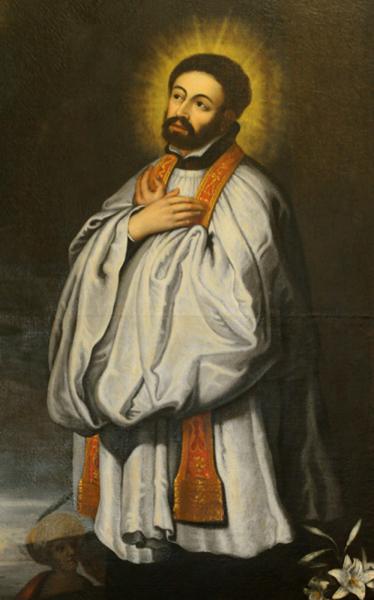
St. Paul the Apostle traveled the breadth of the Mediterranean world, to make known “the unfathomable riches of Christ.” The St. Paul of our modern world, who preached to three continents, was St. Francis Xavier. (Pronounced Zavier, by the way.). A well-born native of Spain, Francis went to study in the great University of Paris. Whatever career he might have planned was all changed after he met there a Spanish fellow student named Ignatius of Loyola. The future St. Ignatius, fired with zeal to promote only the “greater glory of God,” persuaded Francis and a few others to vow themselves to this cause in 1534. They went to Italy in 1536; and in 1539 Pope Paul III accepted them as the pioneer members of a new religious order called the Company or Society of Jesus - we know them better as “the Jesuits”.
Ignatius, seeing in Francis a man whose administrative skill matched his zeal, picked him in 1540 to carry the gospel to India and the Far East. Xavier went to Portugal and on April 7, 1541, with the title of papal ambassador, he set out for Asia. The little Portuguese fleet had to sail all the way around Africa, so the trip to India took 13 months! Father Francis kept busy on shipboard as chaplain, teacher, arbitrator and sometimes nurse of the crews. When he reached Goa, India, in May, 1542, Xavier found that the Portuguese who had settled there in 1510 had given anything but Christian example to the Indians. He had to rechristianize these Europeans - a long task. But he also began to preach to the Indians themselves. He would go through the crowded streets ringing a handbell to summon the children and the mistreated slaves to religious instructions. Naturally of sweet character, he won a large following by his strict morality and his attention to the lepers and the other sick. One of his teaching methods was to set Christian doctrinal statements to popular tunes that the people loved to sing. From the Indians around Goa, St. Francis turned to the Paravas along India’s southwest coast. Approaching these impoverished people as a devotee of religious poverty, he won thousands to Christianity, and his arm even grew weary baptizing their throngs of converts. On the other hand, when he preached to the proud upper-caste Brahmans, it took him a whole year to convert just one person! Despite his large success, Francis had much to suffer from both Portuguese and pagans.
But India was only his first step. In 1545 he went east to the Portuguese port of Malacca on the Malay Peninsula. Here he preached for three years before returning to India to see how his school and missions were faring. While at Malacca, Francis had heard about Japan. That was his next goal. In 1549 he set out with two other priests and three Japanese converts. Reaching Japan, he labored in its southern part for over two years. When he left for Goa, the number of Japanese Christians had risen to 2,000. In Japan Xavier had come to realize that Japanese culture owed very much to China. He therefore determined to go next to the Chinese mainland. By now the head of all the Jesuits in the far east, St. Francis set out eagerly on this new mission trip.
Political red tape complicated his journey, and Divine Providence itself prevented him from achieving his goal. In late August 1552 he reached the lonely Chinese island of Sancian, just off the coast near Canton. There he had to await transportation to the mainland, which was visible from where he had disembarked. But at Sancian he was stricken with a heavy fever. Now alone, with the exception of one Chinese, one Portuguese and two slaves, Francis died on December 3, 1552, aged only 46. Two months later his body was disinterred and found still incorrupt. It was taken back to Goa where it still remains enshrined.
Francis Xavier was declared a saint in 1622 along with St. Ignatius of Loyola. He deserved sainthood for his epic effort as a latter-day St. Paul to carry the good news “even to the ends of the earth”. --Father Robert F. McNamara
Scripture.1 Corinthians 9:16-19, 22-23
Brothers and sisters: If I preach the Gospel, this is no reason for me to boast, for an obligation has been imposed on me, and woe to me if I do not preach it! If I do so willingly, I have a recompense, but if unwillingly, then I have been entrusted with a stewardship. What then is my recompense? That, when I preach, I offer the Gospel free of charge so as not to make full use of my right in the Gospel. Although I am free in regard to all, I have made myself a slave to all so as to win over as many as possible. To the weak I became weak, to win over the weak. I have become all things to all, to save at least some. All this I do for the sake of the Gospel, so that I too may have a share in it.
Writings
(Year A). I and Francis Mancias are now living amongst the Christians of Comorin. They are very numerous, and increase largely every day. When I first came I asked them, if they knew anything about our Lord Jesus Christ? but when I came to the points of faith in detail and asked them what they thought of them, and what more they believed now than when they were Infidels, they only replied that they were Christians, but that as they are ignorant of Portuguese, they know nothing of the precepts and mysteries of our holy religion. We could not understand one another, as I spoke Castilian and they Malabar; so I picked out the most intelligent and well-read of them, and then sought out with the greatest diligence men who knew both languages. We held meetings for several days, and by our joint efforts and with infinite difficulty we translated the Catechism into the Malabar tongue. This I learnt by heart, and then I began to go through all the villages of the coast, calling around me by the sound of a bell as many as I could, children and men. I assembled them twice a day and taught them the Christian doctrine: and thus, in the space of a month, the children had it well by heart. And all the time I kept telling them to go on teaching in their turn whatever they had learnt to their parents, family, and neighbors.
Every Sunday I collected them all, men and women, boys and girls, in the church. They came with great readiness and with a great desire for instruction. Then, in the hearing of all, I began by calling on the name of the most holy Trinity, Father, Son, and Holy Ghost, and I recited aloud the Lord's Prayer, the Hail Mary, and the Creed in the language of the country: they all followed me in the same words, and delighted in it wonderfully. Then I repeated the Creed by myself, dwelling upon each article singly. Then I asked them as to each article, whether they believed it unhesitatingly; and all, with a loud voice and their hands crossed over their breasts, professed aloud that they truly believed it. I take care to make them repeat the Creed oftener than the other prayers; and I tell them that those who believe all that is contained therein are called Christians. After explaining the Creed I go on to the Commandments, teaching them that the Christian law is contained in those ten precepts, and that every one who observes them all faithfully is a good and true Christian and is certain of eternal salvation, and that, on the other hand, whoever neglects a single one of them is a bad Christian, and will be cast into hell unless he is truly penitent for his sin. Converts and heathen alike are astonished at all this, which shows them the holiness of the Christian law, its perfect consistency with itself, and its agreement with reason.
As to the numbers who become Christians, you may understand them from this, that it often happens to me to be hardly able to use my hands from the fatigue of baptizing: often in a single day I have baptized whole villages. Sometimes I have lost my voice and strength altogether with repeating again and again the Credo and the other forms. The fruit that is reaped by the baptism of infants, as well as by the instruction of children and others, is quite incredible. These children, I trust heartily, by the grace of God, will be much better than their fathers. They show an ardent love for the Divine law, and an extraordinary zeal for learning our holy religion and imparting it to others. Their hatred for idolatry is marvellous. They get into feuds with the heathen about it, and whenever their own parents practise it, they reproach them and come off to tell me at once. Whenever I hear of any act of idolatrous worship, I go to the place with a large band of these children, who very soon load the devil with a greater amount of insult and abuse than he has lately received of honor and worship from their parents, relations, and acquaintances. The children run at the idols, upset them, dash them down, break them to pieces, spit on them, trample on them, kick them about, and in short heap on them every possible outrage.
I had been living for nearly four months in a Christian village, occupied in translating the Catechism. A great number of natives came from all parts to entreat me to take the trouble to go to their houses and call on God by the bedsides of their sick relatives. Such numbers also of sick made their own way to us, that I had enough to do to read a Gospel over each of them. At the same time we kept on with our daily work, instructing the children, baptizing converts, translating the Catechism, answering difficulties, and burying the dead. For my part I desired to satisfy all, both the sick who came to me themselves, and those who came to beg on the part of others, lest if I did not, their confidence in, and zeal for, our holy religion should relax, and I thought it wrong not to do what I could in answer to their prayers. But the thing grew to such a pitch that it was impossible for me myself to satisfy all, and at the same time to avoid their quarreling among themselves, every one striving to be the first to get me to his own house; so I hit on a way of serving all at once. As I could not go myself, I sent round children whom I could trust in my place. They went to the sick persons, assembled their families and neighbors, recited the Creed with them, and encouraged the sufferers to conceive a certain and well-founded confidence of their restoration. Then after all this, they recited the prayers of the Church. To make my tale short, God was moved by the faith and piety of these children and of the others, and restored to a great number of sick persons health both of body and soul. How good He was to them! He made the very disease of their bodies the occasion of calling them to salvation, and drew them to the Christian faith almost by force!
I have also charged these children to teach the rudiments of Christian doctrine to the ignorant in private houses, in the streets, and the crossways. As soon as I see that this has been well started in one village, I go on to another and give the same instructions and the same commission to the children, and so I go through in order the whole number of their villages. When I have done this and am going away, I leave in each place a copy of the Christian doctrine, and tell all those who know how to write to copy it out, and all the others are to learn it by heart and to recite it from memory every day. Every feast day I bid them meet in one place and sing all together the elements of the faith. For this purpose I have appointed in each of the thirty Christian villages men of intelligence and character who are to preside over these meetings, and the Governor, Don Martin Alfonso, who is so full of love for our Society and of zeal for religion, has been good enough at our request to allot a yearly revenue of 4000 gold farlams for the salary of these catechists. He has an immense friendship for ours, and desires with all his heart that some of them should be sent hither, for which he is always asking in his letters to the King.
There is now in these parts a very large number of persons who have only one reason for not becoming Christian, and that is that there is no one to make them Christians. It often comes into my mind to go round all the Universities of Europe, and especially that of Paris, crying out everywhere like a madman, and saying to all the learned men there whose learning is so much greater than their charity, "Ah! what a multitude of souls is through your fault shut out of heaven and falling into hell!" Would to God that these men who labor so much in gaining knowledge would give as much thought to the account they must one day give to God of the use they have made of their learning and of the talents entrusted to them! (Letter from India; 15543)
Musical Selection
O Deus, ego amo te,
O God I love Thee for Thyself
Nec amo te ut salves me,
and not that I may heaven gain
Nec quod qui te non diligent,
nor yet that they who love Thee not
Æterno igne pereunt.
must suffer hell's eternal pain.
Ex cruces lingo germinat,
Out of the bud of the wood of the Cross
Qui pectus amor occupant,
wherefore hearts' love embraces
Ex pansis unde brachiis,
whence out of extended arms
Ad te amandum arripes. Amen.
you lovingly take us. Amen.
Collect
Almighty Father, who inspired the preaching of Francis Xavier so that he could bring many nations to you: fill us with zeal for the faith that we may continue to rejoice as our brothers and sisters of every race turn to Jesus as their Saviour, for he lives and reigns with you, in the unity of the Holy Spirit, God, now and for ever. Amen.(English Missal)