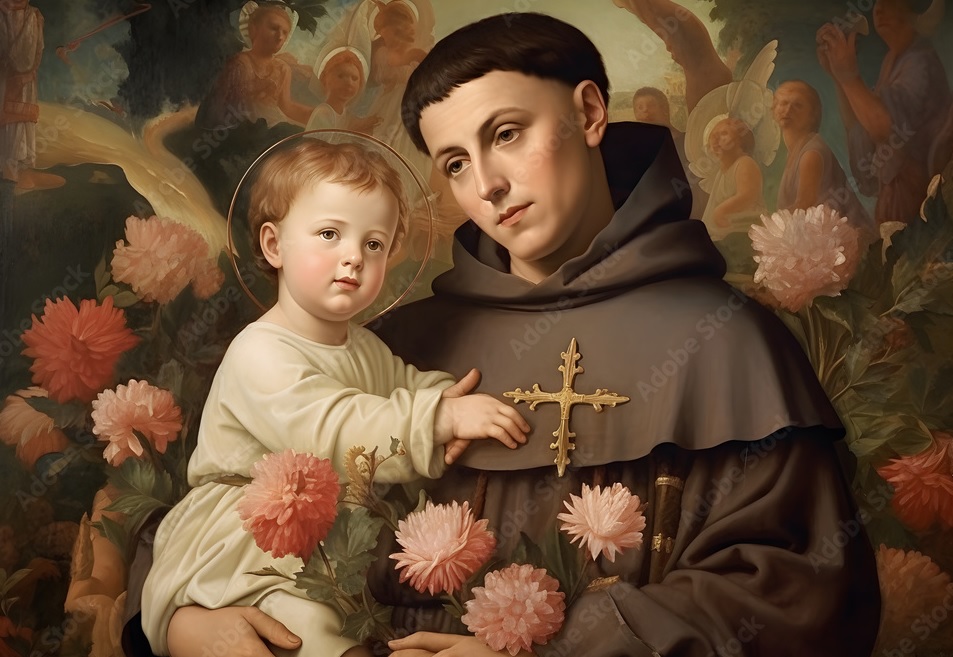
Next to Mary, St. Anthony is perhaps the most often invoked of all saints. Although the Italian city of Padua claims him by reason of his death there, Lisbon claims him by reason of his birth, for Anthony was Portuguese by nationality.
Born Ferdinand de Bulhoes, he was the son of a nobleman, who sent him to Lisbon’s cathedral school. Talented, but also very devout by nature, the lad joined the Augustinian Canons when only 15. But he found that their monastery was too close to Lisbon for his own spiritual good. At his request, therefore, he was transferred to the Augustinian house at Coimbra. There he devoted himself intensively to prayer and study.
In 1220, Don Pedro of Portugal brought back from Morocco the remains of several Franciscan missionaries who had lately been martyred by the Moors. Deeply moved, Fernando began to wish that he, too, might die for Christ. He therefore joined the new Franciscan order. (It had received papal approval only eleven years before.) Given the religious name of Anthony or Antony, he was soon permitted to sail for Morocco in order to preach to the Muslim Moors.
Martyr he would not become, however. God had other plans. Soon after his arrival in Africa Anthony was stricken with a prolonged illness, which necessitated his recall to Portugal after only a few months. He did not even reach Lisbon. Adverse winds blew his ship far off course, so that it finally docked at Messina in Sicily!
Learning at Messina that an important assembly of the Friars Minor was about to take place in Assisi, Anthony set out for there and arrived in time for the meeting, which opened on May 30, 1221. St. Francis of Assisi was on hand, although he had just resigned the headship of the order. The meeting concluded with the reassignment of the friars. Anthony was officially transferred from the Portuguese to the Italian province of the Franciscans and sent to a little friary in out-of-the-way Forli.
The Italian friars did not yet know the talents of this quiet Portuguese newcomer. However, not long after his arrival in Forli, he was called upon to substitute as preacher at an ordination ceremony. Yielding out of obedience, Anthony preached a sermon that so thrilled the audience that his superiors sent him out to preach throughout northern Italy and southern France. He quickly achieved an enviable reputation as a missionary, particularly because of his ability to convert some of the brightest of the Albigensian heretics who were operating in the regions assigned to him.
Anthony’s career was now cut out for him: it would not be martyrdom but oracular preaching. Though not physically pre-possessing (he was short and pudgy), he had skill, learning, charisma, and the power to work miracles that enabled him to convert the most hardened souls. Pope Gregory IX would call him “Treasury of Holy Scripture” because of his strongly biblical preaching. Assigned thereafter to residence in Padua, he toured the country, evangelizing, serving as an arbitrator, and defending the poor even against political bigwigs. In fact, this tireless apostolic work undermined his frail health, and he died at the early age of 39.
Inevitably, stories and legends clustered around this much-loved friar.
For instance, when he was preaching conversion to a heretical group at Rimini, and they would not listen, he was inspired to preach to the fish in the nearby river. The longer he preached, the more the fish gathered, giving every sign of understanding him. Impressed by this wonder, the heretics had a change of heart.
On another occasion his host saw Anthony in rapture, holding the Christchild in his arms. Pictures and statues of the saint usually depict this moment of his life. Still another story says that a novice made off one time with the saint’s psalmbook. Anthony prayed for its return. The guilty novice thereupon experienced such a frightening apparition that he hastened to bring back the purloined book. Perhaps St. Anthony’s skill in retrieving lost objects is based on this recollection.
But Anthony of Padua/Lisbon was not merely a spiritual clone of St. Francis of Assisi and a charismatic preacher. He was also a brilliant theologian, the first in the Franciscan order. In testimony of this brilliance, Pope Pius XII, in 1946, declared Anthony a doctor of the Church, and bestowed on him the title “Doctor Evangelicus”, “Evangelic Doctor.” His feastday is June 13. --Father Robert F. McNamara
(Year A). Look! The fountain is open, and communicates itself to all! …. Behold our Beloved, a cluster of Cyprus, a bundle of myrrh, in this banquet celebrated with rich food and fine drink; Then a hymn being said, he went out with his disciples to mount Olivet [cf. Mt 26.30]. He spent the whole of this night sleepless, so as to transact carefully the business of our salvation. He drew apart from the Apostles, he began to grow sorrowful even unto death, to fall on his knees before the Father, and ask that, if it were possible, the hour might pass him by; yet submitting his own will to the Father’s [cf. Mt 26.38-39]. Being in an agony, his sweat became as drops of blood [cf. Lk 22.44]. After this he was betrayed by a disciple’s kiss, bound, and led away like a thief [cf. Mt 26.47,50,55; Lk 22.47-48,52]. His face was veiled, he was spat on [cf. Lk 22.63-64; Mk 14.65]. His beard was plucked, he was struck on the head with a reed, and buffeted with blows [cf. Mk 15.17-19]. He was scourged at the pillar, crowned with thorns and condemned to death. The wood of the Cross was laid on his shoulders and he went out to Calvary [cf. Jn 19.1-2,17]. He was stripped of his garments, crucified naked between two thieves, given gall and vinegar to drink, blasphemed by the passers-by [Mt 27.34,39; Mk 15.23,27-30; Lk 23.33-36]. And what more? Life died on behalf of the dead. O eyes of our Beloved, closed in death! O face on which the angels long to look [cf. 1Pt 1.12], grown so pale! O lips, distilling the honeyed words of eternal life, grown livid! O head, before which angels tremble, hanging bowed! Those hands, at whose touch leprosy departed, life returned, lost light was restored, the demons fled, bread was multiplied: those hands, I say, Alas! Pierced with nails, flowing with blood! Let us gather all these things together, dearest brothers, and make a bundle of myrrh, and place it between our breasts (that is, let us carry it in our hearts), especially this day and tomorrow, so that we may deserve to rise with him on the third day. May he grant this, who is blessed for ever. Amen. (Sermon for Holy Thursday)
Almighty God,
who gave Anthony of Padua to your people
as an outstanding preacher
and a ready helper in time of need:
with the assistance of his prayer and example,
may we follow the gospel of Christ
and know the help of your grace in every difficulty.
We ask this in the name of Jesus Christ your Son our Lord,
who lives and reigns with you,
in the unity of the Holy Spirit,
God, now and for ever. Amen. (English Missal)