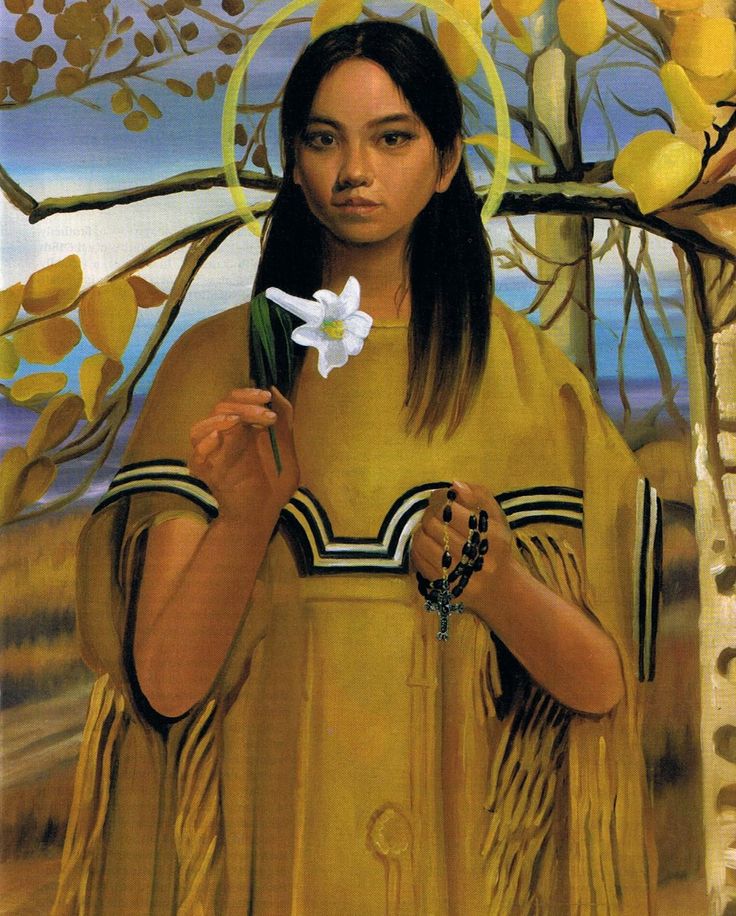
In 1646, the Mohawk village of Ossernenon, near present-day Auriesville, New York, was scarcely welcoming territory for Christian missionaries. The Jesuit Fr. Isaac Jogues and the layman Jean de la Lande were killed there that year. Four years before, in the same village, Fr. Jogues had undergone such prolonged and brutal torture as to have been regarded as a “living martyr,” and his companion, René Goupil, had also been killed. Three of the eight North American martyrs watered the earth of this small Native American village with their blood, and one might have thought that the story ended there…But ten years later, in 1656, a girl was born in that same village to an Algonquin Christian mother, captured by the Mohawks and married to the chief of the Mohawk clan. The child’s parents and brother died in a smallpox epidemic that left her face scarred and her eyes damaged. “Tekakwitha,” she was called, “she who bumps into things” – a testimony to her impaired eyesight. The girl was adopted by her uncle, who became chief in turn.
Tekakwitha learned the traditional women’s arts of her tribe: making clothing, weaving baskets, preparing food, and helping with crops. She listened to the French priests who passed through her village, but she did not dare interact further with them. Not with her uncle and many of her clan so hostile to Christianity. At seventeen, Tekakwitha’s aunts pressured her to marry. She refused, suffering their taunts and punishments. At eighteen, she met a priest, Fr. Jacques de Lamberville, and at last felt free enough to say what was on her heart. She asked for baptism. The following year, Tekakwitha was baptized “Kateri,” the Mohawk form of the name “Catherine.” In this village that gave no welcome to Christians, she was a Christian. Kateri had known it would be hard. She prayed, eliciting contempt. She would not work on Sundays, and so received no food at all that day. She was treated little better than a slave. Soon, some of her fellow villagers accused her of sorcery. Kateri was in danger, and the priest advised her to set out on foot on a 200-mile journey to a Jesuit mission and Native Christian village south of Montreal.
Kateri arrived there in 1677. A Christian Iroquois woman, Anastasia, taught her to pray, to do penance, and to help those in need. Kateri embraced this new life with all her heart. She would pray alone in the woods, falling ever more in love with the Lord who had redeemed her, and did strenuous penance – of a style influenced by Mohawk traditions – asking the Lord to have mercy on her people who did not yet know him. The two priests and the inhabitants of the mission watched her with growing admiration. At 23, Kateri made a decision astonishing for a Mohawk maiden, whose well-being depended upon marriage. She told one of the priests, “I have deliberated enough. For a long time, my decision on what I will do has been made. I have consecrated myself to Jesus, Son of Mary. I have chosen Him for husband, and He alone will have me for wife.” She and two friends longed for some form of religious life, but the priest told them that they were still too young in the faith. So Kateri lived her ordinary life with a great love hidden in it. She belonged to her Lord, and in him, to all who were in need.
By Holy Week of 1680, Kateri’s health was failing. She died on Holy Wednesday. Those present said that her face became radiantly beautiful shortly after her death, and that her smallpox scars disappeared. Two Native women friends and a priest, Fr. Chauchetière, all said that she appeared to them within weeks of her death. On the gravestone of this spiritual daughter of the martyrs was written this epitaph: “Kateri Tekakwitha, Ownkeonweke Katsitsiio Teonsitsianekaron,” “The fairest flower that ever bloomed among red men.” In 2012, the “Lily of the Mohawks” became the first Native American to be declared a saint.
She shall respond there as in the days of her youth,
when she came up from the land of Egypt.
I will espouse you to me forever:
I will espouse you in right and in justice,
in love and in mercy;
I will espouse you in fidelity,
and you shall know the Lord.
Writings
(Year A). Continuing our catechesis on the theme of apostolic zeal and passion for proclaiming the Gospel, we look today at Saint Kateri Tekakwitha, the first native North American woman to be canonized. Born around the year 1656 in a village in Upstate New York, she was the daughter of an unbaptized Mohawk chief and an Algonquin Christian mother, who taught Kateri to pray and sing hymns to God. Many of us were also first introduced to the Lord in family settings, especially by our mothers and grandmothers. This is how evangelization begins and, indeed, we must not forget that the faith is always transmitted in “dialect” by mothers, by grandmothers. Faith should be transmitted in dialect, and we received it in dialect from our mothers and grandmothers. Evangelism often begins this way: with simple, small gestures, such as parents helping their children learn to talk to God in prayer and telling them about His great and merciful love. And the foundation of faith for Kateri, and often for us as well, was laid in this way. She received it from her mother in dialect, the dialect of the faith. When Kateri was four years old, a severe smallpox epidemic struck her people. Both of her parents and her younger brother died, and Kateri herself was left with scars on her face and vision problems. From then on, Kateri had to face many difficulties: the physical ones from the effects of smallpox, certainly, but also the misunderstandings, persecutions, and even death threats she suffered following her Baptism on Easter Sunday 1676. All this gave Kateri a great love for the Cross, the definitive sign of the love of Christ, who gave Himself to the end for us. Indeed, witnessing to the Gospel is not only about what is pleasing; we must also know how to bear our daily crosses with patience, trust, and hope. Patience in the face of difficulties, of crosses: patience is a great Christian virtue. He who does not have patience is not a good Christian. Patience to tolerate: to tolerate difficulties and also to tolerate others, who are sometimes annoying or cause difficulties. Kateri Tekakwitha’s life shows us that every challenge can be overcome if we open our hearts to Jesus, who grants us the grace we need. Patience and a heart open to Jesus — this is a recipe for living well. After being baptized, Kateri was forced to take refuge among the Mohawks in the Jesuit mission near the city of Montreal. There she attended Mass every morning, devoted time to adoration before the Blessed Sacrament, prayed the Rosary, and lived a life of penance. These spiritual practices of hers impressed everyone at the Mission; they recognized in Kateri a holiness that was appealing because it stemmed from her deep love for God. This is proper to holiness: to attract. God calls us through attraction; He calls us with this desire to be close to us, and she felt this grace of divine attraction. At the same time, she taught the children of the Mission to pray; and through the constant fulfilment of her responsibilities, including caring for the sick and elderly, she offered an example of humble and loving service to God and neighbour. The faith is always expressed through service. The faith is not about putting on make-up, putting make-up on the soul; no, it is to serve. Although she was encouraged to marry, Kateri preferred to completely dedicate her life to Christ. Unable to enter the consecrated life, she made a vow of perpetual virginity on 25 March 1679. This choice of hers reveals another aspect of apostolic zeal that she had: total surrender to the Lord. Of course, not everyone is called to make the same vow as Kateri, but every Christian is called to give him- or herself daily with an undivided heart to the vocation and mission entrusted to them by God, serving Him and one’s neighbour in a spirit of charity. Dear brothers and sisters, Kateri’s life is further proof that apostolic zeal implies both union with Jesus, nourished by prayer and the sacraments, and the desire to spread the beauty of the Christian message through fidelity to one’s particular vocation. Kateri’s last words are very beautiful. Before she died, she said, “Jesus, I love you.” May we too, like Saint Kateri Tekakwitha, draw strength from the Lord and learn to do ordinary things in extraordinary ways, growing daily in faith, charity and zealous witness for Christ. Let us not forget: Each one of us is called to holiness, to everyday holiness, to the holiness of the common Christian life. Each one of us has this calling. Let us go forward along this path. The Lord will not fail us. (Pope Francis)
Musical Selection(Lord's Prayer; Mohawk)
Collect
O God, who desired the Virgin Saint Kateri Tekakwitha
to flower among Native Americans
in a life of innocence,
grant, through her intercession,
that when all are gathered into your Church
from every nation, tribe and tongue,
they may magnify you
in a single canticle of praise.
Through our Lord Jesus Christ, your Son,
who lives and reigns with you in the unity of the Holy Spirit,