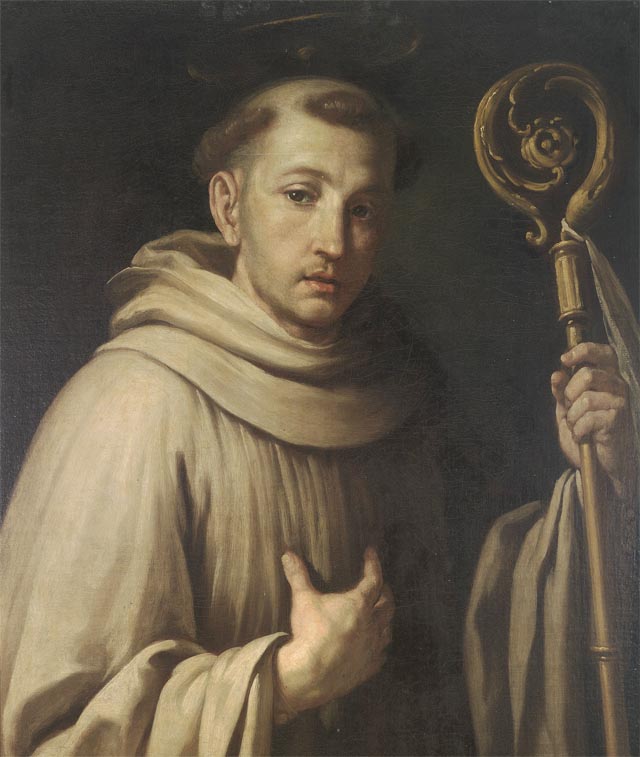
Are you familiar with the Trappist Cistercians --those silent, austere farming monks who have an abbey at Piffard in the Diocese of Rochester? Well, these men mirror the life and values of their “second founder,” St. Bernard of Clairvaux. Bernard was born into a noble French family in 1090 AD. As he grew up, he was admired for his good looks, sharp wits and warm disposition. But those who liked him for these surface qualities did not see his underlying desire to serve God alone.
Attracted to the Cistercian monks at Citeaux, he not only entered this strict monastery in 1112, but brought 31 relatives and friends with him into the religious life. How is that for leadership! Just three years later, his superiors were so pleased with him as a monk that they sent him off, though only 25, to found a new monastery. The locale was called “Wormwood Valley.” He changed the name to “Clairvaux,” “Valley of Light.” The new monastery quickly rose in population from 12 to 130. During his own lifetime, Bernard witnessed the foundation of 767 more Trappist-Cistercian monasteries in many countries.
If he had had his “druthers,” St. Bernard would have spent his whole life within the walls of the cloister. But this was not to be. Most saints are not geniuses; Bernard was. He quickly became recognized as an expert on spiritual life, as a preacher without equal, and as a theological writer; eventually proclaimed a doctor of the Church.
He was recognized even more widely in his lifetime as a natural leader, called on to help Christendom wherever help was needed. Once, two men claimed to be pope. Bernard was brought in to defend the valid claimant. Abelard the philosopher was teaching errors, and the Albigensian sect, heresy. Bernard was brought in to refute both of them. The Holy Land, rescued in the First Crusade from the Muslims, was reconquered by them. Bernard was brought in to preach the Second Crusade (and unfairly blamed when the Crusade fizzled). Even in 1153, when Bernard was in his last illness, the Archbishop of Trier pleaded with him to leave the monastery and make peace between the citizens of Metz and the Duke of Lorraine. Again, the saint succeeded, but he died on August 20 of the same year.
Bernard of Clairvaux was thus both a mystic and a leader. “St. Bernard’s Glove” is a good symbol of both talents. The glove is a relic that has come down from him. On each finger is embroidered a little French motto of Christian behavior. “Merci” (“Say thanks!”). “Volontiers (“Be generous!”). Qu’ importe?” (“Ignore trifles!”). “Tais-toi” (“Don’t Say it!”) and “Confie-toi” (“Be of good heart!”). Try that on for size! --Father Robert F. McNamara
ScriptureEcclesiasticus 15:1-6
Whoever fears the Lord will act like this,
and whoever grasps the Law will obtain wisdom.
She will come to meet him like a mother,
and receive him like a virgin bride.
He will lean on her and will not fall,
he will rely on her and not be put to shame.
She will raise him high above his neighbours,
and in full assembly she will open his mouth.
He will find happiness and a crown of joy,
he will inherit an everlasting name.
Writings
(Year A). Seeing that the Scripture saith, God has made all for His own glory (Isa. 43.7), surely His creatures ought to conform themselves, as much as they can, to His will. In Him should all our affections center, so that in all things we should seek only to do His will, not to please ourselves. And real happiness will come, not in gratifying our desires or in gaining transient pleasures, but in accomplishing God’s will for us: even as we pray every day: ‘Thy will be done in earth as it is in heaven’ (Matt. 6.10). O chaste and holy love! O sweet and gracious affection! O pure and cleansed purpose, thoroughly washed and purged from any admixture of selfishness, and sweetened by contact with the divine will! To reach this state is to become godlike. As a drop of water poured into wine loses itself, and takes the color and savor of wine; or as a bar of iron, heated red-hot, becomes like fire itself, forgetting its own nature; or as the air, radiant with sun beams, seems not so much to be illuminated as to be light itself; so in the saints all human affections melt away by some unspeakable transmutation into the will of God. For how could God be all in all, if anything merely human remained in man? The substance will endure, but in another beauty, a higher power, a greater glory. When will that be? Who will see, who possess it? ‘When shall I come to appear before the presence of God?’ (Ps. 42.2). ‘My heart hath talked of Thee, Seek ye My face: Thy face, Lord, will I seek’ (Ps. 27.8). Lord, thinkest Thou that I, even I shall see Thy holy temple? In this life, I think, we cannot fully and perfectly obey that precept, ‘Thou shalt love the Lord thy God with all thy heart, and with all thy soul, and with all thy strength, and with all thy mind’ (Luke 10.27). For here the heart must take thought for the body; and the soul must energize the flesh; and the strength must guard itself from impairment. And by God’s favor, must seek to increase.
It is therefore impossible to offer up all our being to God, to yearn altogether for His face, so long as we must accommodate our purposes and aspirations to these fragile, sickly bodies of ours. Wherefore the soul may hope to possess the fourth degree of love, or rather to be possessed by it, only when it has been clothed upon with that spiritual and immortal body, which will be perfect, peaceful, lovely, and in everything wholly subjected to the spirit. And to this degree no human effort can attain: it is in God’s power to give it to whom He wills. Then the soul will easily reach that highest stage, because no lusts of the flesh will retard its eager entrance into the joy of its Lord, and no troubles will disturb its peace. May we not think that the holy martyrs enjoyed this grace, in some degree at least, before they laid down their victorious bodies? Surely that was immeasurable strength of love which enraptured their souls, enabling them to laugh at fleshly torments and to yield their lives gladly. But even though the frightful pain could not destroy their peace of mind, it must have impaired somewhat its perfection.(On Loving God)
Musical Selection
Jesu, dulcis memoria, dans vera cordis gaudia: sed super mel et omnia ejus dulcis praesentia.
Jesus, the very thought of Thee With sweetness fills the breast! Yet sweeter far Thy face to see And in Thy Presence rest.
Nil canitur suavius, nil auditur jucundius, nil cogitatur dulcius, quam Jesus Dei Filius.
No voice can sing, no heart can frame, Nor can the memory find, A sweeter sound than Jesus' Name, The Saviour of mankind
Jesu, spes paenitentibus, quam pius es petentibus! quam bonus te quaerentibus! sed quid invenientibus?
O hope of every contrite heart! O joy of all the meek! To those who fall, how kind Thou art! How good to those who seek! But what to those who find?
Nec lingua valet dicere, nec littera exprimere: expertus potest credere, quid sit Jesum diligere.
Ah! this Nor tongue nor pen can show The love of Jesus, what it is, None but His loved ones know.
Sis, Jesu, nostrum gaudium, qui es futurum praemium: sit nostra in te gloria, per cuncta semper saecula. Amen.
Jesus! our only hope be Thou, As Thou our prize shalt be; In Thee be all our glory now, And through eternity. Amen.
Collect
Merciful redeemer, who, by the life and preaching of your servant Bernard, rekindled the radiant light of your Church: grant us, in our generation, to be inflamed with the same spirit of discipline and love, and ever to walk before you as children of light; through Jesus Christ your Son our Lord, who lives and reigns with you, in the unity of the Holy Spirit, one God, now and for ever. Amen.(English Missal)