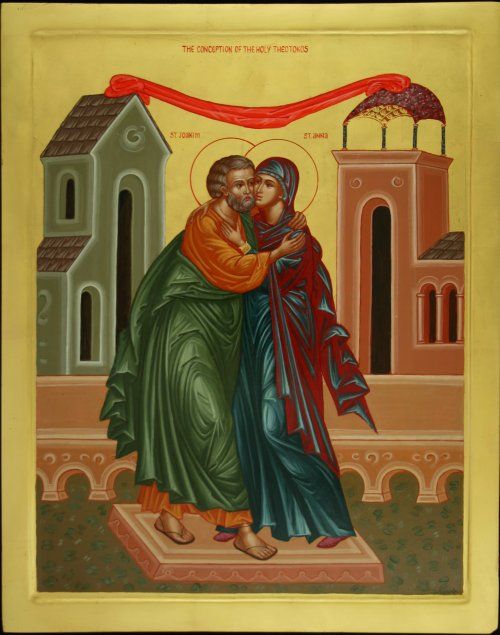
OPENING CHANT
COLLECT
O God, who by the Immaculate Conception of the Blessed Virgin
prepared a worthy dwelling for your Son,
grant, we pray, that as you preserved her from every stain
by virtue of the Death of your Son, which you foresaw,
so, through her intercession,
we, too, may be cleansed and admitted to your presence.
Through our Lord Jesus Christ, your Son,
who lives and reigns with you in the unity of the Holy Spirit,
God, for ever and ever. Amen.
FIRST READING Genesis 3:9-15, 20
When the man had eaten from the tree, 9 the Lord God called to him, and said, “Where are you?” 10 The man said, “I heard the sound of you in the garden, and I was afraid, because I was naked; and I hid myself.” 11 God said, “Who told you that you were naked?” Have you eaten from the tree of which I commanded you not to eat?” 12 The man said, “The woman whom you gave to be with me, she gave me fruit from the tree, and I ate.” 13 Then the Lord God said to the woman, “What is this that you have done?” The woman said, “The serpent tricked me, and I ate.” 14 The Lord God said to the serpent, “Because you have done this, cursed are you among all animals and among all wild creatures; upon your belly you shall go, and dust you shall eat all the days of your life. 15 I will put enmity between you and the woman, and between your offspring and hers; he will strike your head, and you will strike his heel.” 20 The man named his wife “Eve,” because she was the mother of all the living.
RESPONSORIAL PSALM Ps 98:1, 2-3ab, 3cd-4
R. (1) Sing to the Lord a new song, for he has done marvelous deeds.
SECOND READING Ephesians 1:3-6, 11-12
Blessed be the God and Father of our Lord Jesus Christ, who has blessed us in Christ with every spiritual blessing in the heavenly places, 4 just as he chose us in Christ before the foundation of the world to be holy and blameless before him in love. 5 He destined us for adoption as his children through Jesus Christ, according to the good pleasure of his will, 6 to the praise of his glorious grace that he freely bestowed on us in the Beloved. 11 In Christ we have also obtained an inheritance, having been destined according to the purpose of him who accomplishes all things according to his counsel and will, 12 so that we, who were the first to set our hope on Christ, might live for the praise of his glory.
ALLELUIA Luke 1:28
Ave Maria gratia plena, Dominus tecum; benedicta tu in mulieribus.
Hail, Mary, full of grace, the Lord is with you; blessed are you among women.
GOSPEL Luke 1:26-29 (cf. 1962 Roman Missal)
The angel Gabriel was sent by God to a town in Galilee called Nazareth, 27 to a virgin engaged to a man whose name was Joseph, of the house of David. The virgin’s name was Mary. 28 And he came to her and said, “Greetings, favoured one! The Lord is with you.” 29 But she was much perplexed by his words and pondered what sort of greeting this might be.
HOMILY (St. John Henry Newman)
Memorandum On the Immaculate Conception
I
1. IT is so difficult for me to enter into the feelings of a person who understands the doctrine of the Immaculate Conception, and yet objects to it, that I am diffident about attempting to speak on the subject. I was accused of holding it, in one of the first books I wrote, twenty years ago. On the other hand, this very fact may be an argument against an objector—for why should it not have been difficult to me at that time, if there were a real difficulty in receiving it?
2. Does not the objector consider that Eve was created, or born, without original sin? Why does not this shock him? Would he have been inclined to worship Eve in that first estate of hers? Why, then, Mary?
3. Does he not believe that St. John Baptist had the grace of God—i.e., was regenerated, even before his birth? What do we believe of Mary, but that grace was given her at a still earlier period? All we say is, that grace was given her from the first moment of her existence.
4. We do not say that she did not owe her salvation to the death of her Son. Just the contrary, we say that she, of all mere children of Adam, is in the truest sense the fruit and the purchase of His Passion. He has done for her more than for anyone else. To others He gives grace and regeneration at a point in their earthly existence; to her, from the very beginning.
5. We do not make her nature different from others. Though, as St. Austin says, we do not like to name her in the same breath with mention of sin, yet, certainly she would have been a frail being, like Eve, without the grace of God. A more abundant gift of grace made her what she was from the first. It was not her nature which secured her perseverance, but the excess of grace which hindered Nature acting as Nature ever will act. There is no difference in kind between her and us, though an inconceivable difference of degree. She and we are both simply saved by the grace of Christ.
Thus, sincerely speaking, I really do not see what the difficulty is, and should like it set down distinctly in words. I will add that the above statement is no private statement of my own. I never heard of any Catholic who ever had any other view. I never heard of any other put forth by anyone.
II
(1.) Next, Was it a primitive doctrine? No one can add to revelation. That was given once for all;—but as time goes on, what was given once for all is understood more and more clearly. The greatest Fathers and Saints in this sense have been in error, that, since the matter of which they spoke had not been sifted, and the Church had not spoken, they did not in their expressions do justice to their own real meaning. E.g. (1), the Athanasian Creed says that the Son is “immensus” (in the Protestant version, “incomprehensible”). Bishop Bull, though defending the ante-Nicene Fathers, says that it is a marvel that “nearly all of them have the appearance of being ignorant of the invisibility and immensity of the Son of God.” Do I for a moment think they were ignorant? No, but that they spoke inconsistently, because they were opposing other errors, and did not observe what they said. When the heretic Arius arose, and they saw the use which was made of their admissions, the Fathers retracted them.
(2) The great Fathers of the fourth century seem, most of them, to consider our Lord in His human nature ignorant, and to have grown in knowledge, as St. Luke seems to say. This doctrine was anathematized by the Church in the next century, when the Monophysites arose.
(3) In like manner, there are Fathers who seem to deny original sin, eternal punishment, &c.
(4) Further, the famous symbol “Consubstantial,” as applied to the Son, which is in the Nicene Creed, was condemned by a great Council of Antioch, with Saints in it, seventy years before. Why? Because that Council meant something else by the word.
Now, as to the doctrine of the Immaculate Conception, it was implied in early times, and never denied. In the Middle Ages it was denied by St. Thomas and by St. Bernard, but they took the phrase in a different sense from that in which the Church now takes it. They understood it with reference to our Lady’s mother, and thought it contradicted the text, “In sin hath my mother conceived me”—whereas we do not speak of the Immaculate Conception except as relating to Mary; and the other doctrine (which St. Thomas and St. Bernard did oppose) is really heretical.
III
As to primitive notion about our Blessed Lady, really, the frequent contrast of Mary with Eve seems very strong indeed. It is found in St. Justin, St. Irenæus, and Tertullian, three of the earliest Fathers, and in three distinct continents—Gaul, Africa, and Syria. For instance, “the knot formed by Eve’s disobedience was untied by the obedience of Mary; that what the Virgin Eve tied through unbelief that the Virgin Mary unties through faith.” Again, “The Virgin Mary becomes the Advocate (Paraclete) of the Virgin Eve, that as mankind has been bound to death through a Virgin, through a Virgin it may be saved, the balance being preserved, a Virgin’s disobedience by a Virgin’s obedience” (St. Irenæus, Hæer. v. 19). Again, “As Eve, becoming disobedient, became the cause of death to herself and to all mankind, so Mary, too, bearing the predestined Man, and yet a Virgin, being obedient, became the CAUSE OF SALVATION both to herself and to all mankind.” Again, “Eve being a Virgin, and incorrupt, bore disobedience and death, but Mary the Virgin, receiving faith and joy, when Gabriel the Angel evangelised her, answered, ‘Be it unto me,'” &c. Again, “What Eve failed in believing, Mary by believing hath blotted out.”
1. Now, can we refuse to see that, according to these Fathers, who are earliest of the early, Mary was a typical woman like Eve, that both were endued with special gifts of grace, and that Mary succeeded where Eve failed?
2. Moreover, what light they cast upon St. Alfonso’s doctrine, of which a talk is sometimes made, of the two ladders. You see according to these most early Fathers, Mary undoes what Eve had done; mankind is saved through a Virgin; the obedience of Mary becomes the cause of salvation to all mankind. Moreover, the distinct way in which Mary does this is pointed out when she is called by the early Fathers an Advocate. The word is used of our Lord and the Holy Ghost—of our Lord, as interceding for us in His own Person; of the Holy Ghost, as interceding in the Saints. This is the white way, as our Lord’s own special way is the red way, viz. of atoning Sacrifice.
3. Further still, what light these passages cast on two texts of Scripture. Our reading is, “She shall bruise thy head.” Now, this fact alone of our reading, “She shall bruise,” has some weight, for why should not, perhaps, our reading be the right one? But take the comparison of Scripture with Scripture, and see how the whole hangs together as we interpret it. A war between a woman and the serpent is spoken of in Genesis. Who is the serpent? Scripture nowhere says till the twelfth chapter of the Apocalypse. There at last, for the first time, the “Serpent” is interpreted to mean the Evil Spirit. Now, how is he introduced? Why, by the vision again of a Woman, his enemy—and just as, in the first vision in Genesis, the Woman has a “seed,” so here a “Child.” Can we help saying, then, that the Woman is Mary in the third of Genesis? And if so, and our reading is right, the first prophecy ever given contrasts the Second Woman with the First—Mary with Eve, just as St. Justin, St. Irenaeus, and Tertullian do.
4. Moreover, see the direct bearing of this upon the Immaculate Conception. There was war between the woman and the Serpent. This is most emphatically fulfilled if she had nothing to do with sin—for, so far as any one sins, he has an alliance with the Evil One.
IV
Now I wish it observed why I thus adduce the Fathers and Scripture. Not to prove the doctrine, but to rid it of any such monstrous improbability as would make a person scruple to accept it when the Church declares it. A Protestant is apt to say: “Oh, I really never, never can accept such a doctrine from the hands of the Church, and I had a thousand thousand times rather determine that the Church spoke falsely, than that so terrible a doctrine was true.” Now, my good man, WHY? Do not go off in such a wonderful agitation, like a horse shying at he does not know what. Consider what I have said. Is it, after all, certainly irrational? is it certainly against Scripture? is it certainly against the primitive Fathers? is it certainly idolatrous? I cannot help smiling as I put the questions. Rather, may not something be said for it from reason, from piety, from antiquity, from the inspired text? You may see no reason at all to believe the voice of the Church; you may not yet have attained to faith in it—but what on earth this doctrine has to do with shaking your faith in her, if you have faith, or in sending you to the right-about if you are beginning to think she may be from God, is more than my mind can comprehend. Many, many doctrines are far harder than the Immaculate Conception. The doctrine of Original Sin is indefinitely harder. Mary just has not this difficulty. It is no difficulty to believe that a soul is united to the flesh without original sin; the great mystery is that any, that millions on millions, are born with it. Our teaching about Mary has just one difficulty less than our teaching about the state of mankind generally.
I say it distinctly—there may be many excuses at the last day, good and bad, for not being Catholics; one I cannot conceive: “O Lord, the doctrine of the Immaculate Conception was so derogatory to Thy grace, so inconsistent with Thy Passion, so at variance with Thy word in Genesis and the Apocalypse, so unlike the teaching of Thy first Saints and Martyrs, as to give me a right to reject it at all risks, and Thy Church for teaching it. It is a doctrine as to which my private judgment is fully justified in opposing the Church’s judgment. And this is my plea for living and dying a Protestant.”
INTERCESSIONS (Peter Scagnelli)
God most high, from the first moment of her conception you favoured the Virgin Mary with your grace, that she might become the mother of the world’s Redeemer. As you blessed the daughter of Israel, so grant us the grace to be fully engaged in your service, eager to do your will. Hasten that day of gladness when you will bring to completion your saving work, through Jesus Christ our Lord, who lives and reigns with you in the unity of the Holy Spirit, God for ever and ever. Amen. (ICEL; 1998)
INTERLUDE
HYMN (Libera)
O Sanctissima O Piissima
Dulcis Virgo Maria
Mater amta intemerata
Ora ora pro nobis
Ora ora
Ora pro nobis
Virgo respice, Mater adspice
Audi nos, O Maria!
Sicut lilium inter spinas
Sic Maria inter filias
Jubilate, Cherubim,
Exsultate, Seraphim!
Consonante perpetim,
Salve, salve Regina!
O Sanctissima, O Piisima
Dulcis Virgo Maria
Ora, ora, ora Pro Nobis
Sancta Maria, sancta Maria Mater Dei
Sancta Maria, sancta Maria Mater Dei
Jubilate, Cherubim,
Exsultate, Seraphim!
Consonante perpetim,
Salve, salve Regina!
O most holy one, O most loving one, Sweet virgin Mary.
Beloved mother and chaste, Pray for us Pray for us, pray for us.
Look upon us, look after us, Hear us, O Mary
Like a lily among thorns, So is Mary among women
Rejoice ye Cherubim, Exult ye Seraphim Sing aloud forever
Hail, hail O Queen Holy Mary, Mother of God
ANTIPHON
CLOSING HYMN
Of one that is so fair and bright,
Velut maris stella
Brighter than the day is light;
Parens et puella.
I cry to thee to turn to me,
Lady, pray thy Son for me
Tam pia
That I may come to Thee
Maria.

In sorrow, counsel thou art best,
Felix fecundata.
For all the weary thou art rest,
Mater honorata
Beseech him in thy mildest mood,
Who for us did shed His blood
In Cruce
That we may come to Him
In luce.

Lady, flow'r of ev'rything,
Rosa sine spina,
Thou bore Jesus Heaven's King,
Gratia Divina,
Of all I say thou bore the prize
Lady, Queen of Paradise
Electa,
Maiden mild, Mother
Es effecta.