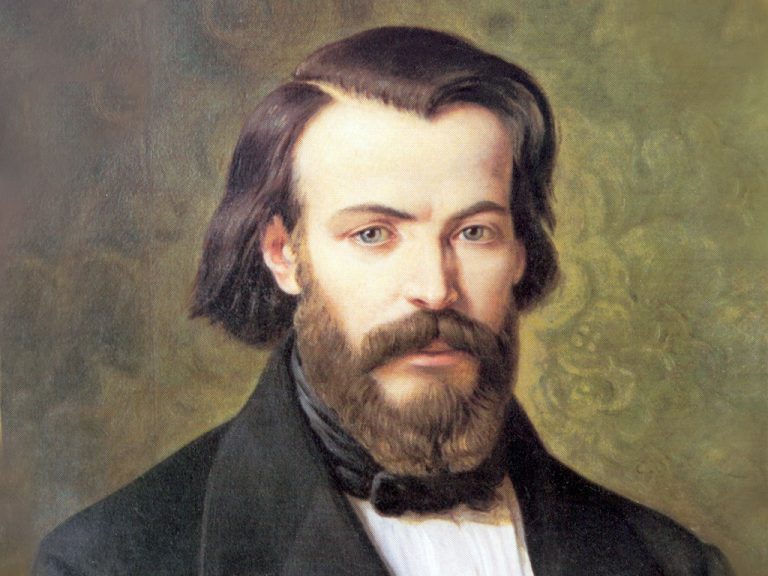
Outstanding French historian, literary critic, legal authority, AND exemplary lay leader, Antoine Frederic Ozanam was also the founder of the international hands-on charitable organization, the Society of St. Vincent de Paul. Although born in Milan, Italy, Frederic was a part of French history. According to family tradition, he was the descendant of a 7th-century convert from Judaism, Samuel Hosannam. Raised in Lyons, France, he experienced a “crisis of doubt” in his teens; but with the aid of his teacher, Abbe Noirot, he emerged from the struggle all the firmer in his Catholic faith, and with deep charity towards unbelievers with similar doubts.
Having published his first book – a refutation of socialism – when only 18, he went to Paris to study law. Here he met and became closely associated with the most notable young Catholic lay leaders at the Sorbonne. Active in countering the anti-Catholicism then prevalent at the University, he and several Catholic fellow students also established in 1833 a “Conference of Charity” dedicated to practical lay work among the poor. Two years later its name was changed to the “Society of St. Vincent de Paul,” and its formal rules were published. It aimed at serving the needy of every faith and nation, and the Society in one nation was expected to come to the aid of the needy of other nations in seasons of crisis. (Thus the Paris branch assisted Dublin during the Irish famine, and the Dublin branch reached out to the Parisian victims of the French revolution of 1848.) The remarkable thing about this worldwide organization, which now has 46,650 local conferences with 880,000 members, is that, although blessed by the Church, it is strictly a lay undertaking.
Meanwhile the young founder himself continued his studies and won doctorates in law and in literature. Elected professor of foreign literature at the Sorbonne in 1844, he became noted for his Dante scholarship, and for his general proficiency in Latin and foreign languages. But his interests were not merely literary. In a country where most Catholics were monarchists, he believed that they should play a role in the Christian evolution of the democratic state. He himself ran for office (although unsuccessfully) in the French National Assembly in 1848. The social question was also being raised in his era. In his law lectures he denounced both economic liberalism and any form of socialism even before Karl Marx and Friederich Angels published the Communist Manifesto. His brilliant exposition of Catholic social doctrine anticipated much of what Pope Leo XIII would teach on social justice in the historic encyclical Rerum Novarum (1891).
Ozanam, married and a parent, was therefore unrivalled as an exemplar of the lay apostolate in family, intellectual, and social life. The cause for his beatification was introduced in 1923. On July 6, 1993, Pope John Paul II approved the decree of heroic sanctity, which conferred on Professor Ozanam the title “venerable.” The same pope declared him “blessed” in Notre Dame Cathedral on August 22, 1997 at the “World Youth Day” in Paris. The occasion of the beatification was appropriate, for Blessed Frederic was a young man (only 40) when he died, and his greatest accomplishments had been those of a youthful layman full of practical faith and worldwide compassion. --Father Robert F. McNamara
Scripture(1 Jn 4:7-16)
Dear friends, let us love one another, for love comes from God. Everyone who loves has been born of God and knows God.8 Whoever does not love does not know God, because God is love.9 This is how God showed his love among us: He sent his one and only Son into the world that we might live through him.10 This is love: not that we loved God, but that he loved us and sent his Son as an atoning sacrifice for our sins.11 Dear friends, since God so loved us, we also ought to love one another.12 No one has ever seen God; but if we love one another, God lives in us and his love is made complete in us. 13 This is how we know that we live in him and he in us: He has given us of his Spirit.14 And we have seen and testify that the Father has sent his Son to be the Savior of the world.15 If anyone acknowledges that Jesus is the Son of God, God lives in them and they in God.16 And so we know and rely on the love God has for us.
Writings
(Year A). We have the poor in front of us. The saints were out of their minds when it came to love. Their love was limitless, embracing God, humanity, nature. Considering that God became man to live on earth, that a large part of humanity is poor, that nature itself, stupendous as it is, is poor in so far as it is liable to death, the saints also wished to be poor. It is a characteristic of love to wish to be like, as far as possible, what is loved. And so, my dear friend, are we not going to do anything to become like those saints whom we love? Are we going to be satisfied with complaining about the present-day indifference, when each one of us carries in his heart a seed of holiness which, by our merely wanting it, could bloom? If we do not know how to love God as the saints loved him, that is something for which we can be blamed. The same is true if our weakness is suggested as a reason for our being excused, since it seems that in order to love we must be able to see, and we see God only through faith, and our faith is so weak! But we see people, the poor, with human sight, we have them in front of us, we can touch their wounds with our hands, and make out the marks of the crown of thorns on their foreheads. So, we cannot not believe. We should throw ourselves at their feet and cry out like the apostle "My Lord and my God! You are our masters and we your servants. You are the sacred image of that God whom we do not see, and being unable to love in any other way, we love him in your persons". If in the Middle Ages a sick society could be healed only through a huge outpouring of love, especially by St Francis of Assisi, and if, later on, new sufferings called for the helping hands of St Philip Neri, St John of God and St Vincent de Paul, surely there is need today for charity, giving, patience, to heal the sufferings of these poor people, poorer than ever because they were refused food for their souls just when they came to lack material food. The problem which divides people today is not a political problem, it is a social one. It is a matter of knowing which will get the upper hand, the spirit of selfishness or the spirit of sacrifice; whether society will go for ever increasing enjoyment and profit, or for everyone devoting themselves to the general good, and above all to the defence of the weakest. Many people have too much and want still more. Others do not have enough, or do not have anything at all, and they want to take by force what is not being given to them. A war is threatening between these two groups, and looks like being a terrible one. On one side the power of wealth, on the other the force of desperation. We must get in between these two groups, at least to reduce the impact if we cannot stop it. Because we are young, because we are not wealthy, we can more easily fill the role of mediators, which, as Christians, we should consider obligatory. (Letters)
Musical Selection
Beauty for brokenness Hope for despair Lord, in the suffering This is our prayer
Bread for the children Justice, joy, peace Sunrise to sunset
Your kingdom increase!
Shelter for fragile lives Cures for their ills Work for the craftsman Trade for their skills
Land for the dispossessed Rights for the weak Voices to plead the cause Of those who can't speak
God of the poor Friend of the weak
Give us compassion we pray
Melt our cold hearts
Let tears fall like rain
Come, change our love
From a spark to a flame
Refuge from cruel wars Havens from fear Cities for sanctuary Freedoms to share
Peace to the killing-fields Scorched earth to green
Christ for the bitterness His cross for the pain
Rest for the ravaged earth Oceans and streams Plundered and poisoned
Our future, our dreams Lord, end our madness Carelessness, greed
Make us content with The things that we need
Lighten our darkness Breathe on this flame
Until your justice Burns brightly again
Until the nations Learn of your ways
Seek your salvation And bring you their praise
Collect
You raised up Blessed Frederick, God,
as someone blazing with the spirit of your love,
so that he could encourage a group of lay people in helping the poor:
help us, who see his example,
to carry out your commandments of love,
and become like yeast in the mixture of the human race.
We make our prayer through our Lord Jesus Christ your Son,
who lives and reigns with you in the unity of the Holy Spirt,