September 30
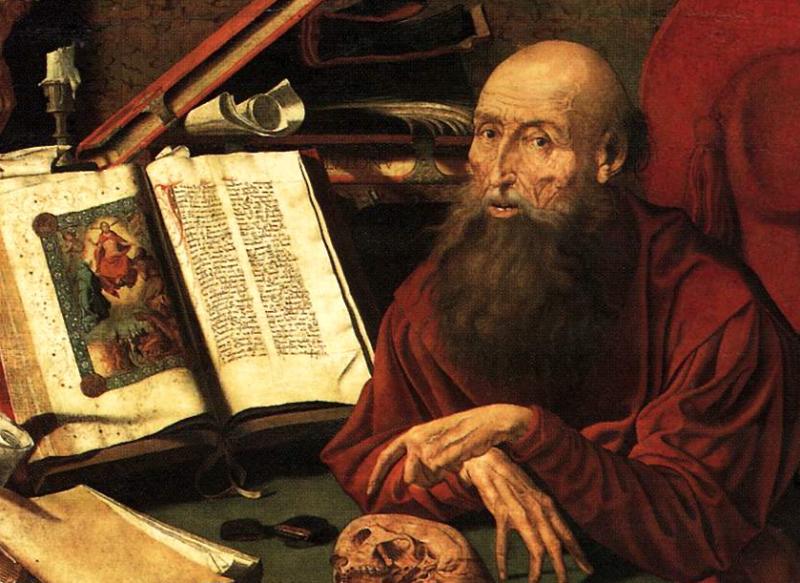
St. Jerome
Life. (329-420)
Saint Jerome, born in Dalmatia in 329, was sent to school in Rome. His boyhood was not free from faults; his thirst for knowledge was excessive, and his love of books, a passion. He had studied under the best masters, visited foreign cities, and devoted himself to the pursuit of learning. But Christ had need of his strong will and active intellect for the service of His Church. He told him in a supernatural experience he never forgot that he was not a Christian, but a Ciceronian: Your heart is where your treasure is, said the Lord to him — that is, in the eloquent writings of antique times. Saint Jerome obeyed the divine call, making a vow never again to read profane works, and another of celibacy. In Rome he had already assisted a number of holy women to organize houses of retirement where they consecrated themselves to God by vow. Calumnies, arising from jealousy, made a certain headway against the scholar whose competence was beginning to attract honors. He fled from Rome to the wild Syrian desert, and there for four years learned in solitude, intense sufferings and persecution from the demons, new lessons in humility, penance and prayer, and divine wisdom. I was very foolish to want to sing the hymns of the Lord on foreign soil, and to abandon the mountain of Sinai to beg help from Egypt, he declared.
Pope Damasus summoned him back to Rome, and there assigned to the famous scholar, already expert in Hebrew and other ancient languages, the task of revising the Latin Bible. Saint Jerome obeyed his earthly Head as he had obeyed his Lord. Retiring once more in 386 to Bethlehem, the eloquent hermit sent forth from his solitary cell not only a solidly accurate version of the Scriptures, but during thirty years' time, a veritable stream of luminous writings for the Christian world. He combated with unfailing efficacy several heresies being subtly introduced by various personages in his own region and elsewhere. For fourteen years the hand of the great scholar could no longer write; but Saint Jerome could still dictate to six secretaries at a time, to each on a different subject, in those final years. He died in his beloved Bethlehem in 420, when over 80 years old. His tomb is still in a subterranean chapel of its ancient basilica, but his relics were transported to Saint Mary Major Basilica of Rome, where the crib of Bethlehem is conserved.
Source: https://sanctoral.com/en/saints/saint_jerome.html
Writings
(Year A). Return to me with all your heart and show a spirit of repentance with fasting, weeping and mourning; so that while you fast now, later you may be satisfied, while you weep now, later you may laugh, while you mourn now, you may some day enjoy consolation. It is customary for those in sorrow or adversity to tear their garments. The gospel records that the high priest did this to exaggerate the charge against our Lord and Savior; and we read that Paul and Barnabas did so when they heard words of blasphemy. I bid you not to tear your garments but rather to rend your hearts which are laden with sin. Like wine skins, unless they have been cut open, they will burst of their own accord. After you have done this, return to the Lord your God, from whom you had been alienated by your sins. Do not despair of his mercy, no matter how great your sins, for great mercy will take away great sins. For the Lord is gracious and merciful and prefers the conversion of a sinner rather than his death. Patient and generous in his mercy, he does not give in to human impatience but is willing to wait a long time for our repentance. So extraordinary is the Lord’s mercy in the face of evil, that if we do penance for our sins, he regrets his own threat and does not carry out against us the sanctions he had threatened. So by the changing of our attitude, he himself is changed. But in this passage we should interpret “evil” to mean, not the opposite of virtue, but affliction, as we read in another place: Sufficient for the day are its own evils. And, again: If there is evil in the city, God did not create it. In like manner, given all that we have said above – that God is kind and merciful, patient, generous with his forgiveness, and extraordinary in his mercy toward evil – lest the magnitude of his clemency make us lax and negligent, he adds this word through his prophet: Who knows whether he will not turn and repent and leave behind him a blessing? In other words, he says: “I exhort you to repentance, because it is my duty, and I know that God is inexhaustibly merciful, as David says: Have mercy on me, God, according to your great mercy, and in the depths of your compassion, blot out all my iniquities. But since we cannot know the depth of the riches and of the wisdom and knowledge of God, I will temper my statement, expressing a wish rather than taking anything for granted, and I will say: Who knows whether he will not turn and repent? “ Since he says, Who, it must be understood that it is impossible or difficult to know for sure. To these words the prophet adds: Offerings and tribulations for the Lord our God. What he is saying to us in other words is that, God having blessed us and forgiven us our sins, we will then be able to offer sacrifice to God. (Commentary on Joel)
Musical Selection
Collect
Loving Father,
who gave Jerome delight
in his study of holy scripture:
may your people find in your word
the food of salvation and the fountain of life.
We ask this in the name of Jesus Christ your Son our Lord,
who lives and reigns with you,
in the unity of the Holy Spirit,
God, now and for ever. Amen. (English Missal)