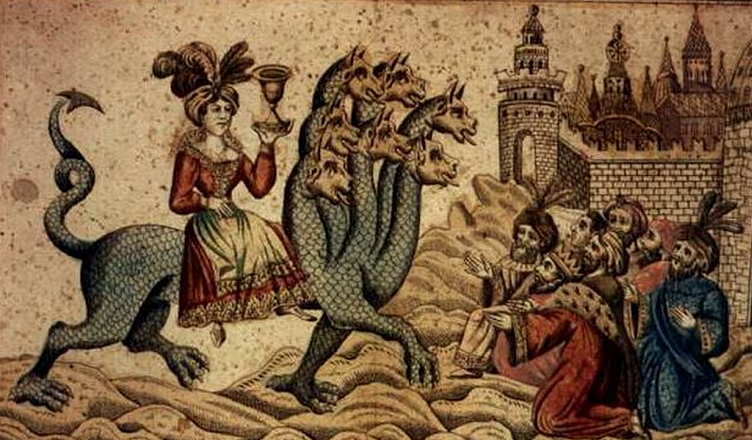
The woman which thou sawest is that great city,
which reigneth over the kings of the earth. (Revelation 17:18)
THE city spoken of in these words is evidently Rome, which was then the seat of empire all over the earth,-which was supreme even in Judaea. We hear of the Romans all through the Gospels and Acts. Our SAVIOUR was born when His mother, the Blessed Virgin, and Joseph, were brought up to Bethlehem to be taxed by the Roman governor. He was crucified under Pontius Pilate, the Roman governor. St. Paul was at various times protected by the circumstance of his being a Roman citizen; on the other hand, when he was seized and imprisoned, it was by the Roman governors, and at last he was sent to Rome itself, to the emperor, and eventually martyred there, together with St. Peter. Thus the sovereignty of Rome, at the time when CHRIST and His Apostles preached and wrote, which is a matter of historical notoriety; is forced on our notice in the New Testament itself. It is undeniably meant in the text, by the great city which reigneth over the kings of the earth.
The connexion of Rome with the reign and exploits of Antichrist, is so often brought before us in the controversies of the day, that it may be well, after what I have already had occasion to say on the subject of the last enemy of the Church, to consider now what Scripture prophecy says concerning Rome; which I shall attempt to do, as before, with the guidance of the early Fathers.
Now let us observe what the Chapter says, in which the text occurs, concerning Rome, and what we may deduce from it.
This great city is described under the image of a woman, cruel, profligate, and impious. She is described as arrayed in all worldly splendour and costliness, in purple and scarlet, in gold and precious stones, and pearls, as shedding and drinking the blood of the saints, till she was drunken with it Moreover she is called by the name of "Babylon the Great," to signify her power, wealth, profaneness, pride, sensuality, and persecuting spirit, after the pattern of that former enemy of the Church. I need not here relate how all this really answered to the character and history of Rome at the time St. John spoke of it. There never was a more ambitious, haughty, hardhearted, and worldly people than the Romans; never any, for none else had ever the opportunity, which so persecuted the Church. Christians suffered ten persecutions at their hands, as they are commonly reckoned, and very horrible ones, extending over two hundred and fifty years. The day would fail to go through an account of the tortures they suffered from Rome; so that the Apostle's description was as signally fulfilled afterwards as a prophecy, as it was accurate at the time as an historical notice.
This guilty city, represented by St. John as an abandoned woman, is said to be seated on "a scarlet-coloured monster, full of names of blasphemy, having seven beads and ten horns." Here we are sent back by the prophetic description to the seventh chapter of Daniel, in which the four great empires of the world are shadowed out under the figure of four beasts, a lion, a bear, a leopard, and a nameless monster, "diverse" from the rest, "dreadful and terrible, and strong exceedingly;" "and it had ten horns." This surely is the very same beast which St. John saw: the ten horns mark it. Now this fourth beast in Daniel's vision is the Roman empire; therefore "the beast" on which the woman sat, is the Roman empire. And this agrees very accurately with the actual position of things in history; for Rome, the mistress of the world, might well be said to sit upon, and be carried about triumphantly on that world which she had subdued, and made her creature. Further, the prophet Daniel explains the ten horns of the beast to be "ten kings that shall arise" out of this empire; in which St. John agrees, saying, "The ten horns which thou sawest are ten kings, which have received no kingdom as yet, but receive power as kings one hour with the beast." Moreover, in a former vision Daniel speaks of the empire as destined to be "divided," as "partly strong and partly broken." Further still, this empire, the beast of burden of the woman, was at length to rise against her and devour her, as some savage animal might turn upon its keeper; and it was to do this in the time of its divided or multiplied existence. "The ten horns which thou sawest upon the beast, these shall hate" her, "and shall make her desolate and naked, and shall eat her flesh and burn her with fire." Such was to be the end of the great city. Lastly, three of the kings, perhaps all, are said to be subdued by Antichrist, who is to come up suddenly while they are in power; for such is the course of Daniel's prophecy-"Another shall rise after them, and he shall be diverse from the first, and he shall subdue three kings, and he shall speak great words against the MOST HIGH, and shall wear out the saints of the MOST HIGH, and think to change times and laws; and they shall be given into his hands until a time, times, and the dividing of time."'
Musical Selection (We Are Waiting; lyrics in video)
COLLECT