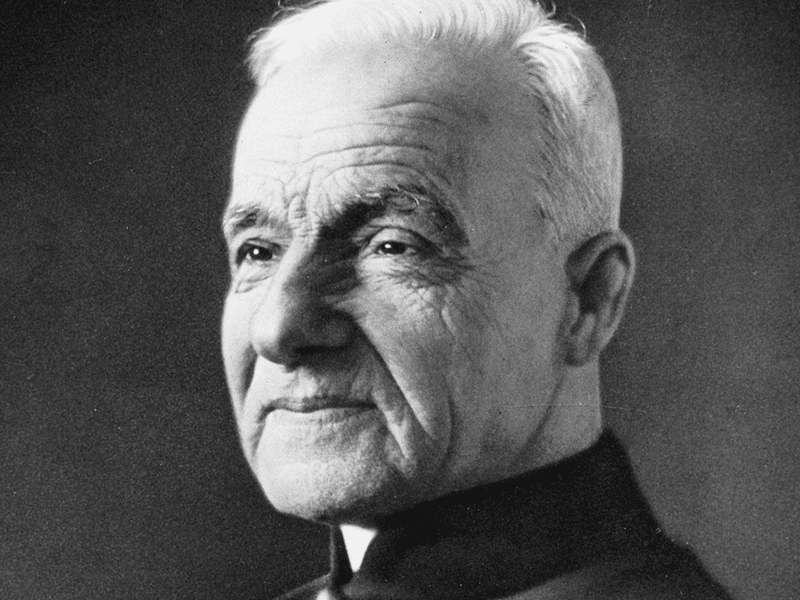
St. Andre Bessette
Life. (1845-1937)
Few visitors to Montreal fail to visit the stunning Basilica of St. Joseph that crowns the “Royal Mountain” from which the city gets its name. This shrine, noted for its miracles, was the great achievement of a little Holy Cross brother, André Bessette.
Baptized Alfred, Bessette was of French-Canadian stock, the sixth of the ten children of Isaac Bessette, a carpenter of Iberville, Quebec. Of frail health from birth, Alfred learned from his mother not only piety but the value of self-denial. Unfortunately, he lost both parents before reaching 12. Cousins raised him, but they often laughed at his puny frame and his little penitential practices. As a member of the working class, Alfred was obliged to earn his own living. He tried cobbling, baking, blacksmithing and farming, and served likewise as the sacristan of his parish church. Physical weakness did not permit him to stay long at any of his jobs. In 1965 he went to Connecticut. There he earned a dollar a day working long hours in the mills at Hartford, Mooseup and Phoenix. At other times he engaged in farming. Once again, ill health kept him from long-term employment.
When Alfred returned to Canada after three years in New England, he was close to 24. His spiritual advisor now helped him discern his true calling. Gladly accepting the priest’s recommendation, Bessette applied for entrance into the Holy Cross Brothers, who had a novitiate on Mount Royal. Received into this order, in 1870, he was given the religious name “André” (Andrew). For the next 40 years, Brother André was to grow in holiness as porter of the Brothers’ College of Notre Dame. It was an ideal assignment, for he was deeply spiritual, efficient, personable, and humorous. His gentle smile charmed those whom he encountered, and he became known as a “friend to all.”
Since childhood, Bessette had been devoted to St. Joseph, the patron saint of Canada. He was happy to find that Joseph was also a favorite of the Holy Cross Brothers. In 1890, he was inspired to set up a tiny chapel of St. Joseph in the woods of Mount Royal near the College. Through his quiet persuasion people began to visit this shrine, and sick people were soon declaring themselves cured there. As the crowds of pilgrims increased, the Holy Cross Congregation had to enlarge the original chapel three times.
In 1910, Montreal’s Archbishop, Paul Bruchesi, after a careful investigation, officially approved of the shrine as a devotional center. Meanwhile, the little Brother who had promoted the movement and was always on hand to greet and counsel pilgrims, was more and more frequently spoken of as the agent of the physical and moral miracles performed on Mount Royal. But Brother André always protested such remarks. “It is not I but God who is responsible,” he would say. “All this comes through St. Joseph’s prayers. I am only St. Joseph’s little dog!” The present vast basilica, begun in 1922, was dedicated only in 1955. Brother Andrew did not live to see its completion. He died on the feast of the Epiphany, January 6, 1937. The nationwide attention given by the press and radio to his death showed the international prominence that he had merited. Over half a million mourners passed by his body as it lay in state. Many touched him with their medals or rosaries so as to have some memento and relic of this remarkable man.
Brother André had once said, “The good one does on earth is nothing in comparison with the good one can do in heaven.” More and more, after his death, pilgrims to St. Joseph’s shrine also prayed to the little Brother who had been his devoted promoter. Only three years after his death, the first steps were taken towards the canonization of the “Miracle Man of Montreal.” The day for proclaiming him a saint has not yet arrived; but on May 23, 1982, Pope John Paul II solemnly declared him “Blessed.”
Andrew Bessette lived and worked in Canada and the United States, two nations more noted for commerce than for sanctity. Perhaps that is why God has given us this saintly man - this “pauper, servus et humilis” (“poor, humble server of others”) to remind us that although we live in a materialistic world, we can and must always keep our sights lifted up to heaven. --Father Robert F. McNamara
André Bessette was canonized by Pope Benedict XVI on October 17, 2010.
Fathers are not born, but made. A man does not become a father simply by bringing a child into the world, but by taking up the responsibility to care for that child. Whenever a man accepts responsibility for the life of another, in some way he becomes a father to that person.
Children today often seem orphans, lacking fathers. The Church too needs fathers. Saint Paul’s words to the Corinthians remain timely: “Though you have countless guides in Christ, you do not have many fathers” (1 Cor 4:15). Every priest or bishop should be able to add, with the Apostle: “I became your father in Christ Jesus through the Gospel” (ibid.). Paul likewise calls the Galatians: “My little children, with whom I am again in travail until Christ be formed in you!” (4:19).
Being a father entails introducing children to life and reality. Not holding them back, being overprotective or possessive, but rather making them capable of deciding for themselves, enjoying freedom and exploring new possibilities. Perhaps for this reason, Joseph is traditionally called a “most chaste” father. That title is not simply a sign of affection, but the summation of an attitude that is the opposite of possessiveness. Chastity is freedom from possessiveness in every sphere of one’s life. Only when love is chaste, is it truly love. A possessive love ultimately becomes dangerous: it imprisons, constricts and makes for misery. God himself loved humanity with a chaste love; he left us free even to go astray and set ourselves against him. The logic of love is always the logic of freedom, and Joseph knew how to love with extraordinary freedom. He never made himself the centre of things. He did not think of himself, but focused instead on the lives of Mary and Jesus.
Joseph found happiness not in mere self-sacrifice but in self-gift. In him, we never see frustration but only trust. His patient silence was the prelude to concrete expressions of trust. Our world today needs fathers. It has no use for tyrants who would domineer others as a means of compensating for their own needs. It rejects those who confuse authority with authoritarianism, service with servility, discussion with oppression, charity with a welfare mentality, power with destruction. Every true vocation is born of the gift of oneself, which is the fruit of mature sacrifice. The priesthood and consecrated life likewise require this kind of maturity. Whatever our vocation, whether to marriage, celibacy or virginity, our gift of self will not come to fulfilment if it stops at sacrifice; were that the case, instead of becoming a sign of the beauty and joy of love, the gift of self would risk being an expression of unhappiness, sadness and frustration.
When fathers refuse to live the lives of their children for them, new and unexpected vistas open up. Every child is the bearer of a unique mystery that can only be brought to light with the help of a father who respects that child’s freedom. A father who realizes that he is most a father and educator at the point when he becomes “useless”, when he sees that his child has become independent and can walk the paths of life unaccompanied. When he becomes like Joseph, who always knew that his child was not his own but had merely been entrusted to his care. In the end, this is what Jesus would have us understand when he says: “Call no man your father on earth, for you have one Father, who is in heaven” (Mt 23:9).
In every exercise of our fatherhood, we should always keep in mind that it has nothing to do with possession, but is rather a “sign” pointing to a greater fatherhood. In a way, we are all like Joseph: a shadow of the heavenly Father, who “makes his sun rise on the evil and on the good, and sends rain on the just and on the unjust” (Mt 5:45). And a shadow that follows his Son. (Pope Francis)