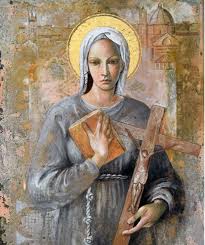
Saint Angela was born in Foligno, Italy, and lived most of her life in the small Umbrian town of her birth. There was nothing remarkable about Angela's early years, and there was nothing scandalous about her life. Yet she tells us in her later writings that for over thirty years she led a mortally sinful life. Perhaps she was referring to the pride and comfort of a wealthy and fashionable existence, for she came from a family of great property, married well, and afterwards ruled a large household of children and servants. As she describes her conversion, it reads like the story of many a soul today. Fear of her damnation led her to the confessional one day. But she was afraid to tell her most serious sins, and so made a bad confession, then a sacrilegious Communion. Only greater remorse followed. Tormented in soul, she prayed to Saint Francis of Assisi, and he appeared to her in a vision. The next day she made a complete and sincere confession. From this point on, her life was completely changed. The thought of her sins gave her a desire for penance, suffering, and reparation. In Foligno and its neighboring town, Assisi, the memory of Saint Francis, who had died in 1226, was still fresh. It is not surprising, then, that Angela was inspired by Franciscan ideals from the time of her conversion until her death in 1309. When one by one her mother, her husband and all her children had died, she became a Franciscan tertiary and later lived as a mendicant, a poor beggar, completely dependent upon the charity of others.
She was a soul whom God chose to fulfill the role of a mystic. Her confessor recorded from her own lips the visions and ecstasies that were granted to her with startling frequency. For Angela the whole world was filled with God, and she was in almost constant communion with Him. Yet we would misunderstand the interior life of this mystic, or any other, for that matter, if we imagine that her life was without pain, without constant suffering. Angela herself tells us that at times she was overcome with grief because she could see nothing but the extraordinary goodness of God and, in contrast, the vanity of earthly things and the ingratitude of creatures. The sight of a crucifix produced in Saint Angela torrents of tears. The intimacy she enjoyed with God was a grace which at one period of her life was entirely withheld from her, that she might like Job, become a model of constancy amid great and prolonged torments. Of the thousands of tourists who annually visit Assisi and pray at the tombs of Saint Francis and Saint Clare, few travel the short distance to Foligno, where Angela is buried in the Franciscan church. But she, like the Saints of Assisi, has many a lesson for our day. No sinner who would have recourse to her would ever despair.
Little Pictorial Lives of the Saints, a compilation based on Butler's Lives of the Saints and other sources by John Gilmary Shea (Benziger Brothers: New York, 1894); Les Petits Bollandistes: Vies des Saints, by Msgr. Paul Guérin (Bloud et Barral: Paris, 1882), Vol. 1.
In Joppa there was a disciple named Tabitha (in Greek her name is Dorcas); she was always doing good and helping the poor. About that time she became sick and died, and her body was washed and placed in an upstairs room. Lydda was near Joppa; so when the disciples heard that Peter was in Lydda, they sent two men to him and urged him, “Please come at once!” Peter went with them, and when he arrived he was taken upstairs to the room. All the widows stood around him, crying and showing him the robes and other clothing that Dorcas had made while she was still with them. Peter sent them all out of the room; then he got down on his knees and prayed. Turning toward the dead woman, he said, “Tabitha, get up.” She opened her eyes, and seeing Peter she sat up. He took her by the hand and helped her to her feet. Then he called for the believers, especially the widows, and presented her to them alive. This became known all over Joppa, and many people believed in the Lord.
Writings
(Year A). I heard the divine voice saying within my soul, “My love for thee was no deceit.” This word was as a shock of mortal pain unto my soul, for the eyes of my mind were instantly opened, and I saw that what He said was very true. I saw the working and effect of that delight; I saw all that the Son of God had done for the sake of this love, and I saw what Christ Crucified had borne in life and in death for the sake of this deep and unspeakable love. Wherefore did I understand that it was indeed true that His love for me had been no deceit or jest, but love most perfect and profound. Then did I perceive just the opposite in myself, that is to say, I knew that I loved Him deceitfully and not truly. […] Then were other words spoken unto me… : “My love for thee was no deceit, My service of thee was not feigned….” Then cried my soul, saying, “Oh Master, that which Thou sayest is not in Thee, is wholly in me; for never have I loved Thee saving deceitfully. I have served Thee with lies and I have never desired to draw nigh unto Thee in very truth for fear lest I might feel those burdens which Thou didst feel and bear for my sake. Wherefore have I never served Thee sincerely and for Thine own sake, but with negligence and duplicity.” Now when I perceived how that He had loved me sincerely, how that He bore in Him all the signs of true love, and how that He had drawn nigh unto me to such a degree that He was become Man in order that He might more completely bear and feel in Himself all our sufferings, I did feel such exceeding great anguish that…I thought mine heart would burst asunder. […] After this He spake certain words unto me which did manifest and show forth His boundless love, saying: “If there were any person who desired to feel Me in his mind, I would not withdraw Myself from him; and unto whomsoever did desire to behold Me would I willingly show Myself, and with whomsoever did desire to speak unto Me would I joyfully converse.” These words did arouse in me the desire never to feel or say or do aught which should offend God. And this is what God desireth and especially seeketh in His sons and His elect; for He hath called and chosen them in order that they may think, see, and speak according unto His will, and that they may take heed to do nothing contrary thereunto. (Book of Divine Consolation)
Musical Selection (John Michael Talbot)
Collect
Almighty God, You caused blessed Angela to excel in contemplating the mysteries of Your Son. Through her merits and prayers may we share in the same mysteries on earth and rejoice exultantly in the revelation of Your glory. Through our Lord Jesus Christ, your Son, who lives and reigns with you in the unity of the Holy Spirit, God, for ever and ever. Amen.