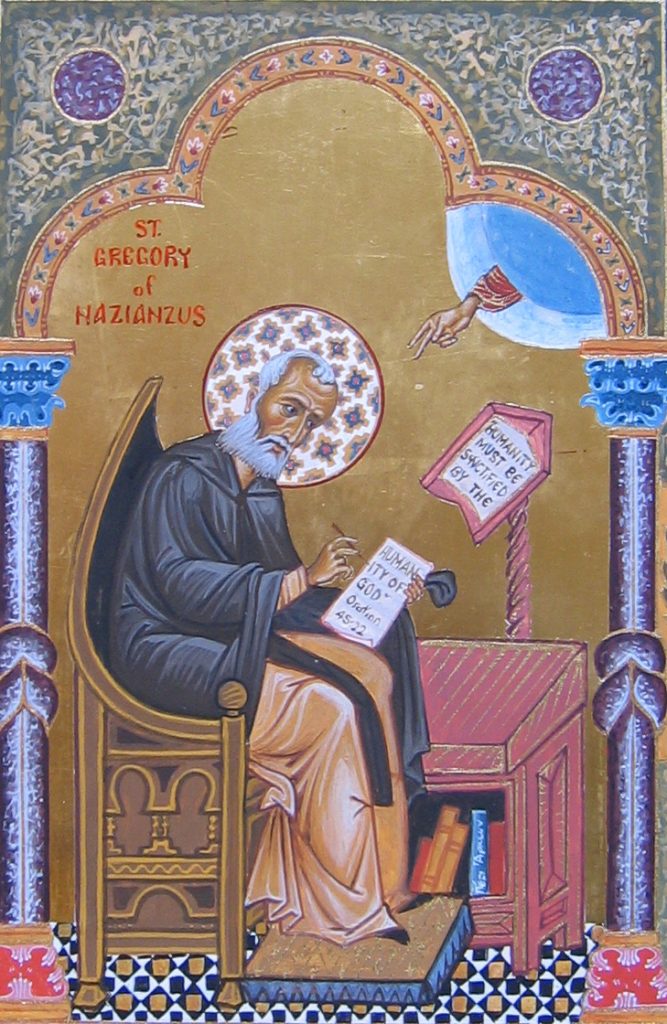
Life (312-390)
Saint Gregory was born in 312 near Caesarea of Cappadocia, of parents who are both honored as Saints, and the infant was immediately consecrated to God. After learning all that he could in his native land, he journeyed to Caesarea in Palestine to study at the famous school founded by Origen, then went to Alexandria in Egypt to rejoin his brother there. After some time he embarked for Athens, the metropolis of the sciences and the humanities. During the voyage, a storm of twenty days' duration nearly caused the loss of the ship and all passengers; their safe arrival in Athens was attributed to Saint Gregory's prayers, and all aboard adopted Christianity.
In Athens he met and became the close friend of Saint Basil, and these noble souls turned away together from the most attractive worldly prospects. For some years they lived in seclusion, self-discipline, and studious labor, knowing only two roads, Gregory wrote, one to church, the other to school. Only after thirty years of studies and good works in Athens did they leave that city and separate. They would meet again in the year 358, to live in solitude for a time in the Province of Pont.
Saint Gregory was raised to the priesthood almost by force, preaching his first sermon, after a ten-weeks' retreat, on the dangers and responsibilities of the priesthood. In 372, when he was sixty years old, he was consecrated a bishop by his dear friend Saint Basil, who had become Archbishop of Caesarea in Cappadocia. All their lives they would correspond; many of Saint Gregory's noble and eloquent letters to Saint Basil can still be read among the 212 pieces of his correspondence which are still conserved.
Saint Gregory's rare gifts and conciliatory disposition had become well known. In the year 379, when he was sixty-seven years old, he was chosen to be Patriarch of Constantinople. That city was distracted and laid waste in those times by Arian and other heretics. After a reception which was at best lukewarm, the new Patriarch labored there successfully, from his base in a small church named the Anastasia (Resurrection), where he gave instructions and saw the number of his listeners increase daily.
The Arians were so irritated at the decay of their heresy that they pursued the Saint with outrage, calumny and violence, and at length resolved to take his life. For this purpose they chose an intrepid youth who was willing to undertake the sacrilegious commission. But God did not allow him to carry it out; he was touched with remorse and cast himself at the Saint's feet, avowing his sinful intent. Saint Gregory forgave him at once, treated him with all kindness and received him among his friends, to the wonder and edification of the whole city and to the confusion of the heretics, whose crime had served only as a mirror to the virtue of the Saint.
Saint Jerome states that he himself learned at the feet of this master, who was his catechist in Holy Scripture. But Saint Gregory's humility, his austerities, the humble appearance of his aging and worn person, and above all his very success in Constantinople, did not cease to draw down upon him the hatred of every enemy of the Faith. He was persecuted by the magistrates, stoned by the rabble, and thwarted and deserted even by his brother bishops. During the second General Council, hoping to restore peace to his tormented city, the eloquent bishop, whom the Church calls Saint Gregory the Theologian, resigned his see and retired to his native town, where he died in the year 390.
Little Pictorial Lives of the Saints, a compilation based on Butler's Lives of the Saints and other sources by John Gilmary Shea (Benziger Brothers: New York, 1894); Les Petits Bollandistes: Vies des Saints, by Msgr. Paul Guérin (Bloud et Barral: Paris, 1882), Vol. 5
Scripture (Eph 4:1-7,11-13)
(Year A). What greater destiny can befall man’s humility than that he should be intermingled with God, and by this intermingling should be deified (2 Peter 1:4), and that we should be so visited by the Dayspring from on high (Luke 1:78) that even that Holy Thing that should be born should be called the Son of the Highest, and that there should be bestowed upon Him a Name which is above every name (Phil. 2:9)? —and what else can this be than God? — and that every knee should bow to Him That was made of no reputation for us, and That mingled the Form of God with the form of a servant, and that all the House of Israel should know that God hath made Him both Lord and Christ? (Acts 2:36). For all this was done by the action of the Begotten, and by the good pleasure of Him That begat Him. […] “He must reign” (1 Cor. 15:35) till such and such a time…and “be received by heaven until the time of restitution” (Acts 3:21) and “have the seat at the Right Hand until the overthrow of His enemies” (Psalm 109:1).
But after this? Must He cease to be King, or be removed from Heaven? Why, who shall make Him cease, or for what cause? […] You have heard that of His Kingdom there shall be no end (Luke 1:33). You must understand that “until” is not always exclusive of that which comes after, but asserts up to that time, without denying what comes after it. To take a single instance—how else would you understand “Lo, I am with you always, even unto the end of the world?” (Matt. 27:20). Does it mean that He will no longer be so afterwards.
[…] He is said to reign in one sense as the Almighty King, both of the willing and the unwilling; but in another as producing in us submission, and placing us under His Kingship as willingly acknowledging His Sovereignty. Of His Kingdom, considered in the former sense, there shall be no end. But in the second sense, what end will there be? His taking us as His servants, on our entrance into a state of salvation. For what need is there to work submission in us when we have already submitted? After which He arises to judge the earth, and to separate the saved from the lost. After that He is to stand as God in the midst of gods (Psalm 81:1), that is, of the saved, distinguishing and deciding of what honour and of what mansion each is worthy. (Oration 30)
Musical Selection (St. Gregory Nazianzen)
Collect
whose servant Gregory
proclaimed the mystery of your Word made flesh,
to build up your Church in wisdom and strength:
grant that we may rejoice in his presence among us,
and so be brought with him to know the power
of your unending love;
through Jesus Christ your Son our Lord,
who lives and reigns with you,
in the unity of the Holy Spirit,
God, now and for ever. Amen. (English Missal; adapted)