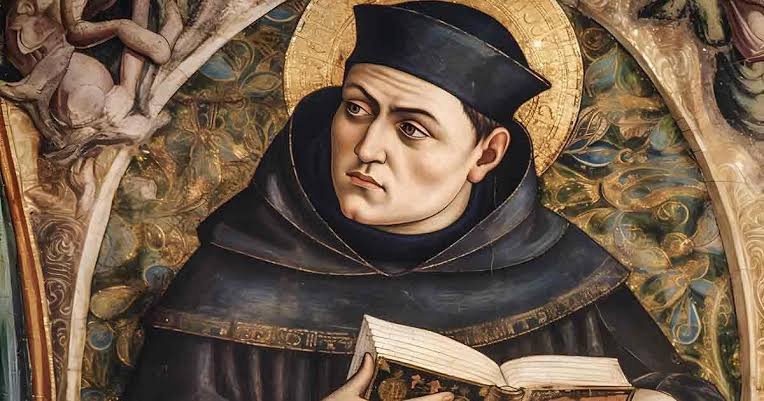
“Angelic Doctor” and “Doctor Communis” (“Everybody’s Teacher”) are only two of the terms of praise bestowed on St. Thomas Aquinas, the most important and influential Catholic philosopher and theologian of the Middle Ages. Thomas was the youngest child of a member of the landed gentry, a government official of Emperor Frederick II. Born at Roccasecca, between Rome and Naples, Thomas was sent as a small child to the great nearby Benedictine Abbey of Monte Cassino, whose abbot was a distant relative of his family. The parents enrolled him there not only as a student, but as an oblate. They hoped that he would become a monk, and eventually abbot of Monte Cassino. Thus, they thought shrewdly, his education and his life career would be taken care of. It didn’t work out that way. In 1239, Emperor Frederick II took over the monastery as a fortress, so the abbot had to send his oblates to study at the University of Naples. There Thomas met his first Dominican Fathers. Attracted by their ideals, he joined this “Order of Preachers” in 1244. Both he and his Dominican superiors knew that his parents would be mad, so they whisked him off to Rome. His mother was hopping mad! She at once sent Rinaldo, her older son, to chase after Thomas and bring him home. Rinaldo succeeded, and indeed, practically kidnapped Tom. Only after a year of virtual imprisonment in his family palazzo, did the young Dominican succeed in persuading his parent that he really did prefer to be a member of that order than a Benedictine. St. Dominic had founded the Order of Preachers to combat error by teaching truth. That meant that his friars had to be very well educated. Thomas was therefore sent to study at the order’s study houses, first at Paris and then at Cologne. St. Albert the Great, one of his professors, quickly saw that he had intellectual gifts of the first order. Thenceforth, Albert became Thomas’ sponsor.
Thomas was called by his talents to an academic rather than a missionary life. He taught at Paris, 1252-59; at Rome and elsewhere in Italy, 1259-60; and again at Paris, 1269-72. His last teaching assignment, 1272-74, was at Naples. Meanwhile, to provide his students with texts, he turned out 20 books. The most noted of his multi-volume works was his Summary of Theology (Summa Theologiae), one of the most influential books ever written. However, the average Catholic knows Aquinas best for the Eucharistic piety he expressed in the office and Mass he (apparently) composed for the feast of Corpus Christi. For this feast he wrote the lovely hymns “O Salutaris Hostia,” “Tantum Ergo,” “Lauda Sion,” and “Adoro Te Devote.” These are still used, in Latin or in translation, in Catholic Eucharistic devotions.
In 1274 the pope commanded Thomas, as a theological expert, to attend the ecumenical council about to open at Lyons, France. Thomas set out obediently, although he was ill. Unfortunately, he died before he got as far as Rome. Already revered as a mystic as well as an intellectual, Thomas of Aquinas was canonized a saint in 1323, and his body was enshrined at Toulouse, France. St. Pius V designated him a doctor of the Church, and Leo XIII declared him patron of all Catholic schools.
Despite his phenomenal brilliance, Thomas had always been a man of humble obedience, prone to think of others as superior to himself. When he first went to Paris to study, his companions nicknamed this quiet, plump young man the “dumb Sicilian ox.” But when in class he came forth with a sharp solution for a knotty problem, St. Albert warned his class: “We call Brother Thomas ‘the dumb ox,’ but I tell you that he will make his lowing heard to the uttermost parts of the earth.” Yet St. Thomas always submitted his writings to the judgement of the Church. A year before his death, he also had some sort of mystical experience that prompted him to stop further writing. “All that I have written appears to be as much straw after the things that have been revealed to me.” What he had written were world classics. But how indeed, can even the most creative of human beings match in skill the Creator of the world? That was what the Angelic Doctor meant. --Father Robert F. McNamara
Writings
(Year A). I answer that, the existence of God can be proved in five ways.
The first and more manifest way is the argument from motion. It is certain, and evident to our senses, that in the world some things are in motion. Now whatever is in motion is put in motion by another, for nothing can be in motion except it is in potentiality to that towards which it is in motion; whereas a thing moves inasmuch as it is in act. For motion is nothing else than the reduction of something from potentiality to actuality. But nothing can be reduced from potentiality to actuality, except by something in a state of actuality. Thus that which is actually hot, as fire, makes wood, which is potentially hot, to be actually hot, and thereby moves and changes it. Now it is not possible that the same thing should be at once in actuality and potentiality in the same respect, but only in different respects. For what is actually hot cannot simultaneously be potentially hot; but it is simultaneously potentially cold. It is therefore impossible that in the same respect and in the same way a thing should be both mover and moved, i.e. that it should move itself. Therefore, whatever is in motion must be put in motion by another. If that by which it is put in motion be itself put in motion, then this also must needs be put in motion by another, and that by another again. But this cannot go on to infinity, because then there would be no first mover, and, consequently, no other mover; seeing that subsequent movers move only inasmuch as they are put in motion by the first mover; as the staff moves only because it is put in motion by the hand. Therefore it is necessary to arrive at a first mover, put in motion by no other; and this everyone understands to be God.
The second way is from the nature of the efficient cause. In the world of sense we find there is an order of efficient causes. There is no case known (neither is it, indeed, possible) in which a thing is found to be the efficient cause of itself; for so it would be prior to itself, which is impossible. Now in efficient causes it is not possible to go on to infinity, because in all efficient causes following in order, the first is the cause of the intermediate cause, and the intermediate is the cause of the ultimate cause, whether the intermediate cause be several, or only one. Now to take away the cause is to take away the effect. Therefore, if there be no first cause among efficient causes, there will be no ultimate, nor any intermediate cause. But if in efficient causes it is possible to go on to infinity, there will be no first efficient cause, neither will there be an ultimate effect, nor any intermediate efficient causes; all of which is plainly false. Therefore it is necessary to admit a first efficient cause, to which everyone gives the name of God.
The third way is taken from possibility and necessity, and runs thus. We find in nature things that are possible to be and not to be, since they are found to be generated, and to corrupt, and consequently, they are possible to be and not to be. But it is impossible for these always to exist, for that which is possible not to be at some time is not. Therefore, if everything is possible not to be, then at one time there could have been nothing in existence. Now if this were true, even now there would be nothing in existence, because that which does not exist only begins to exist by something already existing. Therefore, if at one time nothing was in existence, it would have been impossible for anything to have begun to exist; and thus even now nothing would be in existence—which is absurd. Therefore, not all beings are merely possible, but there must exist something the existence of which is necessary. But every necessary thing either has its necessity caused by another, or not. Now it is impossible to go on to infinity in necessary things which have their necessity caused by another, as has been already proved in regard to efficient causes.
Therefore we cannot but postulate the existence of some being having of itself its own necessity, and not receiving it from another, but rather causing in others their necessity. This all men speak of as God.
The fourth way is taken from the gradation to be found in things. Among beings there are some more and some less good, true, noble and the like. But “more” and “less” are predicated of different things, according as they resemble in their different ways something which is the maximum, as a thing is said to be hotter according as it more nearly resembles that which is hottest; so that there is something which is truest, something best, something noblest and, consequently, something which is uttermost being; for those things that are greatest in truth are greatest in being, as it is written in Metaph. ii. Now the maximum in any genus is the cause of all in that genus; as fire, which is the maximum heat, is the cause of all hot things. Therefore there must also be something which is to all beings the cause of their being, goodness, and every other perfection; and this we call God.
The fifth way is taken from the governance of the world. We see that things which lack intelligence, such as natural bodies, act for an end, and this is evident from their acting always, or nearly always, in the same way, so as to obtain the best result. Hence it is plain that not fortuitously, but designedly, do they achieve their end. Now whatever lacks intelligence cannot move towards an end, unless it be directed by some being endowed with knowledge and intelligence; as the arrow is shot to its mark by the archer. Therefore some intelligent being exists by whom all natural things are directed to their end; and this being we call God. (Summa Theologiae)
Musical Selection
Collect
who enriched your Church
with the learning and holiness of your servant Thomas Aquinas:
give to all who seek you
a humble mind and a pure heart that they may know your Son
Jesus Christ as the way, the truth and the life;
who lives and reigns with you, in the unity of the Holy Spirit,
God, now and or ever. Amen. (English Missal)