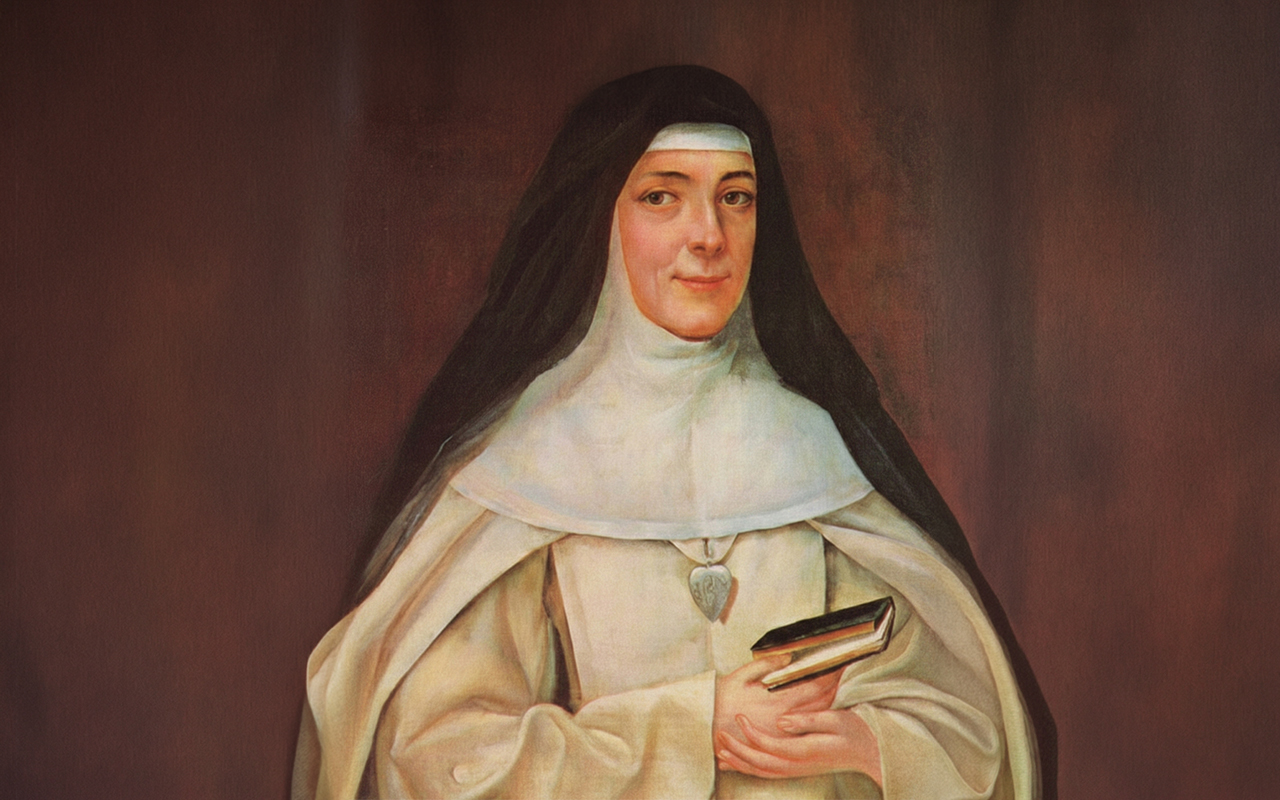
On May 2, 1940, Pope Pius XII raised to the ultimate honors of the altar a most remarkable woman, Mother Mary Euphrasia Pelletier. As the solemn Te Deum swelled in gladness through the Vatican Basilica, its joyous strains were echoed and reechoed in quiet chapels found in virtually all the large cities of the world. Almost a hundred thousand women and girls and over ten thousand white-robed Sisters, in three hundred and fifty homes of charity, rejoiced with their Mother, the new Saint. For Saint Mary Euphrasia Pelletier is the Foundress and first General Superior of the large Congregation of Our Lady of Charity of the Good Shepherd of Angers, and one of the great sociologists of the ages.
Rose Virginia Pelletier was born of pious parents on July 31, 1796 on the island of Noirmoutiers, during the terrible period of the French Revolution. So it was that her life began as a daughter of the suffering faith of her beloved France. Because of the suppression and expulsion of religious Orders, the education of the little girl had to be undertaken by her busy mother. At her knees Rose Virginia learned of God and His service.
In 1814 she entered the Order of Our Lady of Charity of the Refuge at Tours. After ten months as a postulant in this historic community at Tours, Rose Virginia received the habit and entered upon her life as a novice in September, 1815. For two years she remained in the novitiate, being formed to the religious life, studying and absorbing the history and work of her Order. Listening to the life of a Saint one day, she heard that he quickly attained sanctity by his perfect obedience. Obedience, then, reflected the young novice, must be the best means to become holy. If only I might take the vow of obedience at once! Sister Mary Euphrasia consulted her superiors, and was permitted to take a private vow of obedience. In 1817 she was professed, making then her first public vows.
In a few years her exceptional qualifications became so apparent to all that after having been Mistress of penitents, she was elected Superior of the house. A project which had been in her mind for a long time was then made a reality. She had found in many of the penitents a real attraction for the religious life, with no desire to return to the world after their conversion. Where could they go? It was very difficult, virtually impossible, to find a congregation suitable for them or willing to accept them. So Mother Euphrasia inaugurated a community called the Magdalene Sisters. She adapted the rule of Saint Teresa, drew up a set of Constitutions, and erected the first community of Magdalenes in the house at Tours. One of the greatest consolations Mother Euphrasia enjoyed in life was the sanctity attained by so many of these religious, bound by vows to a life of prayer and penance.
During the thirty years she was Superior General, Mother Euphrasia sent out her Sisters from their mother house at Angers to found one hundred and ten houses in every land beneath the sun — Sisters inflamed with her own zeal, trained at her hands. She died at Angers in her seventy-second year, having welcomed death with the faith and serenity which marked her entire life.
Lives of the Saints for Every Day of the Year (Reprint of the work of John Gilmary Shea, with Appendix including recently canonized Saints) (Benziger Brothers: New York, 1955. Third Edition: Tan Books and Publishers: Rockford, Ill., 1995).
Scripture (Ephesians 3:14-20)
I kneel before the Father, from whom every family[a] in heaven and on earth derives its name. I pray that out of his glorious riches he may strengthen you with power through his Spirit in your inner being, so that Christ may dwell in your hearts through faith. And I pray that you, being rooted and established in love, may have power, together with all the Lord’s holy people, to grasp how wide and long and high and deep is the love of Christ, and to know this love that surpasses knowledge—that you may be filled to the measure of all the fullness of God. Now to him who is able to do immeasurably more than all we ask or imagine, according to his power that is at work within us, to him be glory in the church and in Christ Jesus throughout all generations, for ever and ever! Amen.
Writings
(Year A). Now what did Jesus Christ say of Himself? The Son of Man has come to save that which was lost. How did He act? He pursued sinners with fatherly solicitude, He endured every kind of fatigue to bring them back to Him. Remember the ineffable goodness with which He received Magdalen, the great sinner of Jerusalem, who threw herself at His feet, watering them with her tears. Let her alone, He said, Why do you molest her?
See Him on another occasion seated by the well of Jacob. He is weary, He rests awhile, that is, He awaits a soul. He desires to convert the Samaritan woman. Again, when at Jerusalem they bring Him a guilty woman who deserved to be stoned, He said, He that is without sin among you, let him first cast a stone at her and the crowd dispersed.
Consider Him after His Resurrection, always acting the part of the Good Shepherd, pursuing the two sheep who, sad and discouraged, had abandoned Jerusalem, the city of peace, to go to Emmaus, the castle of confusion; He joined the two disciples, who were filled with consternation and whose faith was wavering. He walked with them, accommodating His pace to theirs, taking part in their discourse, condescending to their weakness in order to instruct them and enlighten the darkness of their minds.
Our Lord appears to have always had a special predilection for the title of Shepherd. The rulers of His people had been named shepherds, and He chose as His first adorers at His birth not only the poor, but poor shepherds. And the reason for this was, because their conduct towards their flocks represents better than any other figure, God's tenderness and solicitude for His dear sheep. For how does a shepherd act? He forgets himself, he frequently endures hunger and thirst, he is overwhelmed with fatigue and labour. But this matters little to him, provided his sheep do not suffer, and he recovers those that were lost. What pains he takes to lead his flock to good pastures. In summer he seeks cool places with refreshing streams, in winter he guides them to districts where the cold is less severe and the grass greener and more abundant. If he see any poisonous plant near his little lambs he uproots it, and to protect his sheep from wolves he watches by night as well as by day, he never allows himself entire rest.
When vegetation becomes scarce, the shepherd folds his tent and taking with him, if necessary, other shepherds, he goes in search of richer pastures, where he remains, leaving relations and friends and at the cost of great inconvenience to himself. As long as his sheep are fed he counts no cost. Shall we not do as much for souls as these shepherds do for their flocks ; souls bought by the Precious Blood of Our Lord should be inexpressibly dear to us. (Conferences)