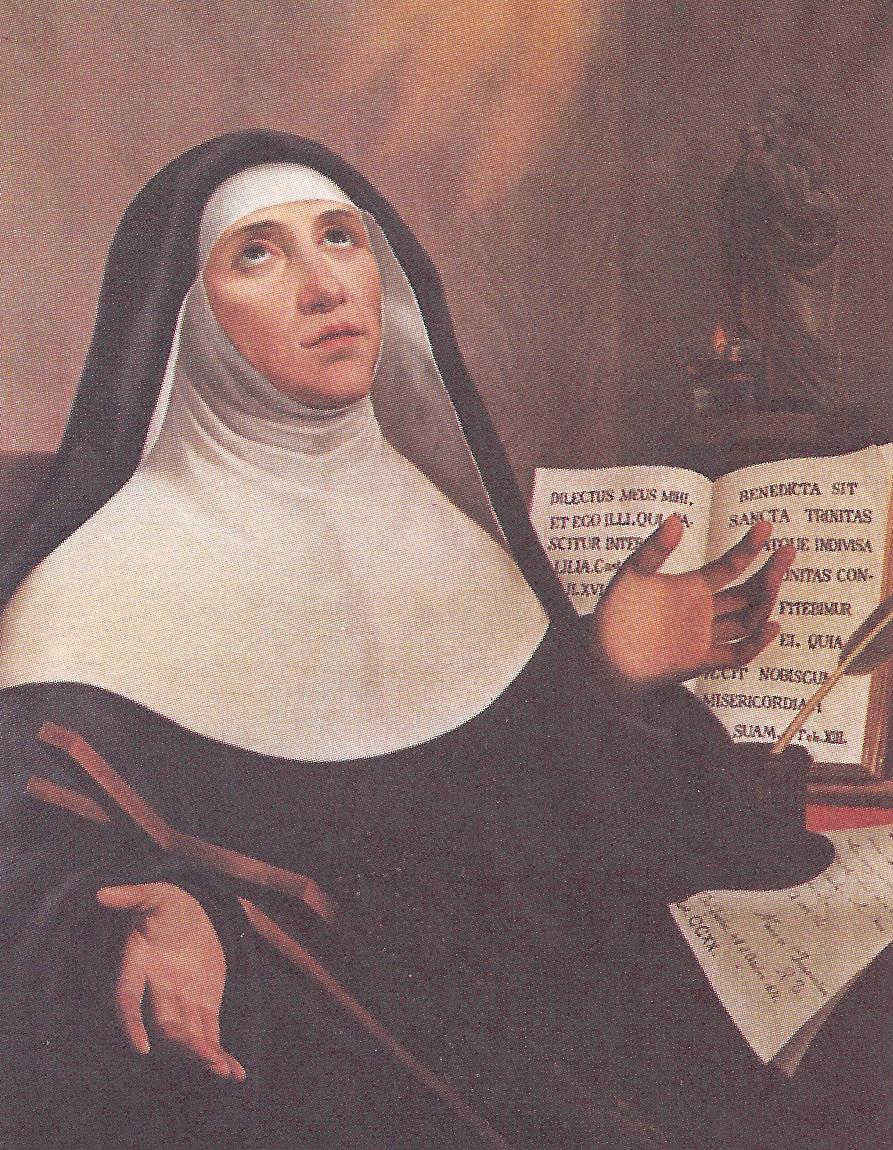
Marie of the Incarnation is the founder of the Ursuline Sisters in Canada, and is a powerful example of trust in God. Marie was born in 1599, to a wealthy merchant family in France. She wanted to enter the religious life from a young age, but her family arranged a marriage for her with a wealthy silk merchant, Claude Martin. They had a son together, and Marie said they had a happy marriage, while it lasted. Claude died just a few months after their son was born, leaving Marie already a widow at nineteen. Marie decided to pursue religious life now that she had the freedom of a widow. She took vows of poverty, chastity, and obedience and began to live as a sister. In 1627. Marie read Teresa of Avila's autobiography and was profoundly inspired by the great Spanish mystic. Marie longed to travel to the New World and spread the Christian faith there.
In 1631, Marie entered the Ursuline convent in Tours, leaving her young son in the care of family friends. The accounts of her young son crying outside the gates of the convent and attempting to storm the gates with a small band of school fellows are heart-wrenching. Marie and her son endured great sorrow at their separation, but they continued to correspond, even when Marie's son became a Benedictine monk. In 1633, Marie had a vision of a band of sisters and herself walking through a distant landscape with the Virgin Mary, and she interpreted this as a sign that she should travel to New France as a missionary. Marie began a correspondence with Jesuit priests in Quebec. They wanted female religious to minister to the native women in Quebec.
Marie's family and religious community objected to her going, but Marie persisted. She found another young noblewoman with a missionary spirit, Madeleine de la Peltrie, and together, they worked tirelessly toward their goal, Madeleine even entered into a legal marriage with a wealthy nobleman to fund the venture. In 1639, Marie and Madeleine set sail for Quebec, accompanied by five other women and two Jesuit priests. Marie founded the first Ursuline Monastery in Quebec, now a National Historic Site of Canada, in 1642. Marie spent the remainder of her life working to educate all the women—French and native Canadian—in Quebec. Marie was a prolific writer, penning over 20,000 letters in her lifetime. She wrote powerfully on trust in God's providence, which had worked such powerful good in her own life: "If we could, with a single interior glance, see all the goodness and mercy that exists in God's designs for each one of us, even in what we call disgraces, pains, and afflictions, our happiness would consist in throwing ourselves into the arms of the Divine Will."
Marie died on April 30, 1672 and was canonized by Pope Francis on April 2, 2014. A statue of Marie stands in front of Quebec parliament.
Source: https://faith.nd.edu/s/1210/faith/interior.aspx?sid=1210&gid=609&pgid=44982&cid=86646&ecid=86646&crid=0&calpgid=61&calcid=53508
The word of the Lord came to me, saying, “Before I formed you in the womb I knew you, before you were born I set you apart; I appointed you as a prophet to the nations.” “Alas, Sovereign Lord,” I said, “I do not know how to speak; I am too young.” But the Lord said to me, “Do not say, ‘I am too young.’ You must go to everyone I send you to and say whatever I command you. Do not be afraid of them, for I am with you and will rescue you,” declares the Lord. Then the Lord reached out his hand and touched my mouth and said to me, “I have put my words in your mouth. See, today I appoint you over nations and kingdoms to uproot and tear down, to destroy and overthrow, to build and to plant.”
Writings
Musical Selection (Hildegard of Bingen)
Favus distillans Ursula virgo fuit, que Agnum Dei amplecti desideravit.
Mel et lac sub lingua eius, quia pomiferum hortum et flores florum in turba virginum ad se collegit.
Unde in nobilissima aurora gaude, filia Sion.
Quia pomiferum hortum …
Gloria Patri et Filio et Spiritui Sancto.
Quia pomiferum hortum …
A honeycomb dripping honey was Virgin Ursula who longed to embrace the Lamb of God.
Honey and milk were beneath her tongue. For she had gathered around her, in a host of virgins, a garden of apples and the flowers of all flowers.
Therefore, O daughter of Zion, rejoice in that noblest dawn.
For she had gathered around her …
Glory be to the Father and to the Son and to the Holy Spirit.
For she had gathered around her …
Collect
God of mercy, who called and strengthened your servant Marie in visions and the mystery of prayer to nurture your people in New France,
grant us so to cherish her example that we may not rest until we have done your will,
and never cease from prayer until this age passes over to your kingdom and we behold your glory;
through Jesus Christ our Lord, who lives and reigns with you and the Holy Spirit,
God, now and for ever. Amen. (Anglican Church of Canada)