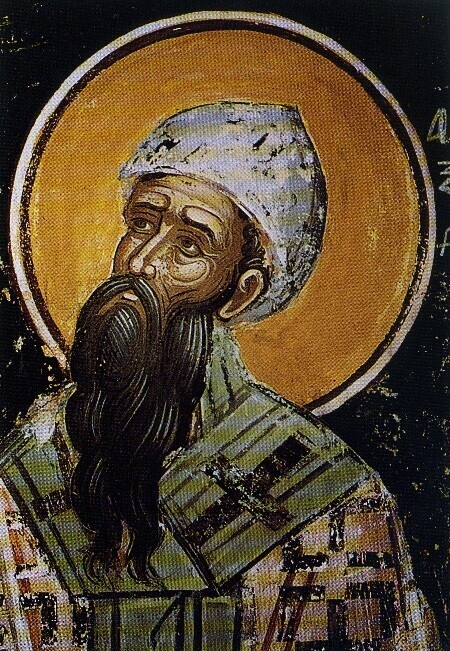
As the early church developed in organization, certain dioceses assumed a predominant role in sections of Christianity. These “superarchdioceses”, acknowledged by 451, came to be called patriarchatea. The five ancient patriarchates were: Rome in the West; and in the East, Antioch (Syria), Alexandria (Egypt), Constantinople (the Balkans, Asia Minor, and Russia), and Jerusalem (Palestine). One of the great archbishops (or, as they are still called, “popes”) of Alexandria, was St. Cyril. Almost nothing is known about this churchman’s early life; but after his election as patriarch in 412, he emerged as the leading defender of the dogma that Christ had two natures, the divine and human, but only one person: the “Word made flesh.”
Cyril was a man always ready for battle. In fact, for a while in his patriarchal career, he seemed to share some of the impetuous, domineering disposition of Patriarch Theophilus, his uncle and predecessor. As time passed he would learn that compromise, too, can be virtuous. The truth itself was compromised, Cyril saw in 428, when Nestorius, the newly installed patriarch of Constantinople, publicly questioned the appropriateness of applying the popular name, “Mother of God” (“Theotokos”, in Greek), to the Blessed Virgin Mary. Nestorius said he preferred the term, “Mother of Christ.” (This is a preference some Christians can tend to even today if they do not understand the real meaning of and implications of “Mother of God.”)
But Cyril saw at once that Nestorius’ theology was superficial. He therefore replied with a series of writings pointing out the true doctrine. When the scriptures say that the Word was made flesh, he said, that implies that the second person of the Blessed Trinity, to redeem humankind, united Himself with a human body and soul in the womb of Mary. God gave Him His divine nature; Mary, His human nature; but He who was born of her on Christmas day was one person, not two (one a human person, the other, divine). Hence the title of “Mother of God” is fitting, even necessary; it does not mean, of course, that she was the mother of the Blessed Trinity (which would be impossible), but that He who was born of her in his human nature, was truly a member of the Trinity. Unfortunately, the controversy that followed between the defenders of Nestorius and the forthright defenders of correct doctrine became involved in church and state politics. It was settled, however, in the third ecumenical council, held at Ephesus in Asia Minor in 431 and approved by Pope Celestine I. When the leaders of the patriarchate of Antioch continued to have questions, Cyril generously qualified some of the incidental phrases he had used as leader of the Council.
In 433 the bishops of the patriarchate of Constantinople agreed with Cyril on a “Formula of Union.” The Formula professed that Christ is one in substance with the Father in divine nature, one in substance with us in the human nature: two natures united in “one Christ, one Son, one Lord.” “According to this unconfused unit,” said the statement, “we confess the Blessed Virgin to be the Mother of God, because God the Word was enfleshed and made human and through that conception united in Himself a temple received from her.” After the Council of Ephesus, a group of Syrians loyal to Nestorius broke off into schism from the rest of Eastern Christianity. They still remain in at least verbal heresy today, now much reduced in number and dwelling mostly in Iraq. Orthodox Christians, however, stuck valiantly by the definition of Ephesus and the theology of Cyril of Alexandria. In their liturgy the Greek Orthodox insistently refer to Mary as the Theotokos (“She who bore God”). You will also notice that the abbreviation for “Mother of God” is still painted boldly on all Greek Orthodox icons of the Virgin and Child.
Cyril’s own mellowing was noticeable as time passed. He seems gradually to have realized that one can defend the truth without being harsh or ungracious. Truth and charity are both Christian virtues. Was it the Mother of God herself who led her strong and brilliant champion to this gentler understanding? --Father Robert F. McNamara
(Year A). Receive Christ, receive power to see, receive your light, that you may plainly recognise both God and man… Let us open ourselves to the light then and so to God. Let us open ourselves to the light and become disciples of the Lord… Let us, then, shake off forgetfulness of truth, shake off the mist of ignorance and darkness that dims our eyes and contemplate the true God… For upon us, buried in darkness, imprisoned in the shadow of death, a heavenly light has shone, a light of a clarity, surpassing the sun’s and of a sweetness, exceeding any this earthly life can offer. That light is eternal life and those who receive it live. Night, on the other hand, is afraid of the light and melting away in terror gives place to the day of the Lord. Unfailing light has penetrated everywhere and sunset has turned into dawn.
This is the meaning of the new creation (Gal 6,15; Rv 21,1) for the Sun of Righteousness (Mal 3,20), pursuing His course through the universe, visits all alike, in imitation of His Father, “who makes his sun rise upon all” (Mt 5,45) and bedews everyone with His truth… He, it is, Who has changed sunset into dawn and death into life by His Crucifixion, He, it is, Who has snatched the human race from perdition and exalted it to the skies. Transplanting what was corruptible, to make it incorruptible, He has transformed earth into Heaven…
He deifies us by His heavenly teaching, by “instilling His laws into our minds and writing them on our hearts. That all, be they of high estate or low, shall know God. And I will be merciful to them, God says and I will remember their sin no more” (Jr 31,33f.). Let us accept the laws of life, then; let us obey God’s promptings, let us learn to know Him.
Musical Selection
All-powerful God,
whose servant Cyril of Alexandria was a tower of strength
and interpreter of the Word of God made flesh:
may we be made strong in our belief
in the mystery of the Incarnation of your Son
and bear witness to the living presence of Christ in the life of humanity,
calling us to be united in love with the power that proceeds from you.
We ask is through Jesus Christ your Son our Lord,
who lives and reigns with you,
in the unity of the Holy Spirit,
God, now and for ever. Amen. (English Missal)