June 22
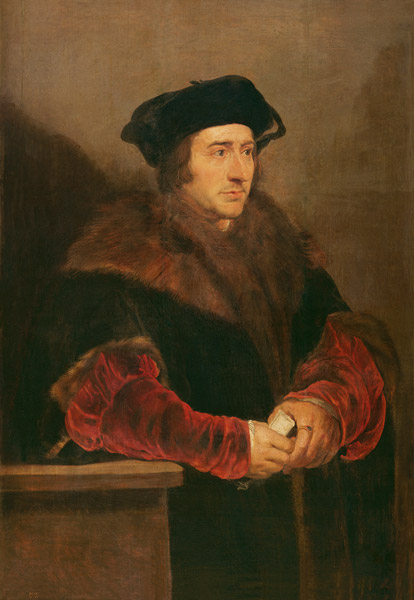
St. Thomas More
Life (1478-1535)
Saint Thomas More, born in 1480 (sic) , was the precocious and amiable son of an English magistrate. Very well educated and brilliant, when he was placed at the age of fifteen in the household of the Archbishop of Canterbury, he soon attracted the Archbishop's attention, and was sent by him to study at Oxford. He debated interiorly for a long time as to whether he should become a priest, but decided otherwise with the approbation of his director.
The practice of civil law was not enough to absorb all his time or energy. The author of the famous satire Utopia, wrote poetry while still young, in both English and Latin. He had completely mastered Latin, as he had also the Greek tongue, by an instinct of genius, as one of his preceptors said. Saint Thomas in 1505 married a virtuous and beloved wife who, after bearing four children, three daughters and a son, died six years later. His second wife, older than himself, took excellent care of the household and of the children; but it was said she could not grasp the sense of her husband's subtle humor, which was a characteristic trait of his cheerful disposition.
Saint Thomas came under suspicion by King Henry VII when he strove in the Parliament to reduce the burden of excessive taxes which the people bore, though he never spoke against the king. But his capacities were appreciated, and when Henry VII died, his 18-year-old son, who was to become Henry VIII in 1509, showed him great favor during the first twenty years of his reign. Saint Thomas was knighted in 1521, and was made Speaker of the House of Commons in 1523, High Steward of Cambridge University in 1525, and Chancellor of the Duchy of Lancaster in the same year. Nonetheless, the king's protege foresaw what could easily happen to anyone who did not agree with his sovereign; he said to his son-in-law in 1525, If my head could win him a castle in France, it would not fail to go. In effect, when in 1530 the order was issued to the clergy to acknowledge Henry as Supreme Head of the Church, insofar as the law of God would permit, Saint Thomas immediately resigned as Lord Chancellor.
His resignation was not accepted. Two years later, in May 1532, after he had lost the royal favor on several counts — his reticence concerning the king's divorce, his non-attendance at the king's illegal marriage, and his formal non-recognition of any future children of Henry and Anne Bolyn as rightful heirs to the throne — he was permitted to retire. The king, the apostate Archbishop Cranmer, and Anne Bolyn were all excommunicated in that year.
Saint Thomas lived in retirement from the age of 52, his revenues considerably diminished, and his health somewhat uncertain. When the king decided to require of the laity, as well as of the clergy, the oath supporting his alleged supremacy, he wanted to obtain first of all the signature of Thomas More, to make of him an example. The Saint declined to sign the oath and thereby brought upon himself a sentence of incarceration in the Tower of London, and a short time afterwards, of death. He was beheaded in 1535, after having said, with his ordinary humor, that he did not consider the severing of his head from his body as a circumstance that should produce any change in the disposition of his mind.
Saint Thomas while in retirement continued to write a number of religious treatises of great value, including an unfinished one on the Passion. He was beatified by Pope Leo XIII and canonized by Pius XI in 1935, with Cardinal John Fisher, who was martyred like himself in the same year and for the same reasons. That year was the 400th anniversary of their death.
The Catholic Encyclopedia, edited by C. G. Herbermann with numerous collaborators (Appleton Company: New York, 1908)
Scripture (1 Peter 4:12-19)
Beloved, do not be surprised at the fiery ordeal which comes upon you to prove you, as though something strange were happening to you. But rejoice in so far as you share Christ's sufferings, that you may also rejoice and be glad when His glory is revealed. If you are reproached for the name of Christ, you are blessed, because the spirit of glory and of God rests upon you. But let none of you suffer as a murderer, or a thief, or a wrongdoer, or a mischief-maker; yet if one suffers as a Christian, let him not be ashamed, but under that name let him glorify God. For the time has come for judgment to begin with the household of God; and if it begins with us, what will be the end of those who do not obey the gospel of God? And "If the righteous man is scarcely saved, where will the impious and sinner appear?" Therefore let those who suffer according to God's will do right and entrust their souls to a faithful Creator.
Writings
(Year A). They have magnificent temples, nobly built and spacious, which is the more necessary as they have so few of them. These are somewhat dark within, which proceeds from no error in the building, but is done with design. For their priests are of opinion, that too much light dissipates the thoughts, while a more moderate degree concentrates the mind and raises devotion.
Though there be many different forms of religion among them, all agree in the main point of worshipping the divine essence. Therefore there is nothing to be seen or heard in their temples, in which the several persuasions among them may not agree. For every sect performs the rites peculiar to it in their private houses, and there is nothing in the public worship which contradicts their peculiarities. There are no images of God in their temples, therefore every one may represent him to his thoughts in his own way; nor do they use for him any other name than Mithras, their term in common for the divine essence, whatever otherwise they think of it; nor have they any forms of prayer, but such as every one of them may use without prejudice to his private opinion.
They meet in their temples on the eve of the festival concluding a month or year, and before breaking their fast, thank God for their prosperity during that period. The next day they meet there again early, to pray for the same prosperity during the period on which they then enter. Before they go to the temple, wives and children kneel to their husbands and parents, confess every thing in which they have erred or failed in their duty, and beg pardon for it. Thus all petty dissatisfactions in families are removed, and they can offer their devotions with serenity and pureness of mind. For they hold it a great impiety to enter upon them with disturbed thoughts, or with a consciousness of bearing hatred or anger to any one; and that they should become liable to severe punishment, if they presumed to offer sacrifices without cleansing their hearts and reconciling every difference.
In the temples the sexes are separated, the men going to the right and the women to the left. Males as well as females place themselves before the master or mistress of the family to which they belong, that those who have the government of them at home may see their deportment in public. They mingle the young with the old, lest, being apart, they might trifle away that time in which they ought to form in themselves that religious awe of the Supreme Being, which is the strongest and nearly the sole incitement to virtue.
They offer no living creature in sacrifice; not thinking it suitable to the Divine Being, by whose bounty these creatures have their lives, to take pleasure in their deaths, or the offering their blood. They burn incense and other sweet odours, and burn a number of waxen lights during their worship. And this, not from any imagination that such oblations can add any thing to the Divine Nature, which even prayers cannot, but it is a harmless and pure mode of worship; and these sweet savours and lights, with some other ceremonies, by a secret and unaccountable virtue, elevate man's soul, and inspire him with energy and cheerfulness during divine worship.
The people appear in the temples in white garments, but the vestments of the priests are party-coloured, and the work as well as the colours are highly curious. They are made of no rich materials, for neither are they embroidered, nor beset with precious stones; but they are composed of the plumage of birds, with such art, that the real value of them exceedeth the costliest materials. They say, that in the disposition of these plumes, some dark mysteries are represented, which descend in a secret tradition among their priests; being a kind of hieroglyphic, reminding them of the blessings derived from God, and of their duty to him and their neighbour.
When the priest appears in these garments, they all fall prostrate to the ground with such reverence and silence, that a spectator cannot but be struck, as if it was an effect of some supernatural appearance. After being for some time in this posture, they all stand up, on a sign given by the priest, and sing hymns to the honour of God, musical instruments playing the while. These are of a form totally differing from those used among us; many are much sweeter, others not to be compared to ours. Yet in one thing they very much excel us. All their music, vocal as well as instrumental, imitates and expresses the passions. It is so well adapted to every occasion, that, be the subject deprecation, gladness, soothing, trouble, mourning, or anger, the music gives such a lively impression of what is represented, as wonderfully to affect and kindle the passions, and work the sentiments deeply into the hearts of the hearers.
This done, priests and people offer very solemn prayers to God in a set form of words; which are so composed, that whatever is pronounced by the whole assembly may be applied by any individual to himself. In these they acknowledge God to be the author and governor of the world, and the fountain of all the good they receive; they therefore offer him their thanksgiving. In particular, they bless him that they are born under the happiest government in the world, and are of a religious persuasion which they hope is the truest of all others. Be they mistaken, and there is a better government, or a religion more acceptable to him, they implore his goodness to let them know it; vowing that they resolve to follow him whithersoever he leadeth. But if their government be the best and their religion the truest, they pray that he may strengthen them therein, and bring all the world to the same rules of life and the same opinions of himself; unless, in his unsearchable wisdom, he be pleased with a variety of religions.
Then they pray that God may give them an easy passage at last to himself. They presume not to limit how early or late it should be; but if a wish may be formed, without derogating from his supreme authority, they desire to be quickly delivered and taken to him, though by the most terrible death, rather than to be long detained from seeing him by the most prosperous life. This prayer ended, they all fall down again to the ground, and after a short pause rise, go home to dinner, and spend the rest of the day in diversion or military exercise. (St. Thomas More; Utopia)