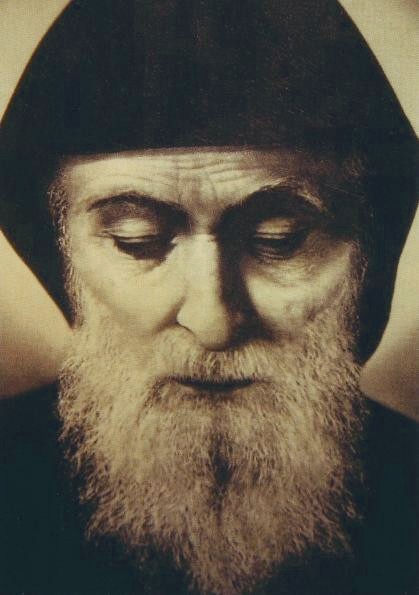
He was the fifth child of a devout farmer in the mountains of Lebanon, north of Beirut. At baptism into the Catholic Maronite (or West Syrian) Rite, he was given the name Joseph (Youssef).
Youssef had two uncles who were Maronite monks. Though initially he tended sheep and worked as a farmhand, he was inspired by his uncles’ vocations to want to be a monk. One day in 1851 a young woman gave signs of desiring to marry him. The next morning, and without even telling his widowed mother, Youssef walked the ten-hour journey to the monastery of Our Lady of Mayfouq, and asked to be admitted into the Lebanese Maronite religious order.
The monks of Mayfouq welcomed him and gave him the religious name Sharbel, after a martyr who had died at Antioch in the year 107. Sharbel made the second year of his novitiate in the monastery of St. Maron at Annaya, some 15 kilometers south of Mayfouq. Thus, he was 25 in 1853 when he took his solemn vows. He then made his priestly studies at the monastery at St. Cyprian at Kfifane. Always near the head of his class, he was ordained a priest on July 23, 1858. He was then assigned to the monastery of Annaya. There he spent the next 16 years in community life with his fellow monks.
Monastic rules are guides to holiness when diligently observed. Father Sharbel tried to live up to his rule perfectly. His obedience became legendary. For humility, he sought out the most menial tasks. His penances and prayer life were just as rigorous. He had special devotion to the Blessed Sacrament and to Mary.
In Eastern monasticism, life as a hermit is considered superior to life in a community. Sharbel asked his abbot for permission to withdraw to the monastery’s nearby hermitage. The abbot refused. Then in 1875 an odd thing happened. The lamp in Sharbel’s cell kept burning even though the reservoir contained not oil but water. That same year the abbot granted his request. For the last 23 years of his life he lived in the hermitage of SS. Peter and Paul, ever increasing in union with God. He died at age 70. His body was then buried unembalmed and coffinless.
It was only after his death that his remains became an attraction. For 45 nights a bright light shone from his tomb. The superiors decided to exhume his body. Although it had spent four months in the earth and was found floating in mud, it was not corrupted but as natural as on the day of burial. It was cleaned, reclothed, put into a coffin, and set in a corner of the chapel.
Now there began to come forth from his body a liquid that seemed a mixture of perspiration and blood. This liquid, collected on cloths, started to work cures. The body was examined again in 1927 and 1950, and found still lifelike and flexible. By now it was an object of pilgrimage, and from 1950 on there were 2,000 reported miracles. Two of these were selected by Pope Paul VI in 1965 as a basis for Sharbel’s beatification.
After his beatification, the body finally decayed, leaving only the skeleton. Paul VI canonized Blessed Sharbel in 1977. His feast day is July 24.
Still another marvel is narrated of this miracle-working saint. Apparently nobody had ever painted his portrait or taken his picture during his life. But, on May 8, 1950, a photographer took a picture of a group of five pilgrims who had come to his shrine. When the picture was developed, there in the group stood a sixth person, a white-bearded monk, hooded and with downcast eyes. Everybody was surprised for there had been no monk on hand when the photographer took the picture. But those who had known the saint exclaimed, “That’s Father Sharbel!” All the pictures of the Saint since then have been based on this seemingly miraculous posthumous portrait. - Father Robert F. McNamara
Writings
(Year A). Why do human beings have to descend when the path of the Lord ascends? People are loaded down with many burdens that bend their back so much that their foreheads touch the ground, preventing them from standing up and raising their heads to see the face of God. They try to liberate themselves from them; everyone gets rid of them only to load themselves down in other ways, and finally they find themselves weighed down with even heavier burdens. Jesus Christ is the only one capable of liberating all human beings from their burdens for a slave cannot set another slave free.
A human being is born tied up with cords and bound with chains to which he becomes accustomed throughout his life. Many are those who die without being freed from them. People get used to their chains. They cherish them as though they were an integral part of themselves so that it becomes difficult for them to set themselves free of them. Their gleaming chains dazzle their eyes so that they no longer see the Lord’s face. Their deafening racket prevents them from hearing His voice. They are so proud of the brilliance of their fetters and of their clanking that they cherish them. The chains may well gleam, but they are nonetheless alienating. Instead of polishing them, break them. Instead of making music with them, unfasten them so as to free yourself from them.
The Lord suffers to see the people for whom He was made flesh, died, and rose again in order to give them life and eternal happiness, chained up and seeking their happiness where they will not find it. Your happiness in this world is not of this world, for if you were of this world you would have remained in it. Your happiness does not lie in material goods, for they will not procure it for you. Why do men run about seeking gold? A human being is much more valuable than gold! He is the son of God and his value is in himself. Gold does not liberate a human being from his attachments; it only makes them more splendid. Your happiness does not come from men who cannot offer it to you, because they do not possess it, and because no one can give what does not belong to him. Jesus alone is able to give you true happiness.
Only human beings live between asphalt and concrete. Their minds become blackened like asphalt, and their hearts harden like concrete. Their intellects produce only dark ideas, and their souls become empty of any love. Human beings are like an inert, soulless matter, and some of them resemble stones. Proud as they are, they stubbornly seek happiness in sin, which causes them nothing but worry, sadness, misery, and emptiness. They have become proud with regard to themselves, towards one another, and towards God. Do you not realize that the Lord is able to reduce them to dust in an instant? But the love of our God is great. He loves human beings with an unending love because they are his sons and daughters. He wanted them to be the light of the world, in his image. (Attributed)