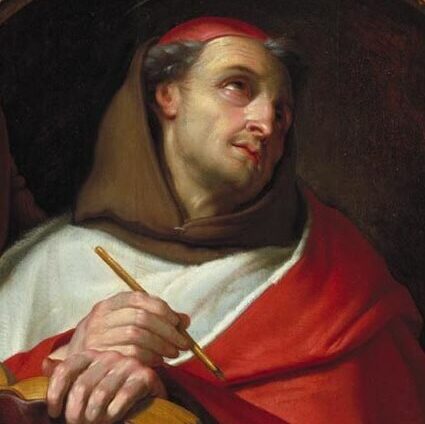
The scholarly heft of Saint Bonaventure legitimized the eccentric Saint Francis of Assisi. Saint Bonaventure was to the Franciscans what Thomas Aquinas was to the Dominicans. These contemporaries form twin summits of scholastic thought, first rate intellectuals whose eminent writings lent their young, revolutionary religious orders credibility. Aquinas and Bonaventure received their doctorates on the very same day and are shown as equals in Raphael’s Disputation of the Holy Sacrament. Both Thomas and Bonaventure were also pious, poor, humble, and holy, giving their theological work even greater weight. Saint Bonaventure was part of that huge influx of second generation Franciscans who never knew their founder. He joined the order in 1243, received his doctorate in theology from the University of Paris, and became master of the Franciscan school at Paris in 1253. In 1257 he was elected minister general of the entire Franciscan order. He was just thirty-six years old.
The pressing responsibilities of religious leadership constrained Bonaventure from total dedication to the life of the mind. He had limited time to read, write, and do research once he was elected head of his order, making the first half of his life his most prolific period of scholarship. But that scholarship was so comprehensive as to be a complete system of thought. He wrote on everything—fundamental theology, the nature of dogma, Scripture and history, the gifts of the Holy Spirit, angels, creation, the virtues—and all of it was suffused with a mature spirituality focused on the individual soul progressing toward God. With this intensely spiritual focus, Bonaventure is said to be more Augustinian in his theology than Aquinas, who is more Aristotelian. The former’s goal was to love, the latter’s to speculate and to know. Bonaventure’s writings on dogma were influential at the Council of Trent and continue to be read.
Bonaventure led his order in a period of sharp tension among Franciscans over the legacy of Saint Francis. Should the order own property directly or just use property owned by others? Should the brothers be educated and teach, or remain simple and only preach? Should the brothers live in the growing cities of the medieval world or stay in the country, like Francis himself? Should the brothers in northern Europe be allowed to wear shoes, or must they go barefoot like Saint Francis commanded? These, and many other questions cleaved the body Franciscan. Many of the diverse interpretations of Francis’ legacy were unresolvable, and in the early sixteenth century the order morphed into three entities, each embodying a particular spiritual emphasis.
Saint Bonaventure navigated these sharp tensions with great skill. His erudition, great patience, and love of others, sewed the diverse patches of Franciscanism into a whole cloth. He had to chastise, punish, and correct too. But he was outstanding in listening to every side before making his final decisions. That Franciscanism survived is thanks to today’s saint, who has been called the Franciscans’ “Second Founder.”
In 1273 Bonaventure was made a Cardinal-Bishop by the Pope. Knowing of this Franciscan’s humility and his refusal to accept a previous episcopal appointment, the Pope inserted into his bull an order that Bonaventure could not decline the honor. Bonaventure was in the kitchen washing dishes when the papal envoys arrived with the news. Saint Bonaventure died with his boots on, while participating in and aiding the Pope at the Council of Lyon in 1274. Aquinas had died on the way to the same Council. Bonaventure was buried in Lyon, canonized in 1482, and declared a doctor of the Church in 1557. Unfortunately, his tomb was desecrated by French Protestants and revolutionaries in later centuries, and his body has been permanently lost. His first professor at Paris, Alexander of Hales, gave him a supreme compliment. He said that Bonaventure “seemed to have escaped the curse of Adam’s sin.”
https://mycatholic.life/saints/saints-of-the-liturgical-year/july-15-saint-bonaventure-bishop-and-doctor/
Scripture. Ephesians 3:14-19
Musical Selection (Lyrics in video)
All-powerful Father,
whose servant Bonaventure
served you in the Franciscan life
and saw that the natural world is the footprint of God:
grant that, with his example to aid us,
we may grow in the praise of your divinity
and come to join with all the seraphim
in their song of praise when our time on earth is over.
Grant this through Jesus Christ your Son our Lord,
who lives and reigns with you,
in the unity of the Holy Spirit,
God, now and for ever. Amen. (English Missal)