June 1
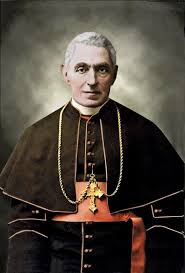
St. John Baptist Scalabrini
Life. (1839-1905)
St. Frances Cabrini has been called “Mother of Immigrants” because of her great work in the Americas on behalf of Italian immigrants. Bishop John Baptist Scalabrini of Piacenza, Italy, has been termed “Father of Immigrants”, and deservedly, as we shall see. Interestingly enough, it was Scalabrini who bestowed their mission crosses on Mother Cabrini and her companions when they set forth in 1889 on their initial assignment to the United States. Now, this “Father of Emigrants” has himself been [canonized]. He did a remarkable service for the thousands of people who left not only Italy but many other countries in the 19th and 20th centuries in search of a better life elsewhere.
Scalabrini was born at Como in northern Italy on July 8, 1839. A man of ability and vision, he studied for the diocesan priesthood and was ordained in 1863. First, he was assigned to teach in Como’s diocesan seminary, and before long was named its rector. Then he was appointed pastor of one of Como’s largest parishes. He succeeded well in both locales, and in 1875, when only 36, he was named bishop of Piacenza. One of the first shocks this forward-looking young prelate received as he entered on his diocesan duties was the large number of Italians who were leaving their home country each year in search of a better livelihood in non-European countries. Between 1880 and 1914, in fact, some 13 million of Italy’s 30 million population were to sail west to begin again in North and South America; 28,000 of these came from the Diocese of Piacenza alone. The transition was to prove more difficult for the emigrants than they anticipated; yet in 1875, nothing was being done in Italy to counsel the departing, and little or nothing was being done in America to guide and comfort the exiles.
Bishop Scalabrini resolved to champion these poor wanderers. Well aware of the needs of publicity, he set about mobilizing Catholic opinion and assistance in Italy. He likewise asked the help of the Italian government and the Holy See. Meanwhile he established in 1887 “the Pious Society of the Missionaries of St. Charles” (popularly known as the Scalabrini Fathers and Brothers) to work among the Italian immigrants of the Americas. In 1895 he founded the Missionary Sisters of St. Charles to engage in the same apostolate. In 1901 the Bishop made a prolonged personal visitation of his missionaries in the United States, and in 1904 to those in Brazil. He was pleased with the good work they were doing. While in the United States he secured an audience with President Theodore Roosevelt. He and the President discussed the phenomenon of immigration, and he made bold to tell Roosevelt of the inhuman treatment of some of the immigrants that he himself had witnessed at Ellis Island.
Bishop Scalabrini died on June 1, 1905. Three weeks before his death he submitted to the Holy See a historic plan dealing with immigration policies to be followed not only regarding Italian emigrants but those from every country. He begged the Vatican to set up a department devoted to the needs of all those uprooted. His advice was heeded. Today, his Scalabrinians alone are at work in 25 countries. In focusing on emigration, Scalabrini by no means neglected his own diocese. A very modern man, he promoted scientific studies of social problems; he welcomed industrialization; but he also defended the workers, as he did the disabled and the poor. He knew his own diocese thoroughly. During his regime he visited each of its parishes intensively three times. He also held three diocesan synods. An innovator in religious instruction, his catechetical work won for him, from Pius IX, the grateful title of “Apostle of the Catechism”.
A devout man personally (his three favorite devotions were to the Holy Eucharist, the Blessed Virgin, and the popes), Scalabrini likewise wrote extensively on several subjects apart from emigration; such as, the reform of clerical studies, and catechetical methods. Politically alert, and a peacemaker, he worked to bring the papacy and the Italian government closer to reconciliation. This “Roman Question” was finally answered in 1929. In beatifying Blessed John Scalabrini, Pope John Paul II has given an appropriate heavenly patron both to those who deal with the ever-increasing migration of peoples and to those who labor to re-evangelize the world. [Pope Francis canonized Scalabrini on October 9, 2022]. -Father Robert F. McNamara
Scripture (Isaiah 66,18-21)
I am coming to gather all nations and tongues; they shall come and see my glory. I will place a sign among them; from them I will send survivors to the nations: to Tarshish, Put and Lud, Mosoch, Tubal and Javan, to the distant coastlands which have never heard of my fame, or seen my glory; and they shall proclaim my glory among the nations. They shall bring all your kin from all the nations as an offering to the Lord, on horses and in chariots, in carts, upon mules and dromedaries, to Jerusalem, my holy mountain, says the Lord, just as the Israelites bring their grain offering in a clean vessel to the house of the Lord. Some of these I will take as priests and Levites, says the Lord.
Writings
(Year A). Communion is the spring from which the soul draws the water that wells up to eternal life; it is the place where its wounds are healed; it is, in a word, the principle and end of that union with God raised to the highest power and brought to that highest degree of perfection that can be hoped for in the present order. If the Word of God was united personally with human nature in the incarnation, it is united even more so to our personality in communion. In this way, he divinizes our essence, Christianizing, so to speak, our individual being; and his union with us has as its emblem the same one that transforms food into the substance of the body that eats it. So those who take communion, as a holy doctor wrote, have Jesus in their minds, hearts, breasts, eyes and tongue. This Savior corrects, purifies and vivifies everything. He loves in the heart, understands in the mind, imparts strength in the breast, sees in the eyes, speaks by means of the tongue, and moves every other power. He works all things in all people, and they no longer live in themselves, but is the Word of God who lives in them, setting nobler and higher aims and purer and more perfect motives for their actions.
As you can see, my loved ones, there is nothing beyond this union but heaven. So when the divine substance is conjoined with ours, if God were to transform our understanding into his and our will into his love in the same proportion, then we would see him clearly and love him with the love of the blessed. Now, what else is this if not eternal life? However, if these are the fruits of communion, what can we say about those confessors and spiritual directors who do not exhort the faithful to attend it, preferably every day, but instead remove them from it, under the pretext of zeal for honor and reverence toward the sacramental Jesus? This is the result of a misunderstood, dry and frozen piety. These people are unintentionally contrary to the mysteries of divine love, perhaps because they are still permeated with a small-hearted, hypocritical and savage doctrine, and could do no better if they wanted to take Satan’s side in bringing about the loss of souls. No, this is not the example left us by the early Christians, who nourished themselves on the eucharistic bread every day; it is not the teaching of the Council of Trent and the Roman catechism; it is not what we are taught by the most eminent fathers, doctors and theologians of the Catholic Church. The authoritative voice of St. Augustine can stand for all when he says: "This is daily bread: receive it every day so that it may be of help to you every day." Lastly, is this not the wish of the divine Master, who excluded nobody from the solemn feast described in the Gospel, which prefigures the Eucharist, except the person who dared come to it without a wedding garment, in other words lacking in grace. So a Christian who is adorned with sanctifying grace may even have imperfections and fall into venial sins, but he is still a child of God, an heir of heaven, and hence worthy of seating himself, even daily, at the great banquet that Jesus Christ keeps laid out in his Church, so that Christians can go forth from it with ever-increasing fervor and a greater desire to return. So why should the faithful be asked for an extraordinary purity of mind, heart and deed before being admitted to this feast? Surely daily communion is in fact the best disposition for approaching the Eucharist worthily? Ah, if everybody had a higher concept of the beauty and nobility of a soul in grace, frequent communion would certainly soon be revived, to the very great - indeed, incalculable - advantage of the Christian people and the whole of civil society.
Take communion, I shall now say to all of you, my very dearest children, take communion often, and you will find all you need. If you lack help, Jesus is strength; if you fear death, he is life; if you desire heaven, he is the way that leads there; if you flee the shadows, he is light; if you seek your food, he is the living bread; so taste how sweet is the Lord. However, so far as you are able, let your life be such as to be worthy of receiving the holy Eucharist each day. Come to Jesus with purity of mind, heart and body, and with the firm intention of never offending him again. Urge yourselves to the liveliest acts of faith, humility, hope and love before receiving him in your breast, and, after receiving him, stay with him for a long time, thanking him for every good thing. Then I am sure that you will always leave the eucharistic table better, and more disposed and ready to walk to the eternal pastures in the footsteps of the Good Shepherd. (Spiritual and Pastoral Essays)
Musical Selection (Sade)
Collect
O God, who in Saint John Baptist Scalabrini, Bishop, gave the migrants a compassionate shepherd, grant us, through his intercession, to promote the unity of the human family by proclaiming the Gospel of Salvation. Through our Lord Jesus Christ, your Son, who lives and reigns with you, in the unity of the Holy Spirit, God, forever and ever. Amen.