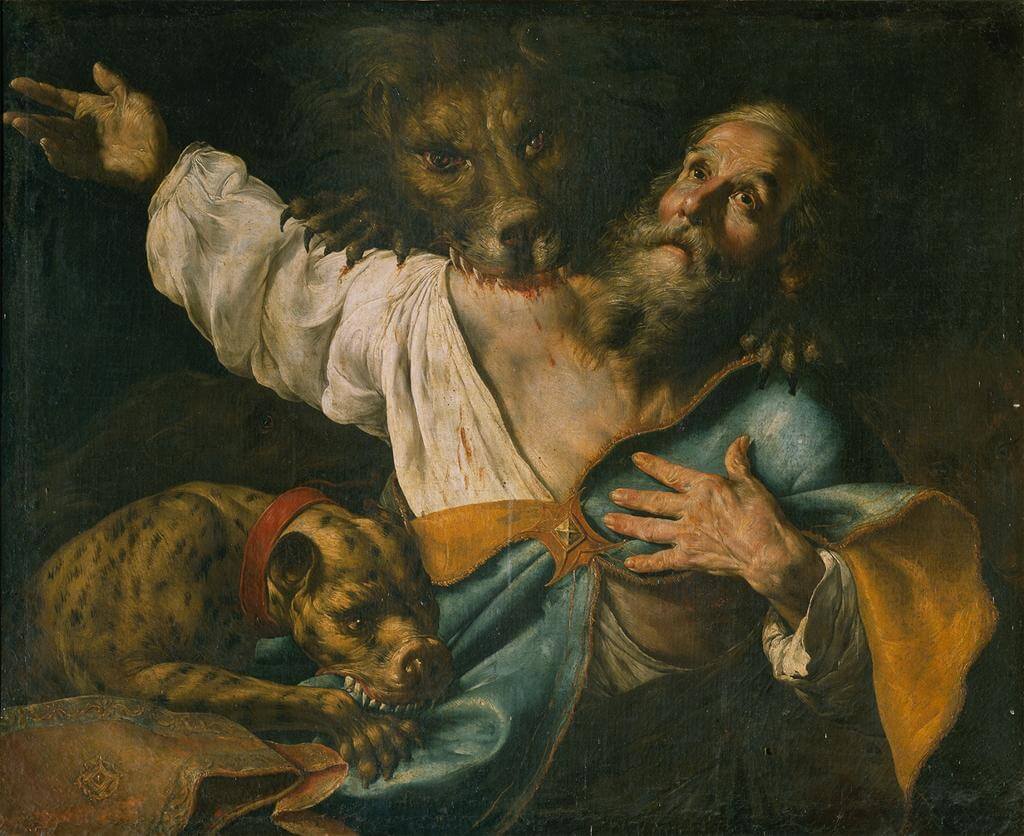
Life (+107 AD)
This great early bishop and martyr was quite possibly a convert of St. John the Apostle. Nothing is known of the details of his life, but he was chosen second bishop of Antioch around the year 60 AD, and he ruled that diocese forty years. Antioch was by then the most important see in the Middle East. Indeed, it was the first large center of mideast Christianity and, as the New Testament tells us, the first place where Christ’s followers were called “Christians.” St. Ignatius the “Godbearer” (as he was called) won the respect of all the faithful along the eastern Mediterranean.
But advanced age did not exempt Ignatius from persecution. Under Emperor Trajan, around 107 AD, he was arrested for not offering patriotic sacrifice to the Roman gods. The judge condemned him to be thrown to the wild beasts in the public “games” in Rome. The bishop was therefore taken aboard a Rome-bound ship. En route he was under heavy guard – ten soldiers who were so brutal that he called them his “ten leopards.” Nevertheless, he was given freedom at ports-of-call in Asia Minor to receive the local bishops and faithful. He wrote to these Christian groups seven letters exhorting all to be strong in faith and love. He also wrote ahead to the Christians of Rome. He suspected that they might try to have his death sentence commuted. This he did not desire. Martyrdom, he believed, was the only way in which he could prove to God his total devotion. “Suffer me to be the food of wild beasts,” he said, “through whom I may attain to God!”
His desire was not thwarted. Ground by the teeth of the animals, he became, as he had hoped to be, the “pure bread of Christ!” His martyrdom may have taken place in Rome’s famous “Colosseum,” then a fairly new stadium. Afterwards his relics were carried back reverently to Antioch.
Ignatius’ seven letters are among the few non-biblical Christian writings of the apostolic period. (St. John the Apostle was still alive when they were written.) They, therefore, bear important witness to the earliest Christian belief and practices. Thus the Bishop of Antioch becomes the first to emphasize Mary’s virginity; to declare the holy Trinity; and to present Jesus as both son of God and son of Mary. He also defends the Real Presence of Christ in the Holy Eucharist.
Of special interest are his references to Church structure. While the apostles lived, it was they who ruled the churches they founded; but they made arrangements to be succeeded by resident bishops in various localities. By the time St. Ignatius (and St. John the Apostle) were dead, the hierarchy was already well established.
Ignatius lays special stress on the importance of the local bishop. He is even the first writer to refer to the hierarchical church as “Catholic.” “Wherever the bishop appears, there let the people be, even as wherever Christ Jesus appears, there is the Catholic Church.” He does not as yet refer to the position of St. Peter’s successors, the bishops of Rome, in that hierarchy. Still, in writing to the Roman Christians, he indicates that the Roman church where SS. Peter and Paul died enjoyed a unique leadership. He advises all other Christians to keep good order under the rule of their bishops: “The bishop is to preside in the place of God, while the priests are to function as the council of the apostles, and the deacons, who are most dear to me, are entrusted with the ministry of Jesus Christ.” Even a youthful bishop is to be obeyed. (There must have been many younger bishops in his day.) Whatever his age, “he embodies the authority of God the Father.”
The bishop is also the chief liturgist of his people, the supreme minister and custodian of the sacraments: “Let that celebration of the Eucharist be considered valid which is held under the bishop or anyone to whom he has committed it.”
Vatican II emphasizes that our bishops, united under the pope as successors of Peter, govern their dioceses as “the vicars and ambassadors of Christ.” In the local dioceses, therefore, they are the ordinary and official teachers and sacramental ministers. This we must not forget. And it is interesting to note that in formulating this doctrine on bishops the Council drew extensively from the apostolic witness of St. Ignatius of Antioch. -- Father Robert F. McNamara
Scripture (Phil 3:17-4:1)
Musical Selection (Bib Hurd)
Feed us, O Lord, with the living bread
and make us drink deep of the cup of salvation that,
following the teaching of your bishop Ignatius
and rejoicing in the faith
with which he embraced a martyr’s death,
we may be nourished for that eternal life
for which he longed,-
through Jesus Christ your Son our Lord,
who is lives and reigns with you,
in the unity of the Holy Spirit,
God, now and for ever. Amen. (English Missal)