October 20 [USA]
St. Paul of the Cross
Life (1694-1775)
St. Paul Danei was one of the outstanding home missionaries of the 18th century, and the Passionists, the religious order that he founded, have since then continued his tradition of parish missions around the world.
Paul Francis Danei was born near Genoa, Italy, on January 3, 1694. His parents, though of noble background, had to struggle to raise their 16 children, and because of their budgetary problems, Paul, the second oldest, had to curtail his schooling, and even, on one occasion, had to pawn his own possessions to assist them. Yet Luke and Anna Maria Danei gave to their brood a still greater treasure: a strong religious sense. His mother, in fact, taught Paul Francis to fervently love the cross. Whenever he was pained or frustrated, she would show him a crucifix and remind him how Jesus bore His own cross to Calvary.
When he was 15, young Danei heard a sermon that made him aware that he was not corresponding sufficiently to God’s grace. He therefore made a general confession and began a program of intensive prayer and mortification. His gift of leadership now began to show itself. He induced his younger brother, John Baptist Danei, to join him in his project, and soon he had persuaded several other teenagers to join them. Of these recruits several eventually entered religious orders. Just where God was leading Paul, however, did not at once appear. In 1714 he enlisted in the Venetian army to fight against the Moslem Turks, a cause promoted by Pope Clement XI. But a year of soldiering convinced him that he was not called to the military life. He decided against marrying, declined to accept a generous inheritance, and began to lead the life of a quasi-hermit in his own home, devoting himself to constant prayer.
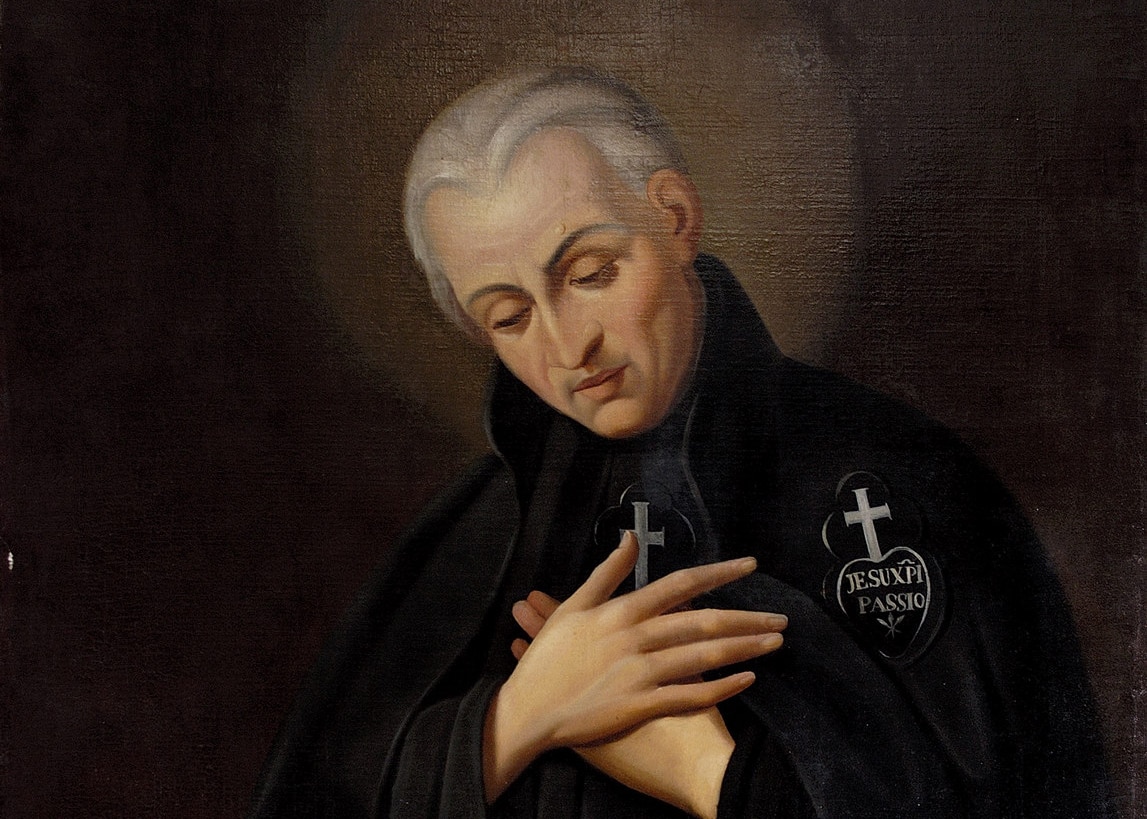
During the summer of 1720, Paul received three extraordinary visions. In them he was shown a black religious habit bearing a breastbadge inscribed with a white heart and cross and the words, “The Passion of Jesus Christ.” Our Lady, dressed in this garb, appeared to him and instructed him to found a religious congregation dedicated to constant mourning for the passion and death of her Son.
Now the career of Paul Danei became clear. He wrote a monastic rule of life, and in 1727, with papal permission, having received, with his brother, ordination to the priesthood, he launched the Passionists, officially called “The Congregation of Discalced Clerks of the Most Holy Cross and Passion of our Lord.” This religious order aimed to preserve the austerity of the hermit life and at the same time to heal souls by reminding them of the debt they owed to the passion and death of Jesus. In preaching parish missions internationally and by offering their own austere example as well as the word of God, the Passionist Fathers achieved amazing success in bringing people back to God. One interesting phase of their campaign was their constant prayer for the conversion of England, begun by the founder in 1720. Significantly, it was a Passionist, Bl. Dominic Barberi, who in 1845 received the Anglican convert John Henry Newman into the Church. St. Paul of the Cross also established the Passionist nuns, a strictly cloistered congregation. An able administrator and an influential guide of souls, he continued to be the recipient of astonishing spiritual graces up to the end of his life - a life fraught, incidentally, with great difficulties, but fortified by faith. The self-sacrificing priest, both organizer and mystic, died at 80, and was canonized in 1867, eight years short of the centenary of his death.
In reading the lives of the male and female saints who have received mystical graces and powers like healing and prophecy, we may wonder why God has not given more of us a share of such gifts. One reason, doubtless, is that you and I are not so prayerful as the canonized saints have been. A surer reason is that God gives graces as He chooses, and is not bound to explain His generosities to the rest of us. But finally, we must remember that the more “extravagant” graces are bestowed not for the benefit of the recipients so much as for the benefit of others. Thus the visions God granted to Paul of the Cross did not make him holier per se, but impelled him to remind all of us of what too often we forget, that Christ died a bitter death to save us. -- Father Robert F. McNamara
Scripture (1 Cor. 1:18-25)
Writings
(Year A). May the sweet and most holy Name of Jesus be in our hearts I received your letter last evening, and I can now tell you the good things which I wanted to tell you in my other letter. First: according to my poor opinion, you have never been in a better state than at present, and for many reasons. The principal reason is that your suffering is more naked and divested of consolation, and this is a grace and a great gift of the Lord which He usually grants only to His most beloved souls.
The point is to know how to profit from this by a silent patience. I have already written to you once, although I do not recall when, that the fish have no tongue and this helps us to understand that one who is in the stormy sea of affliction should not have a tongue to complain with, neither to her neighbor nor to herself nor even to God. Oh, what an important point this is!
Practice it faithfully because after the storm, great tranquillity and serenity will come etc. But you are not yet dead; and the Good God, by the suffering He permits you to endure, wants you to die a mystical death to everything which is not God. Behave like a dead person, without tongue, without ears, without eyes etc.; as a dead body when it is buried is trampled upon by all, so you, who are like one dead and buried, let yourself be trampled on by all, becoming the opprobrium and reproach of the people. I rejoice to hear that this new confessor is treating you harshly and is hard and severe; oh, what a good friend he is!
Now God wants to put the finishing touch to the statue and to embellish it for the gallery of heaven. Therefore He permits the one who should be giving you some spiritual consolation to use the finest and sharpest chisel, to perfect the statue. Oh, what a noble work this is! Profit by this precious opportunity; allow yourself to be mortified, reproved and treated with all severity and harshness. But always act as a true servant of the Lord, ever silent, ever meek, ever peaceful.
Ask His Divine Majesty not to deprive you of such an instrument as long as the work God wants to do in you is unfinished. Continue the interior recollection since aridity cannot impede it because it doesn’t matter whether one feels the taste of the divine presence or not. Rather it is very important to remain in pure faith divested of every joy, for the love of God Who is the joy of our joys. Therefore rest on the bosom of God like an infant, in the silence of faith and holy love, with the superior part of your spirit, paying no attention to the noises which the enemies make around the spirit. These are outside and you are within, in.the most intimate cell of the spirit alone with the Divine Bridegroom.
I wish you a Happy New Year and the same to your good sisters. May you have many more happy ones, fruitful in heroic virtues and great perfection so that you may do what St. John Chrysostom said: show your Creator the same silence which the clay offers the potter. Oh, what a great maxim! And it means this: that that silence which the mud and clay shows and keeps for the potter, you should exhibit the same to your Creator. The mud is always silent, whether the potter makes a vessel for a lofty purpose or for a humble one, it is silent; whether he breaks it or throws it in pieces into the sewer, it is silent and contented as if you were putting it in a royal gallery. Keep this great doctrine in mind and practice it in the circumstance in which you find yourself, with the confessor as well as with the others. (Letter to Mother Mary Crucified)
Musical Selection
Collect
Eternal God,
who gave your priest Paul of the Cross
a special love for the cross and passion of Christ:
may his example inspire us
to embrace our own cross with courage,
that we may rise above pain and suffering
to share in the heavenly glory of your Son,
who lives and reigns with you
in the unity of the Holy Spirit,
God, now and for ever. Amen. (English Missal)