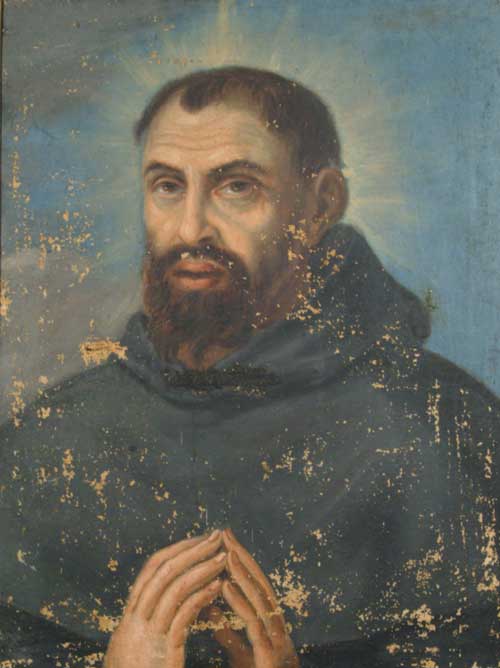
When Joseph Desa was born in southern Italy in 1603, his parents did not rejoice. The father, a carpenter deep in debt, died early. His mother found young Joseph an unpleasant burden. Perhaps it was for want of parental affection that her son developed a preoccupied manner. His young companions called him “Boccaperta,” “the gaper.” He also had a strong temper at first. Still, he was a reverent child. Joseph proved a difficult person to place. Apprenticed to a shoemaker, he showed no talent for cobbling. Therefore, at seventeen, he himself asked to join the Conventual Franciscans. They turned him down. The Capuchin Franciscans did accept him as a lay-brother candidate, but he broke so many dishes that they soon told him he’d better leave. Finally, Signora Desa talked her brother, himself a Conventual Franciscan, into hiring her boy as a servant. They accepted him on this basis. From then on, however, young Joe’s life began to change. He really applied himself to becoming a better person - gentler, calmer, more prayerful. It even came to the point that the Conventuals had him enter the order and study for the priesthood. The reason for his superiors’ changed views was that Joseph had displayed marvelous gifts of mystical prayer.
Chief of these was the gift of ecstasy. In his prayer he was often so swept up into union with God that he lost all sense of time and space. His ecstasies were frequently connected with the still rarer gift of “levitation”: being lifted up into the air when in ecstatic prayer. For example, when Joseph was stationed at the monastery at Grottella, it would take little to send him into rapture: the sight of a religious statue or the mention of anything that reminded him of God. Once, when he was living at their monastery at Orsini, his fellow Franciscans in chapel saw him fly up seven or eight feet into the air, kiss a statue tenderly and float off to his own cell. Sometimes when he started flying he would even pick up a fellow friar and lift him up beside him in the air, much to the consternation of the liftee. Only the command of his superior could bring Friar Joseph down for a soft landing. When he came to, of course, he had no knowledge of what had been going on.
What were the Franciscans going to do with this unique friar? The solution they arrived at was to keep him out of sight, so that he wouldn’t continue to disturb public order. For thirty-five years, therefore, he was forbidden to attend the community Mass and prayers, obliged to say his own Mass and prayers in a private chapel. From 1653 to 1657, church authorities even took him away from his fellow Conventuals and sent him, now to one, now to another remote monastery of the Capuchin Franciscans. When devoted followers located one of his “prisons,” the authorities spirited him off to another. In 1657 he was finally allowed to return to the Conventual monastery of Osimo. There he died in 1663. Meanwhile, separation from almost everybody had caused him no great grief. It merely meant that his only companion was God. And that was what God wanted.
You might say, therefore, that St. Joseph worried his fellow Franciscans because he was a square peg and wouldn’t fit in the usual round hole. What they overlooked is there is no need for every peg to be round. The square pegs that God sometimes makes are also beautiful in His eyes. So should they be in ours. -- Father Robert F McNamara
Scripture: 1 Cor 13:1-8
Brethren: If I should speak with tongues of men and of angels, but do not have charity, I have become as sounding brass or a tinkling cymbal. And if I have prophecy and know all mysteries and all knowledge, and if I have all faith so as to remove mountains, yet do not have charity, I am nothing. And if I distribute all my goods to feed the poor, and if I deliver my body to be burned, yet do not have charity, it profits me nothing. Charity is patient, is kind; charity does not envy, is not pretentious, is not puffed up, is not ambitious, is not self-seeking, is not provoked; thinks no evil, does not rejoice over wickedness, but rejoices with the truth; bears with all things, believes all things, hopes all things, endures all things. Charity never fails, whereas prophecies will disappear, and tongues will cease, and knowledge will be destroyed.
Writings
(Year A).[A] salient characteristic of Joseph is the way in which his ecstasies are inseparable from his simplemindedness and the way in which he, Bocca Aperta, the open-mouthed “holy fool” from Copertino, transcends and trumps reason. In many ways Joseph reifies the ancient Christian archetype of the holy fool found in both the Orthodox and Catholic traditions, which can be traced back directly to the apostle Paul and his boast that “we are fools for Christ’s sake” (1 Corinthians 4:10) and before him to the prophets of the Hebrew Scriptures and also—most significantly—to Jesus himself, who was the paradoxical archetype of unworldly and seemingly unreasonable self-abnegation: the Word of God made flesh who subjects himself willingly and meekly to poverty, harassment, humiliation, extreme suffering, and death….It was ultimately Joseph’s humility, not his loquacity or his theological savvy, that convinced the inquisitors of the genuineness of his holiness and orthodoxy. One might say that it was Joseph’s foolishness, his all-too-obvious witlessness that disarmed the Inquisition and saved his skin in Naples, and afterward, for the rest of his life. Although he could not have been familiar with the work of Saint Thomas Aquinas (1225–1274), Joseph would have agreed with this passage from his Summa Theologica: “One who is strengthened by God professes himself to be an utter fool by h uman standards, because he despises what the wisdom of men strives for.” Joseph’s simplemindedness and lack of education are highlighted in a brutally harsh tone by many sources. This blistering description of him is typical: “Those who knew him would admit that he was an extremely simple person and barely knew how to read, that he wasn’t a theologian, or had studied any other subjects, and that he himself was an idiot of low abilities who could barely read or write….For instance, a fellow friar testified that Joseph “was barely literate, but the way he solved theological problems showed that he had an infused knowledge of God that was lofty and deep.”[Another] echoed these sentiments: “Father Joseph discoursed on very difficult points of theology like a great theologian, and without preparation he superbly answered any doubts put to him concerning Holy Scripture quickly and excellently in a way that showed clearly that his knowledge was supernatural and infused, so that the most learned Father-Master and Regent Antonio di Ponte della Trave, admiring such a depth of understanding, frequently said, ‘he knows more than I do.’”According to some testimonies, Joseph himself seems to have been a bit uncomfortable with his status as idiot savant, most probably because he preferred to emphasize his humility—as he did after his levitations—but this never stopped him from answering questions about his encounters with the divine.(Carlos M.N. Eire; They Flew: A History of the Impossible)
Musical Selection
All we are, we have found in song:
You have drawn this song from us
Songs oflivesunfolding
Fly overhead, cryoverhead:
Longing, rising from the song within
Movinglike the rise and fall of wings
Hands that shape our calling voice
On the edge of answers
You’ve heard our cry, you’ve known our cry:
Music’s fierce compassion flows from you
The night is restless with the sounds we hear
Is broken, shaken by the cries of pain:
For this is music’s inner voice
Saying, yes, we hear you
All you who cry aloud
And we will fly, answering you:
So our lives sing, sing
Wild we will fly
Wild in spirit we will fly
Like a feather falling from the wing
Fragile as a human voice
Afraid, uncertain
Alive to love, we sing as love
Afraid, uncertain
Yet our flight begins as song
Collect
O God, You ordained that Your only-begotten Son
should be lifted up above the earth
and draw all things to Himself;
mercifully grant that,
through the merits and example of Your seraphic confessor Joseph,
we may be lifted up above all earthly desires
and be found worthy to come to Him, who being God,
lives and reigns with You in the unity of the Holy Spirit,