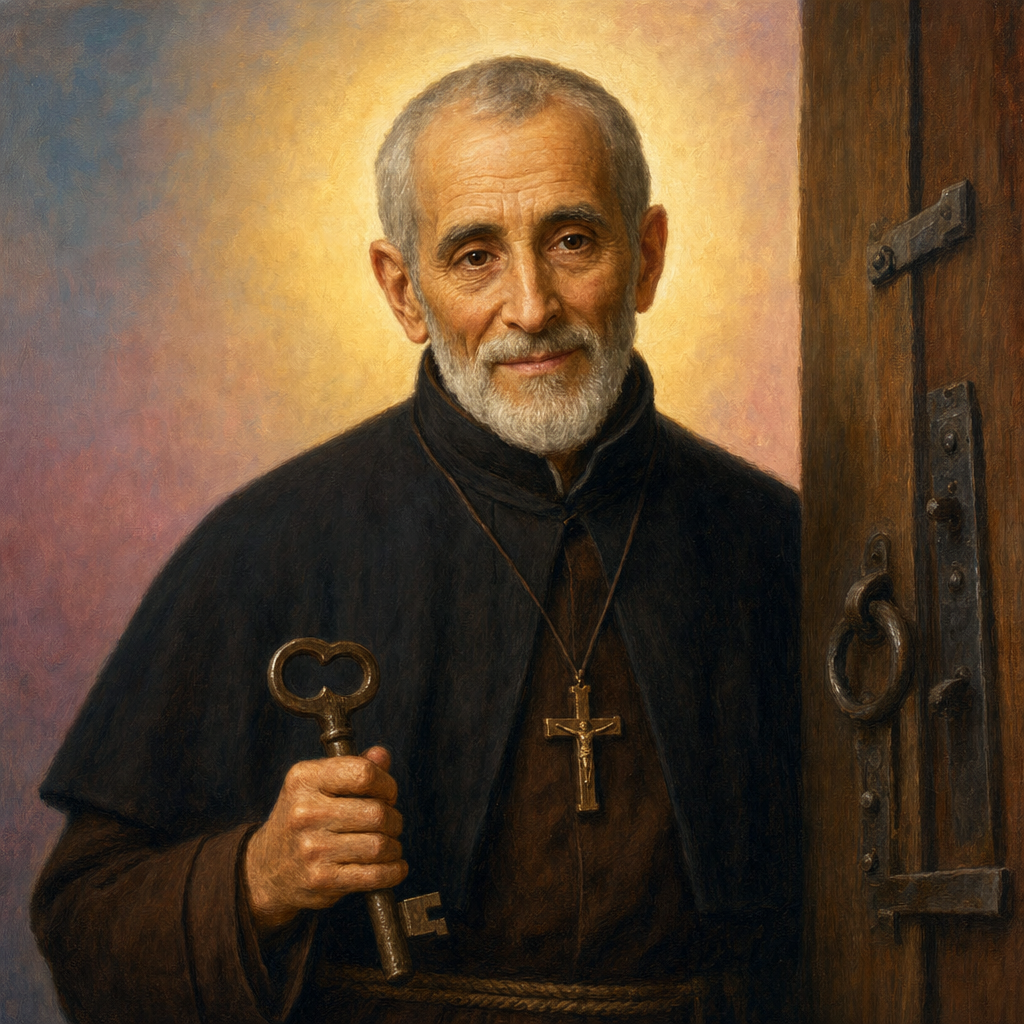
St. Alphonsus Rodriguez
Life (1532-1617)
Alphonsus Rodriguez was one of the many children of Diego Rodriguez, a prosperous wool merchant of Segovia, Spain. Around 1542, Diego, who was devout and hospitable, asked a traveling Jesuit missionary to stop off at his home a few days. The missionary was Blessed Peter Favre, one of the pioneer members of the Society of Jesus. During this visit Blessed Peter prepared Alphonsus and his older brother to study at the Jesuit school in Alcala. But a full year had not passed before Diego died. The widow Rodriguez decided to carry on the family business, so Alphonsus was called home to help her. When he was 23, his mother retired, leaving him in charge of the family trade. That seemed to spell the end of his connection with the Jesuits. At 26 he married a young woman named Maria Suarez.
Alphonsus proved to be a good enough businessman, but an economic depression soon set in and he had increasing difficulty in balancing his accounts. Other misfortunes befell him around the same time. His daughter died, so did his wife after a long illness. Three years later his mother passed away. Thus, the cloth merchant of Segovia was left with only one son. These various losses made him ponder more than ever the meaning of life and the commercial direction his own life had thus far been taking. He decided at length to sell his business and move with his son into the home of his two unmarried sisters. These pious sisters taught Alphonsus the basics of mental prayer, and he soon began to lead a life of meditation and self-denial, with weekly confession and communion. When his son died some years later, Alphonsus wondered if God was calling him to the religious life. He applied, rather naturally, to the Jesuits, whom he knew best. They said they couldn’t take him. He was too old (close to forty), was not well, and had not sufficient educational background to qualify for priestly studies.
On the advice of a Jesuit friend, however, he did not give up. He started to study Latin in a class with little boys. Meanwhile, he had to support himself by menial work and begging. Finally, in 1571, the Jesuit superior relented and said that he would receive Alphonsus, but as a lay brother rather than as a candidate for the priesthood. That was all right with the widower. He had already resolved, “I will never again follow my own will for the rest of my life.”
They assigned the new middle-aged brother to the Jesuit College of Montesione on the Spanish island of Majorca. Here, as “hallporter” he spent the last 46 years of his life. He made his final vows there in 1585 at the age of 54.
How did this porter turn saint? Obviously, a man of conscientious duty, he also became a man of deep mystical prayer. Now, his daily occupations were humble enough, but they brought him into contact with many people – students, clergy, nobles, professional men, merchants and tradesmen. All these came to know him, to be pleased with his competence and even more with his helpfulness and holiness. “That brother is not a man,” exclaimed Father Michael Julian, “he is an angel.”
The most important of his “clients” was St. Peter Claver for whom he was spiritual director for three years. It was Brother Alphonsus’ spiritual counsel that decided Claver to go to South America and become the apostle of the black slaves. Alphonsus also did much to popularize devotion to the Immaculate Conception of Our Lady.
Most outstanding of all was his obedience. When he was over seventy and failing, his rector, to test him, ordered him to go to the West Indies. At once Alphonsus set out to find a ship, but he was stopped at the College gate and sent back to the rector, who explained to him the reason of his command: to see what his reaction would be.
Alphonsus the widower died at the age of 86. He had been the right man in the right place. In death as well as in life he was the agent of miracles. He and his pupil, St. Peter Claver, were canonized at the same ceremony in 1888.
Who says that becoming a widower is the end of a husband’s life? — Father Robert F. McNamara
Scripture: Eph 6:10-13, 18
Collect