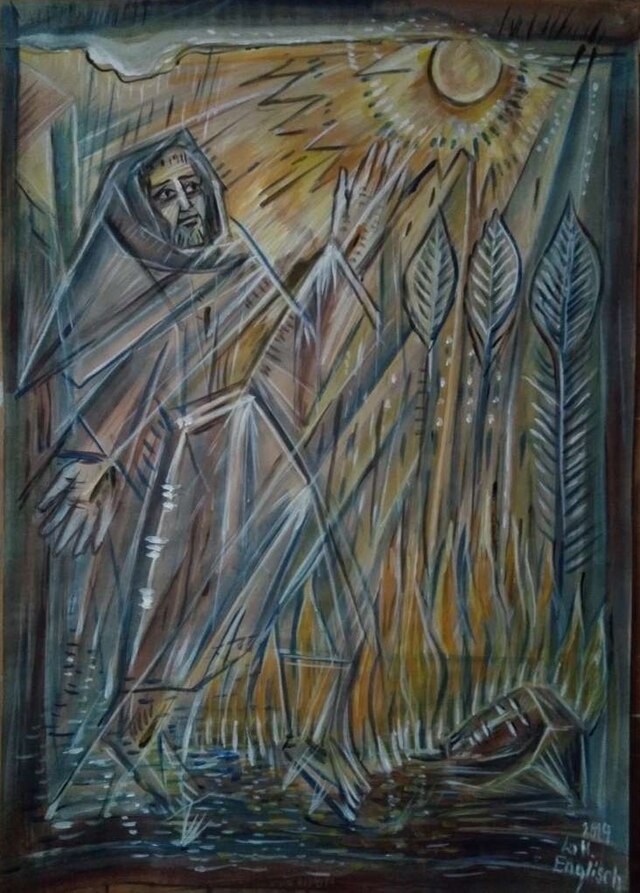
Scripture: John 7: 37 -39
On the last and greatest day of the feast, Jesus stood up and cried out,
“If anyone is thirsty,
let him come to me and drink.
38 Whoever believes in me,
as Scripture has said,
‘Streams of living water
shall flow from within him.’ ”
39 Now he was referring here to the Spirit whom those who believed in him were to receive. As yet the Spirit had not been bestowed because Jesus had not yet been glorified.
Meditation
From his article "Duns Scotus: The Subtle Theology of Love" by Séamus Mulholland OFM
One of the most beautiful aspects of Scotus’ spirituality is his understanding of how the infinite, transcendent God becomes accessible to us through the material world. In an era when many theological traditions emphasised the radical transcendence of God and the unreliability of physical reality, Scotus, true to his Franciscan roots, insisted that the God who created matter loves matter and uses it as the medium of divine self-communication.
This theology finds particular significance in Scotus’ understanding of the Eucharist. Here, the very matter of life—bread and wine, the fruits of earth and human labour—is transformed to become the source of eternal life for Catholics on pilgrimage to their heavenly home. In the consecrated elements, the transcendent God is not merely symbolised but truly and really present, offering divine life through created things. Scotus emphasises that we encounter Christ not by escaping materiality but by entering more deeply into it, recognising how the ordinary ‘stuff’ of creation can bear the weight of divine presence.
Remarkably, Scotus also taught that in the Eucharistic celebration, it is the Church itself that stands in persona Christi, ‘in the person of Christ’, and not solely the priest. While the ordained minister has a specific sacramental role, the entire gathered community acts in Christ’s person, offering the sacrifice and receiving the gift. This insight democratises the sacred encounter, reminding us that God’s self-gift is made to the whole people, and that the humble and lowly have as much access to the divine presence as those in positions of ecclesiastical authority. Indeed, the Eucharist either lifts us all up to the same plane, or it lowers us all to the same plane.
This sacramental vision extends beyond the altar to encompass all creation. If bread and wine can become bearers of divine life, then all matter is potentially charged with divine presence (Gerard Manley Hopkins, the Jesuit poet, who was very influenced by Scotus, wrote that ‘world is charged with the grandeur of God’). The world is not a veil separating us from God but a window through which divine love shines. Every sunset, every human embrace, every meal shared in love becomes a potential Eucharist, a place where the transcendent God touches us through immanent, physical reality. For Scotus, spirituality is not about fleeing the material world but about learning to perceive its true depth, recognising how the God who sustains and nourishes creation meets us in and through that creation.
Duns Scotus has been called the ‘Subtle Doctor’, and his thought requires careful study to grasp its full richness. But this subtlety is not mere intellectual gamesmanship or scholastic hair-splitting. Rather, it is the attempt of a mind formed by the real lived experience of a deeply grasped Franciscan spirituality and enkindled by divine love, to articulate the mystery of God’s relationship with creation, which is fundamentally voluntary rather than necessary.
Every subtle distinction, every careful argument serves to protect and proclaim the dignity of created beings, the accessibility of the transcendent God, and the radical freedom of divine grace. It may be time, therefore, for we Franciscans to stop calling him the ‘Subtle Doctor’ (used too often as a pejorative soubriquet) and start calling him Doctor Amoris Francescanae—Doctor of Franciscan Love.
In our present crises, ecological, social, and spiritual, Scotus offers gifts we desperately need. His doctrine of haecceitas calls us to reverence the irreplaceable uniqueness of every creature and to resist all forces that reduce beings to mere categories or commodities. His teaching on the Primacy of Christ elevates humanity from sinful wretchedness to restored glory, empowering us to see each person’s inherent dignity.
His sacramental vision shows us how to encounter God in the very materiality of creation, especially in bread and wine transformed for our nourishment. And his defence of the Immaculate Conception reminds us that God’s grace comes freely to the lowly, while tumbling the mighty from their various ‘thrones’, so radically inverting all preconceived notions of entitlement and privilege.
The ‘subtle’ theology of John Duns Scotus is, in the end, simply another way of writing about his experience of divine love: a love that cherishes each particular being, which took flesh to restore humanity to glory, that meets us in matter, and that freely exalts the humble. In following this Franciscan theologian, we learn to see creation with new eyes, to recognise the face of God in unexpected places, and to join our voices to Mary’s song of praise for the God who does great things for the little ones.
Musical Selection (Bob Hurd)
Prayer