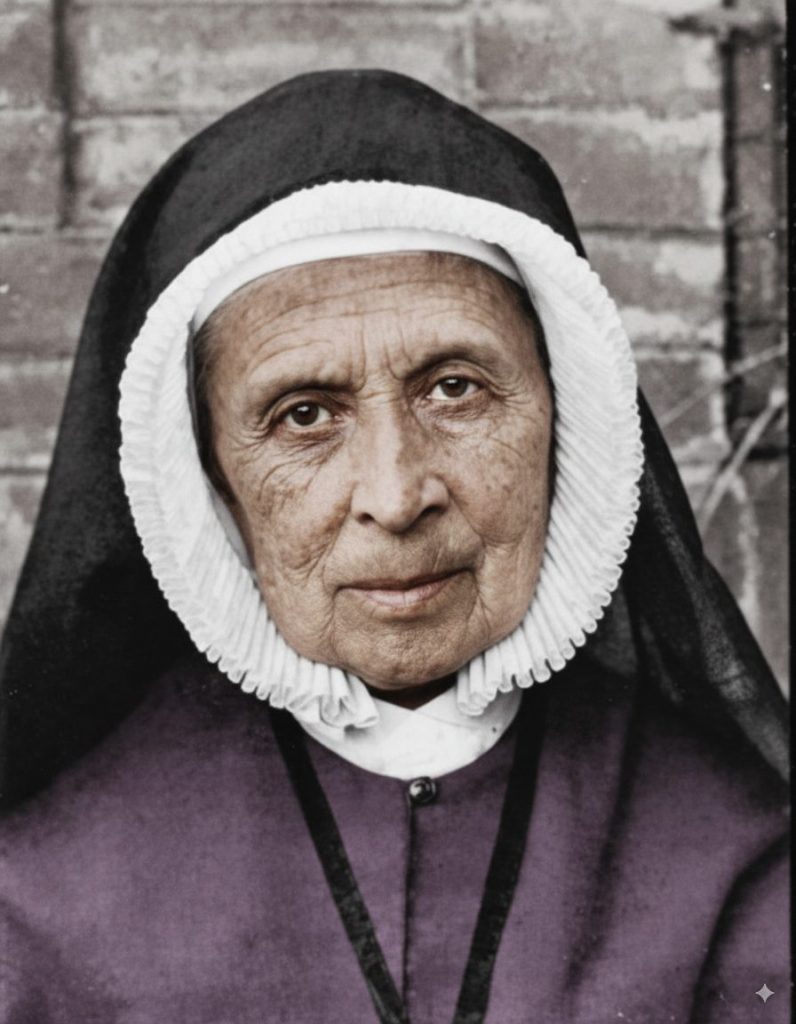
St. Therese Couderc
Life (1805-1885)
The laywomen’s retreat movement in our day owes very much to the pioneering efforts of St. Therese Couderc. But what success she had depended as much upon the trials she willingly accepted, as on her talent as an organizer and spiritual teacher.
Marie Victoire Couderc was the daughter of a prominent farmer of Sablieres in southeast France. After finishing boarding school, she decided to join a religious teaching community, the Daughters of St. Regis, founded recently at Aps by the local pastor, Abbe John Terme. She took the name Therese. This was in 1826. In 1824, Abbe Terme had been sent to LaLouvesc to work among the peasants of the area and at the same time to take charge of the shrine of the popular local missionary and saint, John Francis Regis. Father Terme soon concluded that there should be a hospice for women connected with the shrine. In 1827, therefore, he summoned Sister Therese and two others of his teaching sisters at Aps to manage the hospice. In Sister Couderc he discovered “a sound head, sound judgment and a power of spiritual discrimination.” Therefore, he named her superior of the hospice, although she was only 23. In 1828 Father Terme decided that the guests at the hospice should henceforth be restricted to laywomen who were making retreats according to the Spiritual Exercises of St. Ignatius Loyola. Retreats for women were a great novelty then, and the undertaking caught on at once.
The Jesuit fathers took over the shrine and the hospice shortly before Father Terme’s death in 1834. Gradually the retreat-group at LaLouvesc was separated from the teaching community at Aps and turned into a new religious order devoted solely to retreat-related work. Eventually it took the name “Congregation of Our Lady of the Retreat in the Cenacle.” (The “cenacle” was the “upper room” in which Jesus and the apostles partook of the Last Supper, and in which, after the Resurrection, the disciples and Mary gathered daily to pray.)
When Sister Therese, superior since 1828, made her final vows in 1837, she also made an act of consecration in which she abdicated her authority. She resigned in 1838, blaming herself (though it was not her fault) for the debts the community had incurred. The three women named superiors to follow her were ill-chosen. The third of these nuns held Mother Therese in so small regard that she assigned her only menial tasks and tried to see to it that she had no contact with the other nuns. Mother Couderc’s fourth successor left the order because of the continued internal strife. During this whole period Therese was even denied the credit of being co-foundress, with Father Terme, of the order.
What is remarkable is that throughout St. Therese’s eighty years she held herself so “useless” that she was not disturbed by the confusion around her and the way in which she herself was “discarded.” Although there was much to criticize, she never criticized. She continued to work for the betterment of her religious community by prayer, penance and the acceptance of her rejection. In the end, she was able to say, “God has always given me peace of soul, the grace to leave myself in His hands and to want nothing but to love him and be ever closer to Him.”
The Congregation of the Cenacle eventually steadied and expanded into many nations. (Under Bishop James E. Kearney, the sisters opened their Rochester Cenacle Retreat House at 693 East Avenue in 1948). Stabilization and growth were no doubt largely due to the intercession of the foundress. Therese Couderc was beatified in 1951 and canonized in 1970.
St. Therese’s steadfastness amid trials has set for us all, I think, an admirable example. She belonged to an institution that was good in itself, though it came upon difficult days. If we were in the same position, we might easily grow impatient, say “What’s the use?”, and resign from the community. She didn’t. Because her order was good in itself, she stuck with it, trusting that God would not let it go under.
There is a parallel today with the Church itself. Some Catholics, faced with the Church’s trials during a period of transition, have said, “What’s the use?” and have left the Church along one avenue or another. But the church is a good thing. We should therefore stick with it in steadfast prayer. Our faith assures us that Christ, in due time, will rebuke the wind and say to the sea, “Quiet. Be still!” Will he then turn to us and say, “Why are you so terrified? Why are you lacking in faith?” (Mk. 5:39-40). — Father Robert F. McNamara
Scripture: (Exodus 33:18-23)
Moses said, “Now show me your glory.” 19 And the Lord said, “I will cause all my goodness to pass in front of you, and I will proclaim my name, the Lord, in your presence. I will have mercy on whom I will have mercy, and I will have compassion on whom I will have compassion. 20 But,” he said, “you cannot see my face, for no one may see me and live.” 21 Then the Lord said, “There is a place near me where you may stand on a rock. 22 When my glory passes by, I will put you in a cleft in the rock and cover you with my hand until I have passed by. 23 Then I will remove my hand and you will see my back; but my face must not be seen.”
Writings
(Year A). “Our Lord has often made me understand how helpful it is for a soul desirous of making progress in the spiritual life to surrender herself – to give herself – unreservedly to the guidance of the Holy Spirit. But this morning it pleased his divine goodness to give me a very special perception of it. l was preparing to begin my meditation, when l heard the pealing of the church bells summoning the faithful to assist at the divine mysteries. At that moment the desire came over me to unite myself with all the Masses that were being said, and to that end l directed my intention so that l might participate in them. Thereupon there came to me a general view of the whole Catholic world and of a vast number of altars upon which at one and the same time the adorable Victim was being immolated. The blood of the Lamb without stain was flowing in abundance over every one of these altars, which seemed to be surrounded by a light cloud of smoke ascending towards heaven. My soul was seized and penetrated with a feeling of love and gratitude on beholding this most abundant satisfaction that Our Lord was offering for us. But l was also greatly astonished that the whole world was not sanctified by it. l asked how it was when the Sacrifice of the Cross offered only once was sufficient to redeem all souls, that now being renewed so many times, it did not avail to sanctify them all. This is the answer I thought I heard: “The sacrifice is undoubtedly sufficient by itself and the blood of Jesus more than sufficient for the sanctification of a thousand worlds, but souls do not correspond; they are not generous enough.” Now the great means whereby one may enter the way of perfection and sanctity is to surrender oneself to our good God.
But what does it mean to surrender oneself? I understand the full extent of the meaning of the word, self-surrender; but l cannot explain it. I only know it is very vast; that it embraces both the present and the future. To surrender oneself is something more than to devote oneself, more than to give oneself ; it is even something more than to abandon oneself to God. To surrender oneself is to die to everything and to self, to be no longer concerned with self except to keep it continually turned towards God. Self-surrender is no longer to seek self-satisfaction in anything but solely God’s good pleasure. It should be added that self-surrender is to follow that complete spirit of detachment which holds to nothing; neither to persons nor to things, neither to time nor place. lt means to accept everything, to submit to everything.
But perhaps you will think this is a very difficult thing. Do not let yourself be deceived; there is nothing so easy to do, nothing so sweet to put into practice. The whole thing consists in making a generous act at the very beginning, by saying with all sincerity: “My God, I wish to be entirely thine; deign to accept my offering” – that is all. But you must be careful to keep yourself in this attitude of soul, and do not shrink from any of the little sacrifices which can help you advance in virtue; you must always remember you have surrendered yourself.
I pray our Lord to give an understanding of this word to all souls eager to please him, and to inspire them to take advantage of so easy a means of sanctification. Oh! If beforehand they did but understand the sweetness and peace experienced by those who hold nothing back from the good God. How closely he unites himself to the soul that seeks him sincerely in total self-surrender! Once you have tried this you will see that therein lies the true happiness you are vainly seeking elsewhere.
The self-surrendered soul has found heaven on earth since she enjoys that sweet peace which is part of the happiness of the elect.”
Musical Selection
All to Jesus I surrender,
All to Him I freely give;
I will ever love and trust Him,
In His presence daily live.
I surrender all, I surrender all;
All to Thee, my blessed Savior,
I surrender all.
All to Jesus I surrender,
Make me, Savior, wholly Thine;
Let me feel Thy Holy Spirit,
Truly know that Thou art mine.
All to Jesus I surrender,
Lord, I give myself to Thee;
Fill me with Thy love and power,
Let Thy blessing fall on me.