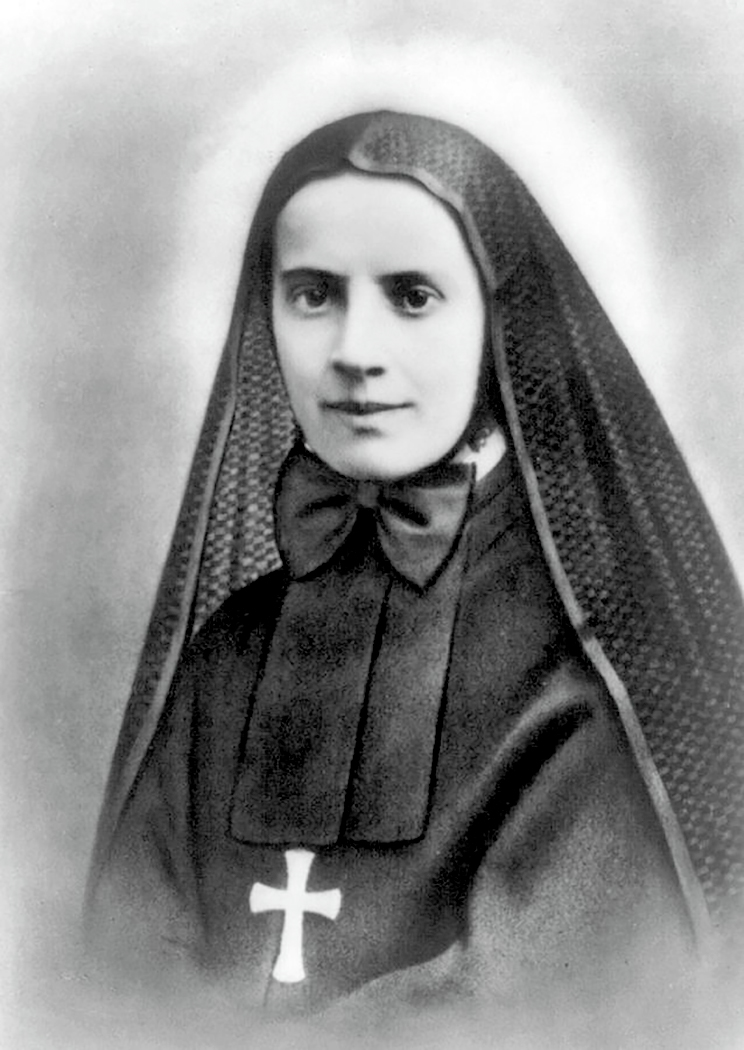
Life (1850 - 1917)
Our memory is still vivid of Mother Teresa of Calcutta, who in 1950 founded the Missionaries of Charity. This Yugoslavian nun, dedicated to “the poorest of the poor”, aimed at spreading her nursing community around the globe. An utterly selfless person, she reminded the whole world of its duty to love one’s neighbor. Mother Teresa was not the only motherly nun to champion the poor. St. Frances Cabrini, a north-Italian schoolteacher, had founded an international nursing congregation as early as 1880 to serve schools, orphanages and hospitals; to catechize, to conduct retreats, and to visit homes, hospitals and prisons. Her contribution to our nation of immigrants was truly great.
Maria Francesca Cabrini was last-born of the 13 children of Agostino and Stella Cabrini, a substantial agricultural couple. As a devout child she dreamed of becoming a missionary to China, but later she trained as a school teacher. In 1872 she tried to join a religious order. Two orders rejected her on the grounds of her “poor health.” When Maria Francesca was wondering what she could do, a local pastor asked her to take care of a small orphanage which he had established, but was unable to run himself. “Try your hand,” he told her, “and you can found a religious order with the women who staff it.” She consented, although without enthusiasm. She did form a little religious order, but circumstances beyond her control prompted the bishop to give up the whole project in 1880. To Francesca he said, “You want to be a missionary sister. Now is the time. I don’t know any institute of missionary sisters, so found one yourself.” Out of this challenge sprang the Missionary Sisters of the Sacred Heart, dedicated to educational and charitable works. The Holy See approved the Cabrini Sisters formally in 1888.
Mother Francesca now began to prove herself an able manager and a go-getter. She had soon founded three houses in Italy, staffed by nuns of her rapidly growing community. But she still yearned to carry the work to China. Meanwhile, however, Bishop John B. Scalabrini, whose priestly Society of St. Charles was working among Italian immigrants, suggested that she go to America, where the emigrated Italians were in great spiritual need. Mother Cabrini decided to leave the decision up to Pope Leo XIII. The Pope told her to go, “not to the East but to the West.” At last she had an answer!
In 1889 the missionary nun set out for New York City with six of her sisters. After a good many initial difficulties, she started an orphanage and her nuns began working among the uprooted Italians. Their efforts quickly expanded, as they attracted religious vocations among young Italian-American women. In 1892 the foundress opened Columbus Hospital in New York (now Cabrini Medical Center). The order then spread out across the States, creating schools, orphanages, and hospitals in particular. As time went on, they took care not only of the grateful Italian-Americans but of other Americans in need. Thus, when the Missionary sisters celebrated their silver jubilee in 1905, even the inmates at Sing Sing prison sent congratulations.
Nor was the United States her only transatlantic beneficiary. Called also to Central and South America, she made foundations in Nicaragua, Costa Rica, Panama, Chile, Brazil, and Argentina. Meanwhile the congregation expanded in Europe into France, England, Spain and Portugal; and eventually into the continents of Africa and Australia. By 1907 the Cabrini Sisters (M.S.C.) numbered 1,000 and were in charge of 50 charitable institutions.
Mother Francesca Xavier Cabrini remained throughout her life the inspiration of her institute. In the USA she became known as “Saint of the Immigrants”. Although Mother General of a religious community whose motherhouse is in Rome, in spite of her ever-frail health she crossed the Atlantic 30 times on the business of her congregation. Elected Superior General for life in 1910, she spent most of her last years in the USA. She became an American citizen in 1909, naturalized in Seattle.
Mother Cabrini died of malaria in Columbus Hospital, Chicago on December 22, 1917. The cause for her canonization was introduced in Rome as early as 1931; beatification came in 1938; and canonization on July 7, 1946. Pope Pius XII praised her “singular strength” of character in the discharge of her religious duties. St. Frances Xavier Cabrini was the first American citizen to be raised to the honors of the altar. Living, she had shown great concern for her American fellow citizens. It stands to reason that as saint she can help them even more effectively. -- Father Robert F. McNamara
Scripture. (Song of Songs 8:6-7)
Deep waters cannot quench love,
nor floods sweep it away.
Were one to offer all he owns to purchase love,
he would be roundly mocked.
Writings
(Year A). Be not discouraged at seeing yourselves so far from the perfection of Holy Love, because Jesus desires to grant it to you, to help you in your own efforts. It suffices if we have recourse to Him with a sincere desire to correspond with His graces and to trust entirely to His Love.
Musical Selection
A poor, wayfaring Man of grief
Hath often crossed me on my way,
Who sued so humbly for relief
That I could never answer nay.
I ran and raised the suff’rer up;
Thrice from the stream he drained my cup,
Dipped and returned it running o’er;
I drank and never thirsted more.
‘Twas night; the floods were out; it blew
A winter hurricane aloof.
I heard his voice abroad and flew
To bid him welcome to my roof.
I warmed and clothed and cheered my guest
And laid him on my couch to rest,
Then made the earth my bed and seemed
In Eden’s garden while I dreamed.
In pris’n I saw him next, condemned
To meet a traitor’s doom at morn.
The tide of lying tongues I stemmed,
And honored him ‘mid shame and scorn.
My friendship’s utmost zeal to try,
He asked if I for him would die.
The flesh was weak; my blood ran chill,
But my free spirit cried, “I will!”
Then in a moment to my view
The stranger started from disguise.
The tokens in his hands I knew;
The Savior stood before mine eyes.
He spake, and my poor name he named,
“Of me thou hast not been ashamed.
These deeds shall thy memorial be;
Fear not, thou didst them unto me.”
Collect